


Real estate operations face a persistent challenge: disconnected systems that fragment data and create operational inefficiencies. iPaaS for real estate addresses this problem by acting as “the plumber of the IT world,” connecting disparate systems and enabling smooth data flow throughout property management ecosystems. Without proper integration, real estate companies encounter critical obstacles including limited integration capability, inefficient API management, and scalability issues that directly impact their operational effectiveness.
Modern iPaaS solutions offer user-friendly interfaces that make complex data integration accessible to all stakeholders. This approach to system connectivity fosters collaboration between IT development, business development, and operations teams—essential for real estate companies that require continuous operations. Multiple organizations have implemented iPaaS for data integration to build central solutions that enable smooth transitions to new systems without service interruptions.
What does iPaaS mean for real estate’s future? The potential extends beyond basic integration capabilities. Current projects involve connecting separate integration platforms to access a property’s digital twin for enhanced property management and customer portal data sharing. With investments in AI technology, iPaaS can deliver substantial benefits to the real estate sector throughout 2025 and beyond.
System Fragmentation Creates Operational Bottlenecks
The real estate industry operates with fragmented technology landscapes that generate significant operational challenges. According to industry research, 61% of commercial real estate firms still rely on legacy systems for their core technology infrastructure, while the average organization uses 367 different software tools. This technological patchwork creates integration challenges that directly impact efficiency.
Data silos represent a persistent problem. 60% of companies report difficulty consolidating information from various sources, while 50% struggle to integrate data across platforms. Teams spend valuable time on duplicate data entry and manual reconciliation rather than focusing on strategic growth initiatives.
Legacy systems amplify these challenges through multiple factors:
- Compatibility issues – 58% of property owners report that new systems don’t integrate easily with existing infrastructure
- Resource drain – Legacy applications consume between 60-80% of IT budgets
- Operational complexity – Large firms typically operate 5-10 different property management systems simultaneously
Geographic expansion compounds integration difficulties as organizations encounter different market conditions and regulatory requirements. Without proper documentation and standardized interfaces, connecting systems becomes a costly technical challenge rather than a straightforward process.
What drives the need for unified integration? These gaps create inefficiencies, errors, and missed opportunities that cost organizations both time and money through fragmented tools that fail to communicate effectively.
How iPaaS Connects Real Estate Systems
What is iPaaS in real estate? Integration Platform as a Service offers the missing connection that real estate operations need to overcome system fragmentation. Unlike traditional integration methods, iPaaS acts as a digital switchboard, routing and translating information between multiple applications and databases without requiring extensive technical expertise.
iPaaS connects legacy systems with newer cloud applications using standardized connectors, enabling communication regardless of software age or architecture. Real estate professionals can configure workflows through user-friendly visual interfaces, specifying how data moves between applications—automatically sending customer feedback to marketing teams or updating property records across multiple platforms.
The benefits of iPaaS implementation include:
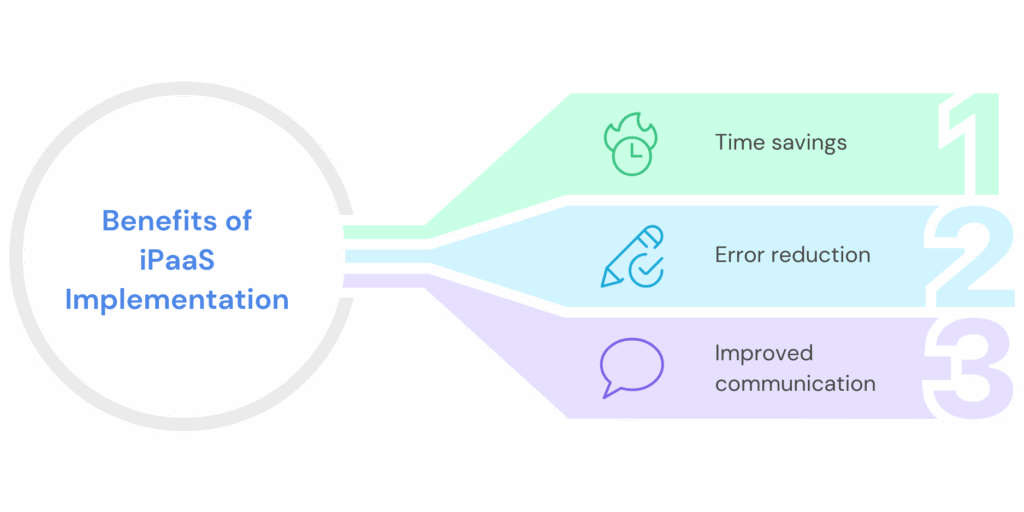
- Time savings: Tasks that previously required hours now complete in minutes, allowing professionals to focus on high-value activities
- Error reduction: Automated data entry and validation minimize human mistakes
- Improved communication: Automated email and messaging systems facilitate communication between clients, brokers, and stakeholders
Real estate firms gain centralized data management capabilities, where client information, property details, and transaction records exist in one accessible location. This centralization enhances customer experience through personalized messaging, automated follow-ups, and instant updates on property status or transaction progress.
How does iPaaS work in practice? Real estate companies implement iPaaS for data integration projects that connect property sensors, providing real-time insights on energy consumption and room utilization. This approach converts property management into a data-driven operation where facility managers can monitor building performance, optimize energy usage, and predict maintenance requirements based on sensor data analytics.
The Future Landscape for iPaaS in Real Estate
The iPaaS market shows remarkable expansion potential, projected to reach $17.55 billion by 2025 and surge to $79.38 billion by 2030 with a CAGR of 35.23%. This growth indicates a fundamental shift in how real estate businesses structure their technology ecosystems.
How is artificial intelligence changing iPaaS capabilities? AI-powered integration platforms now predict integration failures, optimize data flows, and suggest new integration opportunities. For real estate operations, this means predictive maintenance capabilities that forecast equipment faults before they occur, reducing costly emergency repairs.
Real-time analytics create new possibilities for property management efficiency. Organizations while pursuing critical projects connect sensors through iPaaS to provide instant insights on energy consumption and room utilization. These implementations generate dashboards that offer customers visibility into energy usage and costs, enhancing both management capabilities and customer experience.
Digital twins—virtual replicas of physical properties—gain significant value when connected through iPaaS platforms. One project underway involves connecting separate integration platforms to access a property’s digital twin for enhanced property management and customer portal data sharing. Combined with sensor networks, this technology enables real-time monitoring that drives operational efficiency and provides predictive insights.
Industry-specific iPaaS solutions continue gaining momentum, allowing real estate professionals to access integration platforms tailored specifically to their operational requirements. These specialized solutions deliver precision that exceeds generic integration approaches.
iPaaS represents a fundamental solution for real estate companies facing disconnected systems and operational inefficiencies. The evidence demonstrates how fragmented technology landscapes create bottlenecks, with most firms operating hundreds of software tools that fail to communicate effectively. Real estate professionals spend excessive time on manual data entry rather than strategic growth initiatives.
What makes iPaaS different? Rather than maintaining costly fragmented systems, real estate companies can connect their entire technology ecosystem through a single platform. This approach reduces errors significantly while automating workflows that previously required manual intervention.
The business benefits extend well beyond efficiency improvements. Centralized data management provides teams with instant access to property details, client information, and transaction records from a unified source. Customer experiences improve through personalized communication and real-time updates.
The future applications of iPaaS in real estate show significant promise. Projected market growth to $79.38 billion by 2030 indicates this technology is becoming essential rather than optional. AI-powered integrations will predict maintenance issues before they occur, while digital twins connected through iPaaS will provide unprecedented visibility into property operations.
Real estate companies that adopt iPaaS today position themselves at a considerable advantage. The transition from fragmented systems to a cohesive technology ecosystem represents more than an operational upgrade—it fundamentally changes how properties are managed, marketed, and maintained. Forward-thinking real estate professionals should consider iPaaS not merely as an IT solution but as a strategic business asset essential for success in 2025 and beyond.
With Aekyam, we bring this vision to life.
Aekyam is built to address the industry’s complex needs—enabling rapid implementation, pre-configured workflows, and seamless connectivity between property systems, sensors, cloud apps, and customer platforms. Whether it’s unlocking the power of digital twins, enabling predictive maintenance, or centralizing client and property data, Aekyam empowers real estate businesses to operationalize iPaaS with unmatched speed and precision.
Share
Read Similar Blogs