

How real-time anomaly detection helps you save millions of money?
Real-time anomaly detection is the AI-powered early warning system that modern retailers are using to protect their margins. It identifies deviations in data, fraud signals, inventory discrepancies, demand shifts, pricing errors as they happen, not hours or days later.
In a sector where margins are thin and data volumes are enormous, the ability to catch a problem in seconds rather than discovering it in next week’s report is the difference between a recoverable incident and a significant financial loss. Here is exactly where and how it is saving retailers millions.
What Is Real-Time Anomaly Detection?
Real-time anomaly detection uses AI models to continuously monitor data streams and flag deviations from expected patterns the moment they occur. It does not wait for a scheduled report or a manually set threshold to be breached. It identifies what is unusual, in context, and surfaces it immediately.
Traditional monitoring relies on batch reports, end-of-day reviews, threshold-based alerts, and periodic manual audits. These approaches are too slow for retail’s pace. A fraudulent transaction clears in seconds. A shelf goes empty within hours. By the time a batch report surfaces the problem, the loss has already occurred. In retail, anomalies are not just technical irregularities. They are revenue leaks. Every undetected one costs money.
Where Retailers Are Losing Money — and How Anomaly Detection Stops It
Retailers lose margin across five distinct areas:
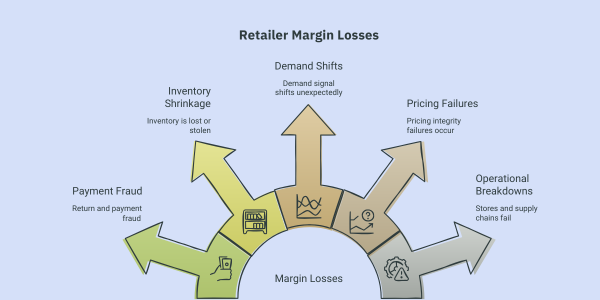
- Payment and return fraud
- Inventory shrinkage
- Demand signal shifts
- Pricing integrity failures
- Operational breakdowns across stores and supply chains.
Real-time anomaly detection addresses all five. Here is how.
Payment and Return Fraud
The problem
Payment fraud and return abuse cost the retail industry tens of billions of dollars annually. Traditional rule-based fraud systems are reactive by design. They flag transactions that match known patterns of past fraud. Novel fraud tactics, coordinated abuse rings, and account takeover schemes move faster than static rules can be updated. By the time a rule is written, the loss has already occurred.
What anomaly detection catches
Real-time anomaly detection monitors purchase velocity, transaction patterns, account behaviour, and return history simultaneously. It identifies unusual spikes in purchase frequency from a single account, mismatches between return behaviour and purchase history, geographic inconsistencies in account activity, and signals that suggest an account has been taken over. It does not wait for a pattern to match a pre-defined rule. It flags what is statistically unusual, in real time, before the transaction completes or the return is processed.
The savings
Retailers using real-time anomaly detection report significant reductions in chargebacks, lower return fraud rates, and fewer false positives that block legitimate customers. Catching fraud at the point of transaction, rather than reconciling it after the fact, prevents the loss rather than documenting it.
Inventory Shrinkage and Stock Anomalies
The problem
Shrinkage and phantom inventory are among the quietest drains on retail margins. Stock disappears through theft, supplier short-shipments, mishandling, or administrative error. These discrepancies are often discovered weeks or months later during physical audits, long after the opportunity to intervene has passed. By then, the margin impact has already been absorbed.
What anomaly detection catches
Anomaly detection monitors inventory levels continuously across locations, comparing real-time stock positions against expected levels based on sales velocity, transfer activity, and scheduled deliveries. It flags unexpected inventory drops that do not correspond to sales, discrepancies between POS records and warehouse stock, and deviations in supplier delivery quantities. These signals are surfaced immediately, when action is still possible.
The savings
Retailers recover margin through reduced write-offs, faster resolution of supplier disputes supported by real-time data, and more accurate stock positions that improve replenishment decisions. Detecting a supplier short-shipment on the day of delivery is far less costly than discovering it at the end of the quarter.
Demand Signal Shifts
The problem
Demand can shift overnight. A product goes viral on social media. A local event drives unexpected regional demand. A competitor runs out of stock and customers move to an alternative. Traditional demand forecasting models are built on historical patterns. They are not designed to detect these sudden, sharp shifts in real time. The result is empty shelves, lost sales, and markdowns on inventory that was positioned for demand that has already moved elsewhere.
What anomaly detection catches
Anomaly detection monitors sell-through rates, basket composition, regional sales patterns, and inventory draw-down velocity in real time. It identifies when a product is selling significantly faster than expected, when demand is spiking in a specific region without a planned promotional driver, and when basket data suggests a shift in purchasing behaviour. These signals are surfaced before shelves empty, giving supply chain teams a window to respond.
The savings
Retailers reduce lost sales from stockouts, lower markdown costs by repositioning inventory before it becomes stranded, and improve supply chain responsiveness with earlier, data-driven signals. The value is not just in catching what went wrong. It is in giving teams the lead time to act before it does.
Pricing Integrity Across Channels
The problem
Omnichannel retail creates enormous complexity in pricing management. Promotional prices applied to the wrong SKUs, regional price variations that were never intended, margin compression from mis-configured discounts, and inconsistencies between in-store and online pricing are all common. In a large retail operation, these errors can persist across thousands of transactions before anyone notices. The cumulative margin leakage is significant.
What anomaly detection catches
Anomaly detection flags deviations from expected price ranges at the SKU level, identifies promotions being applied outside their intended scope, and surfaces sudden margin compression across product categories. It monitors pricing data across every channel simultaneously and alerts when something falls outside the expected band. The detection happens in minutes, not at the end of a promotional period.
The savings
Retailers recover margin from pricing errors that are caught and corrected before they run at scale. Promotional execution becomes cleaner. Pricing inconsistencies between channels are resolved before they damage customer trust or trigger competitor price-matching at the wrong level.
Operational Anomalies Across Stores and Supply Chain
The problem
POS system downtime, unusual refund or void rates at specific store locations, logistics delays, and cold chain deviations often go unnoticed until they have already cascaded into larger operational failures or customer experience issues. A store transacting at half its normal rate may not surface in a daily report until close of business. By then, hours of revenue have been lost and the root cause may be harder to isolate.
What anomaly detection catches
Anomaly detection monitors transaction rates at the store level and flags drops that deviate from expected patterns for that location, day, and time. It identifies unusual concentrations of refunds or voids that may indicate error or misuse, tracks logistics deviations against expected delivery windows, and monitors equipment signals such as cold chain temperature data for deviations that could indicate a failure. Each of these is surfaced in real time, with location-level specificity.
The savings
Faster incident response reduces the duration and scale of operational losses. Earlier intervention protects customer experience before it is visibly impacted. Cold chain anomalies caught early prevent spoilage at a fraction of the cost of a full-scale loss. The compounding effect across a network of stores is substantial.
What Makes Anomaly Detection Truly "Real-Time" and Why Speed Is Everything
Real-time anomaly detection operates in milliseconds to seconds. Batch anomaly detection processes data at scheduled intervals, end of shift, end of day, or end of week. The distinction is not technical nuance. In retail, speed is the entire value.
A fraudulent transaction clears in seconds. A pricing error multiplies across thousands of transactions within hours. A demand spike empties a shelf before a replenishment order can be raised. A POS system goes down and remains undetected for a full trading shift. In each of these cases, the cost of detection at the end of the day is fundamentally different from the cost of detection at the moment it begins.
True real-time anomaly detection requires streaming data architecture that processes data as it is generated, low-latency machine learning models that score events without introducing delay, and instant alerting paired with automated response triggers that can act without waiting for a human to review a dashboard. Platforms that describe themselves as “real-time” but operate on micro-batch processing every five or ten minutes do not deliver the same value. In retail, the gap between five minutes and five seconds is measurable in lost revenue.
In Retail, Every Undetected Anomaly Has a Price
Retail is a data-rich, margin-thin industry. Anomalies are present in every layer of operations in transactions, in inventory, in demand signals, in pricing, and in the behaviour of stores and supply chains at scale. The question is never whether anomalies exist. The question is whether they are detected before they become losses.
Real-time anomaly detection is the difference between reacting to losses and preventing them. Retailers who invest in this capability are not just improving their fraud controls or tightening their inventory management. They are building an operational layer that continuously monitors the health of the entire business and surfaces problems when they can still be resolved at low cost. That is what separates retailers who protect their margins from those who explain away why they did not.
Frequently Asked Questions
How does the lack of real-time anomaly detection affect retailers?
Without real-time anomaly detection, retailers operate on delayed information. Fraud is discovered after the transaction has settled. Inventory discrepancies appear in periodic audits rather than at the moment they occur. Pricing errors run at scale for hours or days before anyone identifies them. Demand shifts are missed until shelves are empty. The cumulative effect is a steady drain on margins that is difficult to attribute to a single cause, which makes it equally difficult to address systematically.
How is real-time anomaly detection different from traditional fraud detection systems?
Traditional fraud detection systems are rule-based. They flag transactions that match pre-defined patterns derived from known fraud scenarios. Real-time anomaly detection uses statistical and machine learning models to identify what is unusual relative to expected behaviour, without requiring a pre-defined rule for each scenario. This means it can detect novel fraud tactics, coordinated abuse patterns, and account takeover signals that a rule-based system would miss entirely.
What types of data does anomaly detection monitor in a retail environment?
Anomaly detection in retail monitors transaction data including purchase frequency, value, and location; return and refund patterns; inventory levels and movement across warehouses, distribution centres, and store locations; pricing data across channels and SKUs; demand and sell-through rates by product and region; logistics and delivery data against expected schedules; and operational data including POS transaction rates, void rates, and equipment signals such as cold chain temperature readings.
Is real-time anomaly detection viable for large retail chains?
Yes, and large retail chains are among the primary beneficiaries of this capability. A pricing error, a fraudulent return pattern, or a POS irregularity that might be isolated in a single store becomes a significant financial exposure when it runs undetected across an entire network. Real-time detection at scale requires robust streaming data infrastructure and low-latency models, but modern AI orchestration platforms are built to handle this. The return on investment at enterprise scale is significant, given the volume of transactions, inventory positions, and pricing decisions being monitored continuously.
Is real-time anomaly detection viable for mid-sized retailers?
Yes, and the barrier to entry is lower than most mid-sized retailers expect. Modern AI orchestration platforms make this capability accessible without requiring a dedicated engineering team or custom-built infrastructure. The platform deploys against existing systems and scales with the business. For mid-sized retailers, the priority is finding a solution with pre-built connectors that delivers value without extensive configuration.
How does real-time anomaly detection help small businesses?
For smaller retail operations, real-time anomaly detection provides a level of operational visibility that was previously only accessible to large enterprises. It surfaces unusual transaction behaviour, unexpected inventory movements, and demand shifts that a small team would not have the capacity to monitor manually.
Which platform should retailers look at for real-time anomaly detection?
Any AI-driven orchestration platform with strong data integration capabilities and real-time processing architecture can support anomaly detection in a retail environment. Aekyam, as an AI orchestration platform, includes this capability as part of its core offering. It connects to retail data sources across transactions, inventory, pricing, and operations, and monitors those streams continuously for deviations from expected patterns.
Which feature of Aekyam makes it stand out?
Aekyam includes dedicated anomaly detection as a native platform capability. This means retailers do not need to integrate a separate monitoring tool or build detection logic from scratch. The anomaly detection layer sits across all connected data streams, transactions, inventory, pricing, logistics, and operational systems and surfaces deviations in real time. Combined with Aekyam's multi-agent orchestration and self-healing workflows, the platform does not just detect anomalies. It can initiate automated responses, route alerts to the right teams, and trigger corrective actions without waiting for human intervention.
Share
Read Similar Blogs