


What are the features that you should look for in an enterprise ai orchestration platform in 2026?
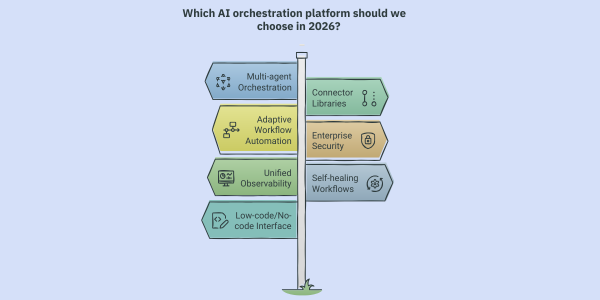
Here are the top seven features to look for in an Enterprise AI Orchestration Platform:
- Multi-agent orchestration
- Pre-built and custom connector libraries
- Adaptive context-aware workflow automation
- Enterprise-grade security and governance
- Unified observability
- Self-healing workflows
- Low-code or no-code interface with developer depth.
What Does "Enterprise-Grade" Actually Mean in 2026?
Enterprise-grade is a set of non-negotiable requirements. A consumer or SMB AI tool is built for speed and simplicity. An enterprise AI orchestration platform is built for scale, security, governance, multi-agent coordination, and deep observability. It must perform reliably under high data volumes, across complex integrations, with multiple teams working simultaneously.
The seven features covered in this article are not a wishlist. They are the minimum bar for any platform that wants to earn a place in a serious enterprise environment.
Top 7 Features an Enterprise AI Orchestration Platform Should Have
Feature #1: Multi-Agent Orchestration
Multi-agent orchestration is the ability to coordinate multiple AI agents working in parallel or in sequence across different systems and workflows. Each agent handles a specific task, and the platform manages how they communicate, hand off work, and maintain shared context.
Enterprises are no longer running a single AI tool. They are running dozens. Without orchestration, agents conflict with each other, duplicate work, or produce inconsistent outputs that undermine trust in the entire AI layer. Managing agents in isolation is not a strategy. It is a liability.
It is important to choose a platform that allows you to define clear agent roles, manage handoffs between agents, handle failures gracefully without human intervention, and maintain context across the full workflow. If a platform cannot do this at scale, it is not ready for enterprise use.
Feature #2: Pre-Built and Custom Connector Library
A connector library is a collection of pre-built integrations to enterprise tools, ERPs, CRMs, data warehouses, and cloud services paired with the ability to build custom connectors for tools that are not in the default library.
No enterprise runs on a single stack. Your AI orchestration platform needs to communicate with the systems you already have, not the ones a vendor wishes you would buy. A platform with shallow integrations forces your team into workarounds that consume engineering hours and introduce risk.
When looking for the right platform, it is important to evaluate the depth of native connectors, not just the count. It is necessary to confirm if it supports legacy protocols, and event-driven architectures. Lastly, also to test how straightforward it is to build a custom connector when your specific tool is not in the library.
Feature #3: Adaptive, Context-Aware Workflow Automation
Context-aware workflow automation goes beyond rule-based logic. Workflows understand what is happening at each step, adjust based on real-time data and outcomes, and correct themselves when conditions change.
Static, rule-based automation often breaks under real-world variability. A shipment is delayed. A dataset arrives incomplete. An exception falls outside the defined parameters. Without adaptivity, every one of these situations requires manual intervention. That erases the value of automation entirely.
When looking for a platform, it is important to look for conditional logic driven by AI, feedback loops that improve over time, exception handling that learns from past failures, and workflows that can self-correct without human input. If the platform still requires a developer to handle every edge case, it has not moved beyond legacy automation.
Feature #4: Enterprise-Grade Security and Governance
Enterprise-grade security and governance includes role-based access control, full audit trails, data masking, compliance certifications such as SOC 2, GDPR, and HIPAA, and policy enforcement across every AI workflow running on the platform.
AI is now touching critical business processes: financial decisions, customer data, supply chain operations, and HR systems. Governance is no longer optional. It is a regulatory requirement and a matter of organizational trust. A platform that cannot demonstrate rigorous security controls should not be in your evaluation.
What to look for
While evaluating the right platform it is important to verify granular access controls that restrict what each user and agent can do. Confirm full auditability of AI decisions, including what data was used and what output was produced. Ensure data lineage tracking is available out of the box. Compliance infrastructure should come standard, not as an add-on.
Feature #5: Unified Observability Across Integrations and AI Agents
Unified observability provides a single dashboard with full visibility into the health, performance, and output of every integration, workflow, and AI agent running on the platform.
Enterprises cannot afford blind spots. When something fails in a multi-agent, multi-system workflow, the team responsible needs to locate the root cause fast. Without unified observability, that investigation becomes a time-consuming exercise in system-by-system log diving. That is not acceptable in a production AI environment.
While looking for a platform it important to ensure that the platform should provide real-time monitoring, configurable alerting, cross-system tracing, and clear explainability of AI decisions. Proactive anomaly detection, which flags issues before they escalate, is a significant advantage worth prioritising.
Feature #6: Self-Healing Workflows
Self-healing capability refers to the platform’s ability to handle growing data volumes, more agents, more integrations, and more concurrent users without the underlying architecture becoming fragile or the maintenance burden expanding in proportion.
Enterprise growth should not require rebuilding your integration layer every eighteen months. A platform that requires constant re-engineering as your AI footprint grows is a constraint on the business, not an enabler of it.
While evaluating the platform it is important to confirm that the platform is built on cloud-native architecture with horizontal scaling. Multi-tenancy support is essential for large organisations. The management model should remain straightforward as the number of agents, workflows, and integrations scales upward.
Feature #7: Low-Code / No-Code Interface with Developer Depth
A dual-interface platform allows business users and operations teams to build and manage workflows without writing code, while giving developers access to full API support, SDKs, and the ability to build complex custom logic underneath.
AI orchestration cannot remain an IT-only capability. Business teams need the autonomy to build and modify workflows without filing a ticket and waiting two weeks. At the same time, that autonomy cannot come at the cost of governance or architectural integrity.
While looking for a platform it is important to look for visual workflow builders and drag-and-drop agent configuration should be standard for non-technical users. Developers should have access to complete API documentation, SDK support, and the tooling required to build advanced, custom use cases. The best platforms do not make you choose between accessibility and depth.
How to Evaluate AI Orchestration Platform Features in Practice?
A feature checklist is a starting point, not a conclusion. The real evaluation happens when you:
- Request live demonstrations
- Test against your own systems
- Assess the vendor’s support model and roadmap.
Here is how to approach each one.
Request live demonstrations of multi-agent scenarios. Vendor slide decks show ideal conditions. Live demos show how the platform behaves under realistic complexity.
Test against your actual systems and edge cases. A platform that performs well on generic examples may struggle with the specific legacy systems, data formats, or workflow exceptions that define your environment.
Evaluate the support model, documentation quality, and roadmap transparency. The platform you choose today will need to evolve with your AI strategy. A vendor that cannot clearly articulate where their product is going in the next twelve months is a risk.
The Platform You Choose Is a Strategic Decision
In 2026, AI orchestration is infrastructure. It is not a pilot tool or a departmental experiment. It is the layer on which your AI strategy is built, and the wrong choice carries real strategic cost. The seven features covered in this article represent the minimum standard for a serious enterprise evaluation. Use them not just to assess vendors, but to ask the right questions before a contract is signed.
Frequently Asked Questions
What is an Enterprise AI Orchestration Platform?
An Enterprise AI Orchestration Platform is a software layer that coordinates AI models, agents, and workflows across an organisation's technology stack. It manages how AI components communicate, share data, hand off tasks, and maintain consistency across complex, multi-system environments. Unlike standalone AI tools, it is designed to operate at enterprise scale with governance, security, and observability built in.
How do I know if an AI Orchestration platform is truly enterprise-grade?
Enterprise-grade platforms meet a defined set of requirements that go beyond general functionality. They support multi-agent coordination at scale, provide comprehensive security and compliance infrastructure, offer deep observability across all workflows, and maintain performance as data volumes and user counts grow. If a vendor cannot demonstrate these capabilities with your specific use cases and systems, the platform is likely built for a smaller or simpler operating environment.
How do I know if an AI Orchestration platform is truly enterprise-grade?
Beyond the seven core features, consider the following: model-agnosticism (the ability to work with multiple AI models from different providers), version control for workflows, support for human-in-the-loop processes, robust disaster recovery, and a marketplace or ecosystem of extensions. These capabilities become important as your AI operations mature and the requirements become more sophisticated.
How do I know if my enterprise needs an AI Orchestration Platform?
There are five clear signals that your organisation has outgrown its current integration and automation setup. First, your teams are managing AI tools in silos with no shared context between them. Second, failures in one system create unpredictable knock-on effects that are difficult to trace. Third, developers are spending more time maintaining integrations than building new capabilities. Fourth, your governance and compliance teams cannot audit what your AI systems are doing or why. Fifth, business teams are building their own workarounds outside of IT oversight, creating shadow AI risk. If any of these apply, it is time to evaluate a dedicated orchestration platform. Read more in our blog about 5 Signs Your Organisation Has Outgrown Integration.
Does Aekyam AI Orchestration Platform have all seven of these features?
Aekyam is built specifically for enterprise AI orchestration and includes all seven features covered in this article: multi-agent coordination, an extensive connector library with custom-build capability, adaptive and context-aware workflows, enterprise-grade security with compliance certifications, unified observability across all agents and integrations, self-healing and scalable architecture, and a dual interface that serves both business users and developers.
Aekyam's enterprise capabilities have been recognised internationally. The platform received the Hong Kong Award for Innovation a credential that reflects both the technical rigour and the real-world impact of the platform across enterprise environments.
If you are ready to evaluate whether Aekyam is the right fit for your organisation, request a live demo and test it against your actual systems and use cases.
Share
Read Similar Blogs

AI Agents and API Integration Platforms: What Changes in the Agentic AI Era
September 15, 2026
AI Orchestration Platform Buyer’s Guide
September 3, 2026