


Introduction
Most integration security problems don’t start with a sophisticated attack. They start with an undocumented API nobody remembers building, a credential that was never rotated, or an integration that quietly outgrew the access it was originally scoped for. As the number of integrations grows, informal governance — “ask the one person who knows” — stops working.
This blog lays out a practical governance framework for an API integration platform: what to put in place, in what order, and how to keep it from becoming so heavy that it slows down the teams it’s supposed to protect.
If you are new to this concept, learn all about API integration in our comprehensive guide.
Why Governance Breaks Down as Integrations Scale
At five integrations, everyone on the team roughly knows what connects to what. At fifty, that shared understanding is gone, and undocumented connections start posing real risk: nobody notices when a connector’s permissions are broader than necessary, or when an integration built for a since-cancelled project is still quietly running. Governance exists to replace informal memory with a system that scales.
The Governance Model
A workable governance model groups into four practical pillars, rather than a long, undifferentiated checklist.
Inventory, Contracts, and Design Standards
Start with a centralized catalog documenting what each API is, who owns it, and its current lifecycle status. Pair that with OpenAPI specifications as the single source of truth for each API’s contract, and enforceable style guides — consistent naming, error handling, and pagination — checked through automated linting rather than manual review.
CI/CD Policy-as-Code and Testing
Bake governance checks into your existing pull request process instead of running them as a separate approval step. Automated policy checks (tools like Spectral are common here), shift-left design reviews using mock servers, and contract testing that continuously verifies implementations match their published specification all catch problems before they reach production.
Security Baseline
Set a small number of non-negotiable requirements that apply to every integration without exception: TLS everywhere, consistent authentication and authorization, and rate limiting on every public-facing endpoint. Non-negotiable means exactly that — no integration ships without meeting this baseline, regardless of deadline pressure.
Runtime Governance and KPIs
Once integrations are live, monitor production metrics, service-level objectives, and error rates continuously rather than checking in quarterly. Track a small set of meaningful KPIs: catalog coverage, standards conformance, how many breaking changes were caught before release, and operational health. This is also where you catch an integration whose access has quietly grown beyond its original scope.
A 30/60/90-Day Rollout Plan for Governance Plans
Governance programs fail most often when teams try to implement everything at once. A phased rollout gets the essentials in place quickly, then builds toward full maturity without stalling in-flight integration work.
| Phase | Focus | Key Deliverables |
|---|---|---|
| Days 0–30 | Foundation | Build the API catalog, establish minimal design standards, ship one or two quick governance wins |
| Days 31–60 | Automation | Implement CI/CD linting, design reviews, and breaking-change detection |
| Days 61–90 | Maturity | Add runtime governance, define SLO targets, and start regular maturity reporting |
What Good KPI Reporting Actually Looks Like
A governance dashboard that just shows “integrations running: 47” tells you nothing useful. A more useful version breaks that down into four key metrics:
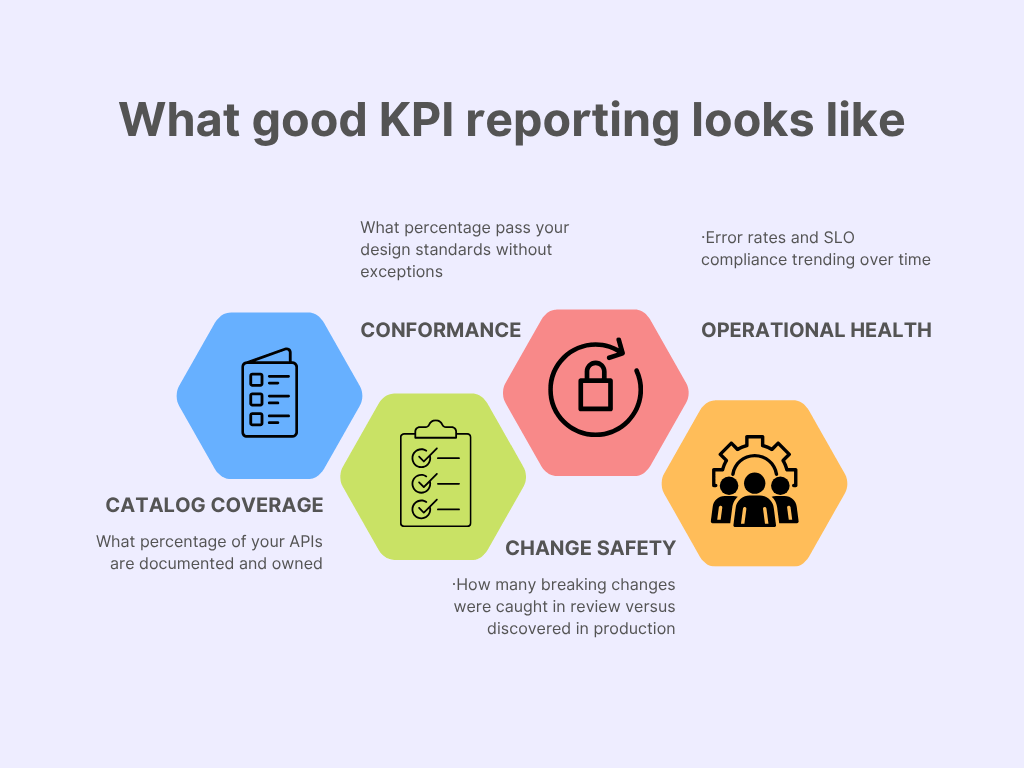
- Catalog coverage – what percentage of your APIs are documented and owned
- Conformance – what percentage pass your design standards without exceptions
- Change safety – how many breaking changes were caught in review versus discovered in production
- Operational health – error rates and SLO compliance trending over time
Reviewed monthly, these four numbers tell you whether governance is actually working or just generating paperwork.
Common Governance Mistakes
Even well-intentioned teams tend to make the same handful of mistakes when governance gets bolted on after integrations are already in production.
- Treating governance as a launch gate, not a lifecycle. Reviewing an integration once before launch and never again misses the problems that show up months later, when permissions have crept beyond their original scope or a dependency has quietly changed behavior.
- Making the security baseline optional under deadline pressure. The first exception granted for a tight deadline becomes the precedent for the next ten. A baseline that bends isn’t a baseline.
- Measuring activity instead of outcomes. Counting how many integrations passed review tells you less than tracking how many breaking changes were caught before they hit production, or how quickly a failed integration gets diagnosed and fixed.
Making Governance a Habit, Not a Project
Treating governance as a one-time project is how organizations end up rebuilding it from scratch every few years, usually after an incident force the issue. Treating it as a standing discipline — with clear ownership, automated checks, and continuous monitoring — is what lets an integration footprint grow without the risk growing faster than the team’s ability to manage it.
If you’re building this out for the first time, weight security posture heavily in our 10-point evaluation framework when choosing a platform, and make sure whatever you choose gives you the observability this framework depends on. Aekyam’s AI workflow orchestration platform is built with this kind of governance in mind from the ground up. Request for a demo or connect with our team of experts to understand how API governance can make a difference for your business.
Frequently Asked Questions
Who Owns API Governance — IT or a Dedicated Team?
In practice, it works best as shared ownership rather than a single gatekeeper. A small central team sets the standards, tooling, and non-negotiable baseline, while individual product and engineering teams are responsible for meeting those standards within their own integrations. A single gatekeeper team becomes a bottleneck the moment integration volume grows past what they can manually review.
How Does Governance Change With AI Agents in the Mix?
AI agents need governance that operates in real time rather than on a review cycle, because an agent can take dozens of actions before a quarterly audit would ever catch a problem. That means scoped, short-lived credentials issued just when an agent needs them, per-agent observability (not just per-application), and clear logging of what an agent actually did versus what it was authorized to do.
What’s the Minimum Viable Governance Setup?
If you’re starting from nothing, the minimum viable setup is an API catalog (even a spreadsheet is a start), a security baseline that’s actually enforced without exception, and one dashboard showing error rates across your integrations. That’s enough to catch the most common failure modes — an undocumented API and a silent, ongoing failure — while you build toward the fuller model above.
Is API Governance Only Necessary for Large Enterprises?
No — it's a question of integration count, not company size. A five-person startup with three integrations can get away with informal governance because everyone knows what connects to what. The tipping point isn't headcount, it's the moment nobody on the team can list every active integration from memory anymore. That can happen at 20 integrations just as easily as at 200, which is why smaller teams shouldn't assume governance is something to "grow into later" — by the time it's obviously needed, the undocumented backlog is already painful to untangle.
What's the Difference Between API Management and API Governance?
They get used interchangeably, but they answer different questions. API management is the operational layer — gateways, rate limiting, developer portals, the tooling that runs your APIs day to day. Governance is the policy layer that decides what "good" looks like before and after that tooling is in place: who's allowed to publish an API, what standards it has to meet, and who's accountable when it doesn't. You can have strong management tooling and still have weak governance, since a gateway will happily run a poorly-designed, undocumented, over-permissioned API just as smoothly as a well-governed one.
How Long Does It Typically Take to See Results From a Governance Program?
Most teams see the first payoff within the 30-day foundation phase, usually in the form of a catalog surfacing an integration nobody remembered was still running. The harder-to-see benefits — fewer breaking changes reaching production, faster incident diagnosis — usually take a full 90-day cycle to show up in the KPI numbers, and a couple of quarters before they're trusted internally as a real trend rather than noise.
How Do You Get Engineering Teams to Actually Buy Into Governance?
Resistance almost always traces back to governance feeling like extra work bolted onto an already-shipped process. Teams tend to buy in when the standards are enforced through tooling they already use (linting in the same pull request, not a separate review board) and when the first wins are visible and fast rather than theoretical. It also helps to lead with the failure modes governance actually prevents — a credential nobody rotated, an integration quietly running past its intended scope — rather than presenting it as compliance for its own sake.
What's a Reasonable First Step If Our Organization Has No Governance at All?
Don't start by writing a policy document — start by finding out what you actually have. An inventory pass (even manual, even incomplete) almost always surfaces something the team didn't know was still active, and that discovery tends to build more internal support for governance than any amount of upfront planning would.
Share
Read Similar Blogs