


How Do You Know It's Time to Upgrade Your Integration Platform?
- Your integrations move data but make no intelligent decisions with it.
- Every new AI tool you add creates a new, disconnected silo.
- Your automations break every time a process changes.
- Scaling your business means adding more integrations, not smarter ones.
- You have no unified view of what your systems and agents are actually doing.
Your integration platform felt like a great fit when you first set it up. It connected your apps, moved your data, and automated basic tasks. However, businesses grow, and what worked before may be slowing you down today.
The truth is, most businesses do not notice the cracks until they are already dealing with the consequences: broken automations, mounting complexity, teams stuck doing work that should be automated. Read the blog for a detailed insight on each of the signs and how to identify them.
The real culprit lurks in plain sight: operational silos. These invisible walls between departments drain businesses each year in lost productivity. Sales teams rarely connect with marketing. IT works in isolation. Production runs on its own schedule. The result is bottlenecks, duplicate work, and a business that can never quite move as one.
The good news is that these walls can come down.
This blog explores strategies to dissolve operational silos, enabling enterprises to achieve agility and seamless collaboration. It highlights how breaking down barriers between departments fosters innovation, improves communication, and accelerates decision-making. Leveraging integrated systems and data-driven approaches, organizations can streamline workflows, enhance productivity, and adapt swiftly to market changes.
What Does a Traditional Integration Platform Do?
A traditional integration platform connects your apps and moves data between them. It lets your CRM talk to your ERP, your helpdesk sync with your billing tool, and your forms feed into your database. It also handles basic workflow automation and API management.
These platforms are often called iPaaS (Integration Platform as a Service), and do their core job well. They save time, reduce manual data entry and help teams stay in sync.
But they were built for a different era. They assume your processes are fixed, your data flows are predictable, and your tools are stable.
In today’s environment with AI agents, fast-changing workflows, and growing tech stacks, it is no longer as useful.
Traditional integration platforms move data, but do not understand it. They connect systems, but do not coordinate them. This gap is exactly where modern businesses get stuck.
This is where an AI Orchestration Platform becomes essential. It does everything a traditional platform does and goes further. It understands context, not just content. It coordinates your AI agents alongside your systems, not separately from them. It builds workflows that adapt when processes change, rather than breaking, and it gives you one unified view of everything that is happening across your entire tech stack.
If you are asking yourself the following questions daily, then it is a clear sign your business has outgrown its traditional integration platform and it is time to move to an AI Orchestration Platform.
Sign #1 — Why Are My Integrations Just Moving Data, But Not Doing Anything Intelligent With It?
Your integrations are just moving data and not doing anything intelligent with it, because your integration platform was built to transfer data, not to think about it. It does the job it was designed for, which is moving information from one system to another. But it stops there, it does not know what the data means, and it does not know what to do next. Your integrations are working but they are not thinking. Data moves from Point A to Point B, but nothing acts on it. No decisions are made; no next steps are triggered based on what the data actually means. The basic work is done, but the intelligence is missing.
An AI Orchestration Platform does not just move data, it understands it. It looks at the context, not just the content, and triggers intelligent actions in response. It can route a ticket to the right team, escalate an issue before it becomes a crisis, or kick off an approval workflow based on what the data signals. It replaces manual interpretation with automated intelligence.
Sign #2 — Why Does Every New AI Tool I Add Create a New Silo?
You add new AI tools to stay competitive, but instead of working together, each one sits in its own corner. This is because each AI tool you add is built to work on its own, not as part of a connected system. You are adding tools, but nothing is coordinating them. So instead of building AI capability, you are building AI clutter.
Instead of AI making your operations smarter, it’s making them more complicated. You now have AI silos sitting on top of your existing data silos. Managing multiple AI tools each with its own setup, maintenance, and quirks drains your IT team and delivers fragmented results.
An AI Orchestration Platform acts as a coordination layer for both your systems and your AI agents. Every tool, every model, every workflow operates in sync under one unified platform. You do not just collect AI tools, you orchestrate them. That’s the difference between AI chaos and AI that actually works.
Sign #3 — Why Does My Automation Break Every Time a Process Changes?
Your automations break everytime because they follow exact rules, and the moment anything changes, those rules no longer match reality. They do not adapt. They just stop working.
Traditional rule-based connectors are rigid. They follow exact instructions. When the environment changes, they do not adapt, they break. Every business process change becomes an IT project. Agility suffers, and teams are afraid to update their own workflows because they do not know what will break next.
AI Orchestration platforms build adaptive workflows. Instead of following hardcoded rules, they understand the intent behind a workflow. When something changes, they adjust rather than collapse. Changes stop cascading into breakage. Your automation stays resilient, even as your processes evolve.
Sign #4 — Why Does Scaling My Business Mean More Integrations and Not Smarter Ones?
Scaling your business means more integration and not smarter ones, because traditional integration platforms grow by adding connections, not by getting smarter. Every new tool, team, or market means more point-to-point links to build and maintain. The more you grow, the messier it gets.
Complexity scales linearly with growth. The more you add, the heavier the maintenance burden. Every new integration is one more thing that can break. One more thing to monitor. One more thing to update when something changes. The system becomes fragile precisely when you need it to be most reliable.
An AI Orchestration Platform does not keep adding connectors, it adds intelligence to the orchestration layer itself. Complexity is handled centrally. Growth does not mean more mess; it means more capability built on a stable foundation. You scale smarter, not louder.
Sign #5 — Why Do I Not Have a Unified View of What My Systems and Agents Are Doing?
You do not have a unified view of what your systems and AI agents are upto because your tools each have their own dashboard, and none of them talk to each other. There is no single place where you can see the full picture. So when something goes wrong, you are piecing it together from five different screens.
Troubleshooting is slow. Accountability is unclear. Proactive monitoring is nearly impossible. You only find out something broke after a user complains. Your team is always reactive, never ahead of problems. That’s a serious risk as your systems grow more interconnected.
An AI Orchestration Platform gives you unified observability. One place to monitor your integrations, your workflows, and your AI agents, all together. You can track what is happening, catch issues early, and debug faster. Instead of jumping between dashboards, you stay in control from a single command center.
What Should You Do Once Your Integration Platform Is Outdated?
The answer is straightforward: assess, evaluate, and migrate, in that order. Rather than trying to patch an outdated platform, building toward the right one is the better choice. Here’s how to approach it:
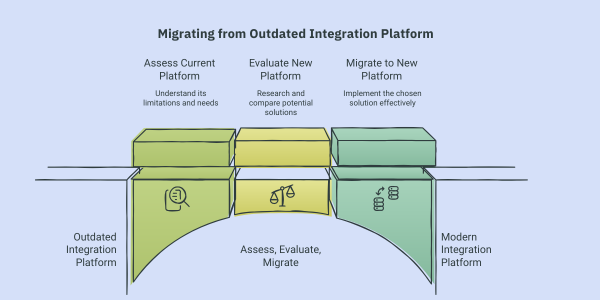
- Audit:Map all your current integrations. Identify where the five signs above are showing up. Be honest about where the gaps are. You can’t fix what you haven’t clearly seen.
- Evaluate:Ask whether your current platform can support AI agents, adaptive workflows, and unified observability. If the answer is no,or even a hesitant maybe that tells you what you need to know.
- Migrate:Plan a phased move to an AI Orchestration Platform. You don’t need to do it all at once. Start with the most critical workflows, prove the value, and expand from there.
The Future of Integration Is Orchestration
Traditional integration platforms have served their purpose. They helped businesses connect their tools, automate repetitive tasks, and move data reliably. For a long time, that was enough.
But the business environment has changed. AI tools are everywhere. Workflows evolve faster. The need for real-time intelligence, and not just real-time data has never been higher.
The shift to AI Orchestration is not a nice-to-have. It is becoming the baseline for competitive operations. The businesses that move early will build systems that are faster, smarter, and more resilient. The ones that wait will keep patching a platform that was never designed for what they need today.
If you have seen yourself in any of the five signs above, you already know what the next step is.
Frequently Asked Questions
When is the right time for a business to move beyond iPaaS?
The right time is when your platform starts holding you back more than it moves you forward. If your integrations are breaking often, your AI tools are not connecting, or your teams are spending more time managing integrations than using them, then it's time. Don't wait for a crisis to force the decision.
What is the difference between an iPaaS and an AI Orchestration Platform?
An iPaaS connects applications and moves data between them. It follows rules.
An AI Orchestration Platform does all of that, but also understands context, coordinates AI agents, adapts to change, and enables intelligent decision-making across your entire tech stack.
How can AI Orchestration help my business?
It can reduce manual work, improve automation reliability, eliminate AI silos, and give you full visibility into your systems. More importantly, it lets your integrations do more than shuttle data, and starts making intelligent decisions, triggering the right actions, and scaling with your business without adding chaos.
How many signs should be evaluated before making a decision?
Even one sign is enough to warrant a serious evaluation. If you are experiencing two or more, the conversation is not whether to move, it is when and how. The five signs in this blog are not hypotheticals. They are real friction points with real business costs.
Is there any platform that can help me identify these signs?
Yes. The right AI Orchestration Platform will often surface these gaps during an audit or proof-of-concept phase. Many platforms offer assessments or demos that help you see exactly where your current setup is falling short. The best approach is to start by mapping your existing integrations and bringing in a platform that can highlight the blind spots.
How is Aekyam as an AI Orchestration Platform?
Aekyam is built specifically for businesses that have outgrown traditional integration platforms. It brings together intelligent workflow orchestration, AI agent coordination, and unified observability in one platform. It is designed to handle complexity without adding to it so your systems scale with your business, not against it.
How do I get started with Aekyam?
Getting started is simple. Begin with an audit of your current integrations, identify the gaps, and connect with the Aekyam team for a walkthrough. From there, you can pilot it on your most critical workflows and expand as you see results. The goal is to make the transition seamless, and not a project in itself.
Share
Read Similar Blogs

AI Agents and API Integration Platforms: What Changes in the Agentic AI Era
September 15, 2026
AI Orchestration Platform Buyer’s Guide
September 3, 2026