


Picture this: A customer spots a jacket on Instagram, taps through to your website, sees it’s in stock in her size, and adds it to cart. But by the time she checks out, maybe six minutes later, the order fails. The item is gone. It was listed across four marketplaces simultaneously, and your inventory systems didn’t talk to each other fast enough.
This is not hypothetical. It plays out thousands of times a day across the retail industry, in brands big and small, across every category from fashion to electronics to home goods. This represents a fundamental gap between how modern retail operates, fragmented, multi-channel, always-on, and the data infrastructure most retailers still rely on.
Real-time data intelligence is the answer to that gap. For retailers serious about growth, it’s quickly becoming less of a competitive advantage and more of a survival requirement.
In this blog, we’ll explore why retail’s data problem runs deeper than most leaders realize, the key operational areas where real-time intelligence delivers the most visible impact, from inventory accuracy and order orchestration to dynamic pricing and returns, and the hidden architecture challenges like integration debt and fragmented systems that hold retailers back. We’ll also look at how modern AI orchestration platforms are helping retail brands close these gaps faster than ever before.
The Retail Data Problem Is Not What You Think
Most conversations about retail data get stuck on analytics, dashboards, reports, and trend lines. But the real crisis isn’t in the analysis layer. It’s in the data infrastructure underneath it.
Retail today means operating across physical stores, owned eCommerce, third-party marketplaces, social commerce channels, and wholesale often simultaneously. Each of these channels generates data constantly: orders, inventory movements, returns, customer interactions, and fulfilment events. The challenge is that this data lives in different systems, updated on different schedules, formatted in different ways, and owned by different teams.
An ERP handles financial and master data. A warehouse management system tracks physical stock. A CRM stores customer history. An order management system processes transactions. Marketplace APIs report sales on their own timelines. None of these systems were designed to work together seamlessly, and the gaps between them are where revenue leaks, customer experience breaks, and operational chaos live.
Closing those gaps in real time, at scale, without an army of developers is the fundamental problem that modern retail technology must solve.
What Real-Time Intelligence Actually Changes in Retail
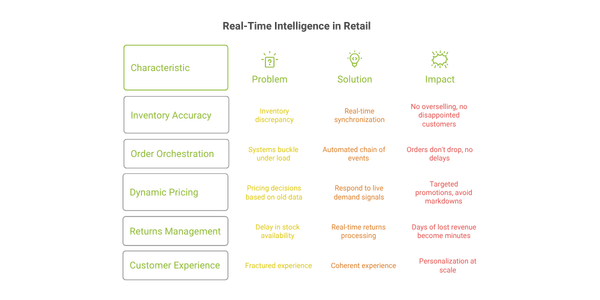
When data flows in real time across the retail operation, the impact isn’t incremental. It’s transformational. Here’s where it shows up most visibly:
Inventory Accuracy Across Every Channel
The single most damaging problem in multi-channel retail is inventory discrepancy. When stock counts are updated on a 15-minute delay let alone overnight, overselling is not a risk. It’s a certainty. Real-time inventory synchronization means the moment a unit sells any channel; every other channel reflects that immediately. No overselling. No disappointed customers. No manual reconciliation at the end of the day.
For fashion and lifestyle brands operating across multiple marketplaces, this is the difference between a scalable multi-channel strategy and a customer service nightmare.
Order Orchestration That Doesn’t Break Under Volume
During peak periods sales events, festival seasons, and product launches; order volumes spike dramatically. Retailers without real-time data orchestration find that their systems buckle under the load. Orders drop; fulfilment delays cascade and customer communications go silent.
Real-time order orchestration means every order, the moment it’s placed, triggers an automated chain of events: inventory reservation, warehouse routing, carrier selection, customer notification. This happens without batch processing, delays, or orders disappearing into the void.
Dynamic Pricing and Promotions That Actually Work
Pricing in retail is increasingly competitive and increasingly dynamic. Competitors adjust prices constantly. Demands shift hour by hour. Promotional windows open and close. Without real-time data, pricing decisions are made on yesterday’s information which in fast-moving categories might as well be ancient history.
Real-time intelligence enables dynamic pricing engines that respond to live demand signals, competitor pricing data, and inventory levels simultaneously. A product that’s running low in stock can be priced automatically. A slow-moving line can trigger a targeted promotion before it becomes a markdown problem.
Returns Management That Doesn’t Hemorrhage Margin
Returns are one of the retail’s most expensive operational realities. But the financial damage isn’t just the cost of the return itself; it’s the delay between a return being initiated and that stock becoming available again for resale. Without real-time visibility into the returns pipeline, items sit in limbo: not available on the website, not in the warehouse available count, generating no revenue.
Real-time returns processing means the moment a return is received and inspected, inventory is updated, and the item re-enters the sellable pool. Days of lost revenue become minutes.
Customer Experience That Feels Effortless
The customer doesn’t see your systems. They see the experience. When data flows in real time, that experience is coherent: accurate stock information, immediate order confirmations, proactive shipping updates, and relevant recommendations based on actual purchase history. When data is delayed or siloed, the experience fractures incorrect stock displays, delayed confirmations, and generic communications that feel like a different brand entirely.
Real-time data is what makes personalization at a scale possible. Not personalization as a marketing concept, but as an operational reality: every touchpoint informed by the same live, consistent view of the customer.
The Architecture Beneath the Experience
Real-time retail intelligence requires getting the architecture right, and that means solving three problems simultaneously.
Integration across a fragmented application landscape
The average retail enterprise runs dozens of applications across its operations. ERP, WMS, OMS, CRM, eCommerce platforms, marketplace connectors, logistics APIs, payment gateways, customer service tools. Getting these to share data in real time, reliably and without data loss, is an integration challenge before it’s anything else. Custom-built connectors are fragile, expensive, and slow to adapt when systems change.
Workflow orchestration that goes beyond simple data transfer
Moving data between systems is the baseline. The real value comes when data movement triggers intelligent actions, automated decisions, conditional workflows, and multi-system processes that execute without human intervention. This is AI workflow orchestration: not just pipes, but intelligence in the pipes.
Visibility and traceability when things go wrong
In complex, automated retail operations, failures happen. A carrier’s API can go down, a marketplace may send a malformed payload, or a product data update may not propagate correctly. Without end-to-end visibility into the data flow, diagnosing these failures is a scavenger hunt. With it, teams can trace any data event back to its origin, identify where it broke, and replay it from the point of failure without losing any data.
The Seller Onboarding Problem: A Hidden Bottleneck
For retailers operating marketplace models where third-party sellers list products on the retailer platform, seller onboarding speed is a direct growth lever. Every week a new seller spends waiting to go live is a week of revenue not earned, on both sides.
Traditionally, onboarding a new marketplace seller requires mapping their product catalog format to the retailer’s systems, setting up data feeds, configuring order routing, and testing the integration end to end. This process, done manually or with bespoke development, can take weeks or months.
Why Retail’s Integration Debt Is a Strategic Crisis
Here is the uncomfortable reality that many retail leaders are beginning to confront: the integration layer that was built over years of incremental technology adoption has become a strategic liability.
Every time a new system was added to a new marketplace connector, a new logistics partner, a new analytics tool, it was integrated individually, often with custom code, by whoever was available at the time. The result, across most large retailers, is a web of brittle point-to-point integrations that nobody fully understands, that break regularly, and that requires specialist knowledge to maintain.
This integration debt has three serious consequences. First, it slows down change. Adding a new channel or system requires months of development work. Second, it creates data inconsistencies. When integrations fail silently, some systems get updated and others don’t, and suddenly nobody’s numbers agree. Third, it limits the business’s ability to adopt AI. AI and automation need clean, consistent, real-time data to function. A fragmented integration layer is the single biggest barrier to AI delivering value in retail operations.
The retailers who are moving fastest right now are the ones who recognized this problem early and invested in a proper integration and orchestration platform rather than continuing to patch the existing web of custom integrations.
Where Aekyam Comes In: Intelligence Woven into the Retail Stack
Aekyam is an enterprise AI orchestration platform purpose-built for the complexity of modern retail operations. It connects the entire retail application landscape, from ERP, WMS, OMS, eCommerce platforms to marketplace APIs, logistics providers, and more into a single, intelligently orchestrated system where data flows in real time and workflows execute automatically.
The platform’s 360-degree data in motion capability means every data payload, every order, every inventory update, every customer event is tracked from source to destination, with full traceability and the ability to reprocess from any point of failure.
Its Gen AI-powered features go further still. Automatic data mapping eliminates the manual labor of connecting new systems. Anomaly detection flags problems in data flows before they become customer-facing failures. Natural language explanations make it possible for non-technical teams like merchandising, operations, and customer service to understand what’s happening in their data without waiting for IT.
The Aekyam Marketplace provides pre-built connectors for the most common retail applications, dramatically cutting the time to integrate a new system from months to days. Aekyam’s deep expertise across retail operations from order orchestration and dynamic pricing to returns management and ATP safety stock management means the platform speaks the language of smart retail operations natively.
As retail moves toward greater automation and AI-driven decision making, Aekyam serves as the orchestration backbone that makes it real, connecting AI agents to live retail data, ensuring they act on accurate information, and maintaining the governance and auditability that enterprise operations demand.
The Retailers Who Win Will Be Those Who Act Now
The window for treating real-time data intelligence as a “future initiative” is closing. The retailers who are building this capability today are doing so not because it’s a nice-to-have, but because customers increasingly have zero tolerance for the failures that fragmented, delayed data creates. An oversold item, a missed fulfillment SLA or a promotion that can’t execute because the systems aren’t talking; these are no longer acceptable as operational edge cases. They are brand-damaging events in a world where alternatives are one swipe away.
The question for retail leaders is not whether to invest in real-time data intelligence. It’s whether to build it piecemeal and expensively, or to do it right with an orchestration platform that was built for exactly this challenge.
Get in touch with the Aekyam team to transform your retail operations.
Share
Read Similar Blogs