


Businesses are drowning in complexity.
Multiple systems. Fragmented teams. Manual handoffs. Data stuck in silos.
The result? Delays, errors, and missed opportunities — at every level, across every industry.
Workflow orchestration changes that.
It connects people, processes, data, and AI agents into a single, coordinated flow. It’s not just automation, but intelligent coordination that adapts, scales, and delivers outcomes in real time.
In this blog, we explore why workflow orchestration has become essential for modern enterprises. We examine the common challenges faced across industries and how workflow orchestration helps address them effectively. Additionally, we highlight key use cases within each industry to illustrate the breadth of what workflow orchestration can enable.
Why has workflow orchestration become the need of the hour
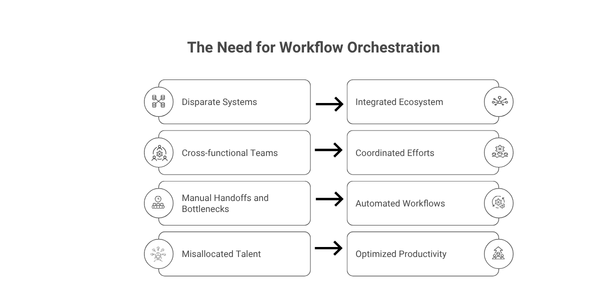
Modern enterprises are no longer running on a handful of tools. They’re managing sprawling digital ecosystems, dozens of applications, cross-functional teams, cloud platforms, legacy systems, and datasets that rarely speak to each other out of the box.
As the scope of services expands, so does the complexity underneath it. Complex integrations, new tools and automation gaps quietly drains productivity in the hundreds of hours spent on manual handoffs, repetitive data entry, and process bottlenecks that no single team owns.
This results in a significant portion of an organization’s most capable people spending their time on work that should never have reached them in the first place.
What It Actually Costs to Operate Without Orchestration
The gap between organizations that have embraced workflow orchestration and those that haven’t is no longer subtle. It shows up in speed, accuracy, visibility, and ultimately, competitive advantage.
| Dimension | Without workflow orchestration | With workflow orchestration |
|---|---|---|
| Speed | Slow; stalled by manual errors and process bottlenecks | Fast; automated, end-to-end seamless flow |
| Visibility | Low; fragmented data, difficult to track or audit | High; real-time dashboards with full operational clarity |
| Errors | High; over-reliance on human intervention at every step | Low; standardised, validated, and consistently reliable data |
| Scalability | Limited; growth creates more complexity, not less | Flexible; infrastructure that scales as the business scales |
| Systems | Siloed; disconnected tools working against each other | Integrated; a unified ecosystem where everything talks |
Having established both the urgency and the cost of operating without orchestration, now, let’s look at how workflow orchestration can be leveraged for major industries through use cases.
Workflow Orchestration Across Industries
- Retail & E-Commerce
Retail and ecommerce industry is moving fast.
With a good number of applications, tools and processes to keep track of, retail and e-commerce industry never slows down. Consumer expectations shift overnight. A trend on social media can spike demand within hours. A competitor’s price drop can reshape a market by morning. And through it all, operations must keep running seamlessly without a missed step.
Workflow orchestration matches this pace. From order management, inventory tracking, returns, logistics, supplier deals and refunds, it brings consistency across all operations to ensure that the product or service meets its final destination.
Some key use cases where workflow orchestration drives value in retail and e-commerce include:
- Order management — With workflow orchestration, orders are automatically routed from placement to fulfilment, across warehouses, carriers, and systems, without major manual effort.
- Inventory sync — Workflow orchestration ensures real-time updates across online, in-store, and third-party channels without overselling and stockouts.
- Returns processing — Reverse logistics from customer request to refund is automated with workflow orchestration.
- Personalised promotions — Workflow orchestration can trigger personalized offers based on browsing behaviour, cart status, and purchase history.
- Supplier coordination — Workflow orchestration auto-generates purchase orders when stock falls below threshold.
The result? Faster fulfilment. Fewer manual errors. Happier customers.
- Fashion & Apparel
Fashion’s biggest enemy is slow response time. Trends don’t wait, and neither do customers. One missed trend, a delay in production, late delivery or even understocking, all of this could very prominently hamper a brand’s reputation and make customer turn away forever. But having operations orchestrated and automated, can change the scene.
Here are a few specific use cases for the fashion and apparel industry where workflow orchestration can help:
- Design-to-production pipelines — Workflow orchestration orchestrates workflows from sketch approval to tech pack creation to vendor assignment.
- Demand forecasting automation — Workflow orchestration can connect trend signals, sales data, and inventory to predict what sells before it sells out.
- Vendor communication — Workflow orchestration can auto-route purchase orders, approvals, and status updates across global supplier networks.
- PLM integrations — Workflow orchestration can bridge legacy product lifecycle tools with modern AI and analytics platforms.
- Sustainability tracking — Workflow orchestration can automate data collection across supply chain tiers to meet ESG reporting requirements.
The result? Reduced overstock. Faster time-to-market. Sustainable, data-driven decisions.
- Healthcare & Life Sciences
In healthcare, delays cost more than money. They cost lives. But healthcare is also a fast paced and a demanding industry. Most healthcare organizations manage a high volume of patients to care for, with a number of processes running simultaneously. Relying on humans to oversee every process manually can be time consuming, and also lead to errors.
Below listed are a few specific use cases where workflow orchestration can help:
- Patient onboarding — Workflow orchestration can automate intake forms, insurance verification, appointment scheduling, and EHR updates in one flow.
- Lab result workflows — Workflow orchestration can route lab results to the right clinician, trigger alerts for abnormal findings, and update patient records automatically.
- Claims processing — Workflow orchestration can orchestrate end-to-end insurance claims — submission, verification, adjudication, and payment.
- Drug supply chain — Tracking pharmaceuticals from manufacturer to pharmacy in real time, flagging exceptions are done automatically with workflow orchestration.
- Clinical trial management — Workflow orchestration can automate data collection, compliance checks, and reporting across trial sites.
The result? Faster care. Reduced administrative burden. Compliance without chaos.
- Banking & Financial Services
Financial institutions operate in an environment where every transaction, decision, and interaction must happen accurately and in real time. From payments processing and loan approvals to fraud detection and compliance checks, these processes are driven by complex, multi-step workflows.
However, these workflows often span multiple systems core banking platforms, payment gateways, risk engines, compliance tools, and customer applications. Without proper coordination, processes become fragmented, manual interventions increase, and delays or errors can impact both operations and customer trust.
This is where workflow orchestration becomes essential.
Here are the following use cases where workflow orchestration can be of help:
- Loan origination — Workflow orchestration can orchestrate the full journey from application to credit check to disbursement.
- KYC & AML compliance — Workflow orchestration automates identity verification, document checks, and regulatory screening workflows.
- Fraud detection — Workflow orchestration connects transaction data, risk models, and alert systems in real time.
- Account opening — Workflow orchestration eliminates manual steps across CRM, core banking, and notification systems
- Reconciliation — Workflow orchestration automates daily financial reconciliation across ledgers, accounts, and entities.
The result? Faster processing. Stronger compliance. Lower operational risk.
- Manufacturing & Supply Chain
Manufacturing is a precision game. From raw material sourcing to final delivery, every process must be executed in the right sequence, with real-time data flowing seamlessly across systems.
Workflow orchestration connects processes end-to-end, eliminating manual handoffs and ensuring that operations remain aligned.
Some key use cases under this industry are as follows:
- Production scheduling — Automatically adjust schedules based on machine availability, raw material status, and order priority
- Quality control workflows — Route inspection results, trigger rework processes, and escalate defects automatically
- Supplier onboarding — Streamline vendor qualification, contract execution, and system integration
- Demand-driven procurement — Auto-generate purchase orders based on production forecasts and inventory data
- Maintenance automation — Trigger preventive maintenance workflows based on IoT sensor data
The result? Reduced downtime. Optimised inventory. End-to-end supply chain visibility.
- Logistics & Transportation
Every delay in logistics has a ripple effect. A missed pickup, a delayed shipment, or a breakdown in communication can quickly cascade across the entire network, impacting delivery timelines, costs, and customer satisfaction. In such a dynamic environment, operations depend on tightly coordinated workflows across multiple moving parts.
This is where workflow orchestration becomes necessary.
Some key use cases where workflow orchestration drives value in logistics & transportation include:
- Shipment tracking — Workflow orchestration unifies data from carriers, customs, and warehouses into a single real-time view
- Last-mile delivery — From automated driver assignment, routing, and customer notifications based on live conditions, workflow orchestration ensures seamless last-mile fulfilment.
- Customs & compliance — Workflow orchestration can orchestrate documentation, duty calculations, and regulatory submissions, ensuring customs and compliance processes.
- Proof of delivery — Workflow automation automates POD capture, billing triggers, and exception handling seamlessly.
- Fleet management — With workflow orchestration connecting GPS, maintenance, and scheduling systems for end-to-end fleet coordination is done seamlessly.
The result? On-time delivery. Reduced exceptions. Lower cost per shipment.
- Human Resources
HR teams handle a high volume of repetitive, high-stakes workflows. From recruitment and onboarding to payroll, performance management, and compliance. These processes require accuracy, consistency, and timely execution, which is where workflow orchestration steps in.
Here are a list of key use cases displaying how workflow orchestration can assist HR operations:
- Employee onboarding — Trigger provisioning, training assignments, IT setup, and welcome workflows automatically on hire with workflow orchestration.
- Leave & attendance — Workflow orchestration can orchestrate approvals, payroll updates, and compliance checks in one flow, without manual effort.
- Performance reviews — Workflow orchestration automates review cycle initiation, form distribution, reminder sequences, and scoring, ensuring timely performance reviews.
- Offboarding — Workflow orchestration coordinates access revocation, exit interviews, final settlements, and knowledge transfer for a smooth offboarding process.
- Recruitment workflows — Connect ATS, background checks, offer letters, and onboarding systems seamlessly with workflow orchestration.
The result? Better employee experience. Reduced HR overhead. Nothing falls through the cracks.
- IT & Technology Operations
For tech teams, orchestration isn’t just a tool, it’s the infrastructure. Modern enterprises rely heavily on their IT and operations teams to keep systems running seamlessly, ensuring that applications, data pipelines, and workflows function without interruption. As systems grow more complex and interconnected, even small breakdowns in processes or coordination can have widespread consequences. A delay in one workflow, a failed integration, or a missed dependency can quickly cascade into larger disruptions. To avoid this, workflow orchestration is required.
Let’s look at the key use cases below to understand how workflow orchestration can help the IT & Operations team.
- Incident management — Auto-detect issues, trigger alerts, assign tickets, and escalate based on severity
- CI/CD pipelines — Orchestrate code commits, testing, approvals, and deployments across environments
- Infrastructure provisioning — Automate cloud resource spin-up, configuration, and teardown on demand
- Security response — Trigger threat response workflows automatically when anomalies are detected
- SLA monitoring — Continuously track performance metrics and trigger remediation workflows proactively
The result? Faster resolution. Fewer outages. Teams focused on building — not firefighting.
The Common Thread
Different industries. Very different challenges. But the same underlying problem:
Disconnected systems and manual processes are holding businesses back.
Workflow orchestration fixes this at the root. It doesn’t just automate steps; it connects intelligence across every layer of the organisation.
The businesses winning today aren’t the ones with the most tools. They’re the ones where every tool works together.
At Aekyam, workflow orchestration isn’t an add-on. It’s the foundation.
Aekyam is an enterprise AI orchestration platform that unifies applications, data, systems, and AI agents, so every workflow runs in sync with your business goals. Whether you’re a retailer syncing omnichannel inventory, a hospital automating patient journeys, a manufacturer coordinating global supply chains, or a bank, orchestrating compliance workflows, Aekyam is built to handle it.
No waiting. No complexity. Just results.
The question isn’t whether your industry needs workflow orchestration.
The question is: how long can you afford to wait?
Get in touch with our team to know more.
Share
Read Similar Blogs