


Organizations today grapple with expanding technology sprawl that creates data silos and repetitive manual tasks. The demand for automated processes has reached critical levels as businesses seek operational efficiency and competitive advantage.
This guide explores workflow orchestration from foundational concepts to practical implementations. Mastering orchestration workflows has become essential for organizations seeking enhanced productivity and operational excellence. The most agile companies utilize workflow orchestration to close deals and outpace competitors in today’s dynamic digital environment.
What is Workflow Orchestration?
Workflow orchestration involves integrating, coordinating, and managing multiple automated steps across diverse systems to achieve end-to-end execution of complex business workflows. While a workflow represents a series of steps needed to complete a specific process, orchestration extends this concept significantly.
Consider this distinction: workflow automation functions like setting up an alarm clock that performs a single function repeatedly. Workflow orchestration resembles organizing your entire day’s schedule—coordinating multiple activities that adjust dynamically when unexpected events occur.
Workflow automation focuses on automating individual tasks. Orchestration manages the sequence and interaction of these tasks to create a cohesive process. The approach involves intelligently determining task sequences for optimal output rather than simple automation.
Workflow orchestration differs from process orchestration, which takes a more holistic, business-oriented approach across organizational boundaries. Unlike data orchestration that focuses specifically on data movement and transformation, workflow orchestration handles the broader coordination of sequential steps within specific processes.
The value lies in streamlining operations, reducing manual intervention, and transforming complex processes into coordinated workflows that ensure each step happens in the right order. This coordination capability enables organizations to handle sophisticated business processes efficiently while maintaining visibility and control throughout execution.
Why Workflow Orchestration Matters for Business
Businesses today face mounting pressure to accomplish more with fewer resources. Workflow orchestration addresses this challenge through concrete benefits that directly impact organizational performance.
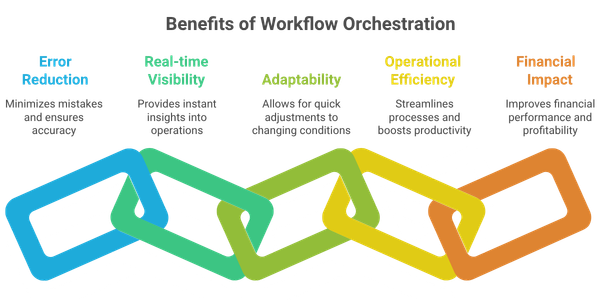
Operational Efficiency: Automating repetitive tasks allows teams to focus on higher-value activities like innovation and relationship building.
Error Reduction: Workflow orchestration reduces human error while ensuring consistency and accuracy. Manual interventions decrease, mistakes naturally diminish, and quality remains consistent across operations.
Real-Time Visibility: Organizations can track workflow performance, identify bottlenecks, and make data-driven decisions. This transparency creates valuable audit trails for compliance and governance requirements.
Adaptability: Companies can adjust processes on demand, integrate new applications without complete system rewrites, and scale seamlessly as teams grow. This flexibility proves essential in unpredictable business environments.
Financial Impact: The monetary benefits prove substantial across industries. Finance companies have used workflow orchestration to streamline burdensome approval and fraud detection processes.
Workflow orchestration serves as a catalyst for digital transformation, enabling businesses to modernize operations without disrupting daily workflows. Organizations implementing these solutions report significant improvements in process efficiency and operational agility.
Real-World Use Cases of Workflow Orchestration
Workflow orchestration demonstrates its value across diverse industry applications.
Software development teams utilize orchestration tools to streamline CI/CD pipelines through automated building, testing, and deployment processes. This automation minimizes human intervention, reduces errors, and accelerates time-to-market for software products.
Big data management represents another critical application area. Organizations handling vast data retrievals and transformations rely on workflow orchestration to manage complex data pipelines, ensuring smooth transitions from collection to storage to analysis. Automated data-handling processes incorporate error handling and retry logic, making large-scale dataset management feasible.
IoT systems benefit significantly from orchestration capabilities. Countless connected devices generate immense data volumes that require coordination. Orchestration coordinates sensor data processing, triggers automated responses, and ensures cohesive device functionality. Smart homes exemplify this application – orchestrated workflows provide the intelligence that transforms interconnected devices into intuitive ecosystems.
Multi-system integration addresses a common enterprise challenge. Workflow orchestration brings together legacy systems, SaaS applications, and modern microservices, enabling efficient communication between them. Enterprises experience fewer data silos, reduced process bottlenecks, and enhanced performance.
Additional applications extend to customer onboarding and supply chain management, where orchestration automates document verification and inventory tracking, ensuring smooth operations throughout business processes.
Orchestrating the Future of Work
Workflow orchestration serves as an essential infrastructure for organizations pursuing competitive advantage in today’s digital environment. This guide has demonstrated how orchestration extends beyond basic automation to intelligently coordinate complex processes across systems and teams.
The business impact reaches well beyond efficiency improvements. Companies implementing orchestration solutions experience enhanced operational accuracy, process transparency, and organizational agility. Quick workflow adaptation enables businesses to respond to market changes without disrupting core operations.
Forward-thinking organizations should prioritize workflow orchestration initiatives. Whether streamlining software development pipelines, managing large datasets, coordinating IoT ecosystems, or integrating enterprise systems, orchestration creates the foundation that unifies fragmented processes into efficient operations.
Successful businesses will execute complex processes with minimal friction while maintaining operational flexibility. Workflow orchestration delivers this balance through structured efficiency combined with adaptable frameworks. Organizations mastering this approach position themselves for competitive advantages as they scale operations and integrate new technologies.
Effective digital transformation requires orchestrating entire processes, not simply automating individual tasks. Organizations that understand this distinction will thrive during technological evolution while delivering superior value to customers and stakeholders.
Aekyam is built for exactly this shift. As an AI-powered orchestration platform, Aekyam goes beyond connecting systems. It actively coordinates workflows, automates decisions through AI agents, and unifies data across cloud, on-premises, and hybrid environments into one intelligent ecosystem.
Aekyam does not just automate tasks; it can orchestrate operations across teams. From supply chain coordination to enterprise integrations, it does it all, with the speed, intelligence, and scalability that modern business demands. The future of work is orchestrated, and Aekyam is the platform that gets you there.
Get in touch with our team to orchestrate your business operations.
Share
Read Similar Blogs