


A staggering 86% of employees point to poor communication and lack of collaboration as the root cause of workplace failures.
The real culprit lurks in plain sight: operational silos. These invisible walls between departments drain businesses each year in lost productivity. Sales teams rarely connect with marketing. IT works in isolation. Production runs on its own schedule. The result is bottlenecks, duplicate work, and a business that can never quite move as one.
The good news is that these walls can come down.
This blog explores strategies to dissolve operational silos, enabling enterprises to achieve agility and seamless collaboration. It highlights how breaking down barriers between departments fosters innovation, improves communication, and accelerates decision-making. Leveraging integrated systems and data-driven approaches, organizations can streamline workflows, enhance productivity, and adapt swiftly to market changes.
Understanding Enterprise Silos
Business silos create major roadblocks in today’s fast-moving digital world. Recent data shows that 75% of companies’ operating models fail to align with their strategy, leaving them too slow and too expensive to compete effectively.
Types of Operational Silos
Organizations typically encounter four common types:
- Information Silos: Where departments restrict data sharing and communication
- Financial Silos: When units hoard resources and budgets
- Vertical Silos: Barriers between different management levels
- Horizontal Silos: Gaps between departments at the same organizational level
Impact on Business Agility
Silos slow decisions and reduce how quickly organizations can respond to change. When functional silos take hold, companies become too rigid to pivot. In fragmented industries like pharmaceuticals, this is especially damaging, the time from idea to action has shrunk dramatically, and siloed thinking simply cannot keep pace.
Root Causes of Silo Formation
Silos rarely appear overnight. Three factors typically drive them:
- Silo mentality starts at leadership level and spreads through the entire organization. Competing agendas at the top create ripple effects throughout the company.
- Departmental egos create an “us versus them” mindset. Teams begin to prioritize their own work above shared goals.
- Physical or organizational distance naturally leads to silos, especially with remote work on the rise. Without the right communication infrastructure, teams drift apart.
Assessing Your Organization’s Silo Status
Research reveals that 83% of companies face negative effects from siloed teams. Before implementing solutions, it’s important to understand where and how silos are forming in your own organization.
Conducting a Silo Assessment
Start with a detailed evaluation of communication patterns and workflows across both vertical and horizontal channels. Statistics show that 55% of companies operate in silos, with each department independently deciding which capabilities matter most — a dynamic that needs to be addressed early.
Key Performance Indicators
These KPIs help measure how silos are affecting your organization:
- Cross-departmental collaboration frequency
- Information sharing effectiveness
- Project completion timelines
- Resource utilization efficiency
- Customer experience consistency
Identifying Critical Pain Points
Watch for these indicators:
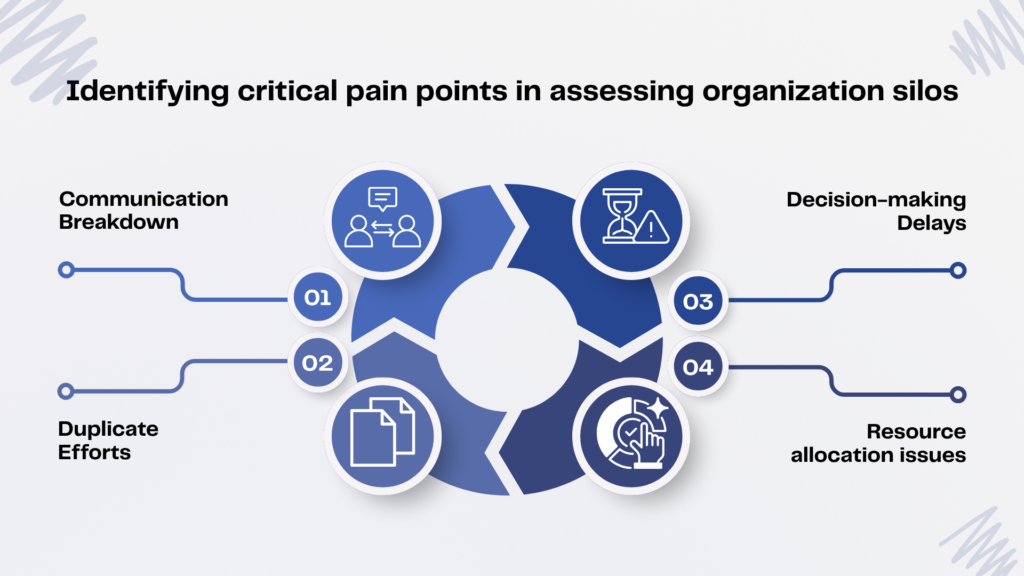
- Communication Breakdown: 61% of leaders report difficulty changing direction due to poor cross-functional alignment.
- Duplicate Efforts: Teams frequently work on similar projects without awareness of each other’s work.
- Decision-Making Delays: 61% of companies cite cross-functional collaboration as the clearest path to strategic goals.
- Resource Allocation Issues: Departments hoard resources or work with conflicting objectives — logistics teams focus on inventory availability while finance prioritizes minimal working capital.
Creating a Silo Dissolution Strategy
Studies show that four out of five companies struggle with cross-functional collaboration. A clear, structured strategy is essential.
Setting Clear Transformation Goals
Successful silo dissolution starts with clear, measurable objectives:
- Increased cross-functional visibility and coordination
- Better information-sharing protocols
- Efficient decision-making processes
- Improved resource utilization
- Strong team collaboration metrics
Developing an Implementation Roadmap
Technology plays a significant role in breaking down silos. Structure your implementation around these steps:
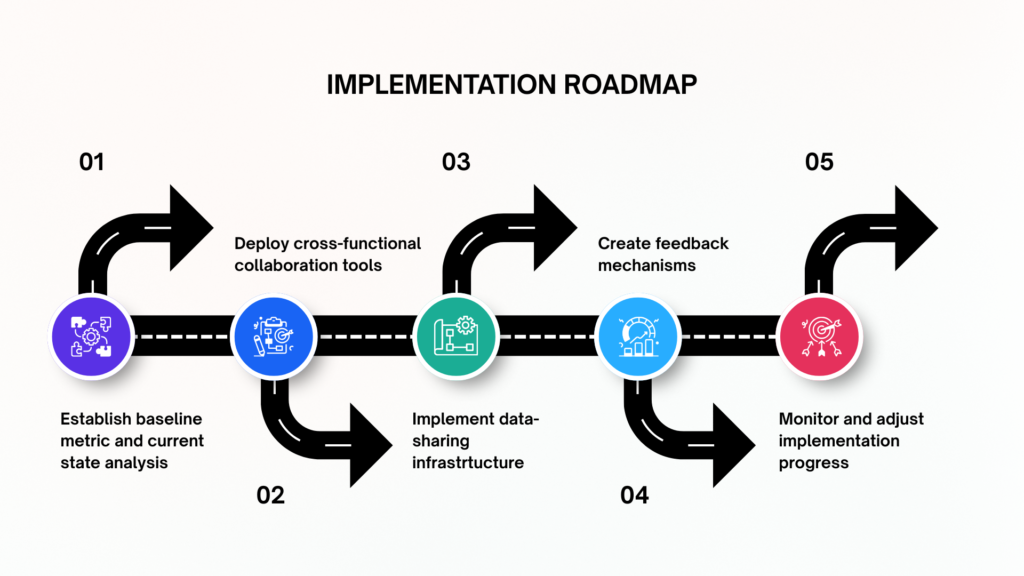
- Establish baseline metrics and current state analysis
- Deploy cross-functional collaboration tools
- Implement data sharing infrastructure
- Create feedback mechanisms
- Monitor and adjust implementation progress
Resource Allocation Planning
Planning often stays separate from operations, creating its own silo. Cloud-based solutions that factor in supply plans, warehousing, and transportation costs can help address this. Effective resource allocation means matching team availability, skill sets, budget constraints, and timeline requirements and doing so transparently across the organization.
Implementing Cross-Functional Teams
Cross-functional teams are one of the most effective tools for breaking down silos but 75% of them fail without proper structure. Getting this right matters.
Team Structure and Composition
The ideal cross-functional team has 4–6 core members, bringing enough variety while staying nimble. Effective teams typically include cultural brokers who can bridge departmental gaps, subject matter experts from critical domains, members with varying experience levels, and representatives from key stakeholder groups.
Roles and Responsibilities
A Stanford study shows 83% of digitally mature companies rely on cross-functional teams. Clear role definition is what makes them work:
| Role | Primary Responsibilities |
|---|---|
| Team Leader | Strategic direction and coordination |
| Cultural Broker | Inter-department communication |
| Subject Matter Experts | Technical guidance and domain expertise |
| Project Coordinators | Day-to-day execution and tracking |
Collaboration Frameworks
Teams work best with the “Three C’s Framework”:
- Communication: Clear channels for information sharing
- Coordination: Regular checkpoints and progress tracking
- Cooperation: A culture that encourages mutual support and shared goals
Teams using this framework achieve 70% higher success rates in eliminating operational silos.
Establishing Unified Communication Channels
US businesses lose around USD 1.2 trillion each year due to miscommunication. Unified communication systems are not a nice-to-have — they are foundational to breaking silos down.
Communication Tools and Platforms
Teams using standardized communication tools see cross-departmental collaboration improve by 70%. A unified system should cover:
| Communication Type | Primary Tool | Purpose |
|---|---|---|
| Real-time Chat | Unified Messaging | Quick team updates |
| Video Conferencing | Integrated Platform | Face-to-face collaboration |
| Document Sharing | Cloud Storage | Resource accessibility |
| Project Updates | Central Dashboard | Progress tracking |
Information Sharing Protocols
About 60% of employees skip work emails because they feel overwhelmed by information. Well-structured sharing protocols help:
- Implement standardized data formats for consistent information exchange
- Establish clear handling designations for sensitive information
- Create automated workflows for routine communications
- Set up secure channels for confidential data sharing
Breaking Communication Barriers
Three strategies consistently help:
- Proactive Communication Planning: Teams share agreements before incidents happen, so everyone understands roles and responsibilities upfront.
- Secure Information Exchange: Protection measures keep sensitive data safe while keeping it accessible to those who need it.
- Automated Workflows: Standardized formats and transport protocols speed up information sharing with less manual effort.
Leveraging Technology Solutions
75% of business executives acknowledge that data silos hamper collaboration and create competitive disadvantages. Technology is the connective tissue that holds an integrated enterprise together.
Collaboration Tools Selection
Knowledge workers dedicate nearly 12 hours weekly to finding data trapped in silos. The right tools prioritize:
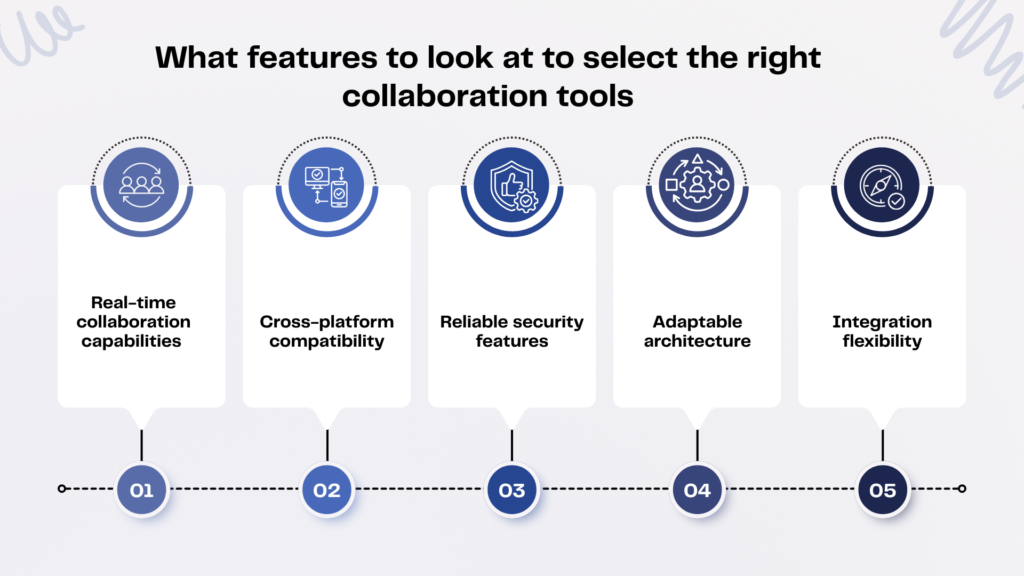
- Real-time collaboration capabilities
- Cross-platform compatibility
- Reliable security features
- Adaptable architecture
- Integration flexibility
Integration Platforms
Integration platforms act as the backbone for eliminating silos. Different approaches serve different needs:
| Integration Type | Best For | Key Benefit |
|---|---|---|
| iPaaS Solutions | Complex Environments | Real-time data sync |
| Data Virtualization | Multi-source Access | Reduced replication |
| Centralized Management | Unified Control | Improved governance |
Data Sharing Infrastructure
A reliable data sharing infrastructure rests on three essentials:
- Data Pipeline Management: Flexible, resilient pipelines ensure steady information flow between departments.
- Security Controls: Perimeter controls at identity and resource levels maintain security without blocking collaboration.
- Cross-Account Access: Secure data sharing between organizational units keeps everyone working from the same source of truth.
Organizations that get this right typically cut data retrieval time by 40% and improve cross-departmental collaboration efficiency by 60%.
Measuring Transformation Progress
Organizations need a systematic approach to measure silo dissolution. Companies that use structured progress tracking see an 18% productivity increase.
Success Metrics and KPIs
| Metric Category | Key Performance Indicators |
|---|---|
| Collaboration | Cross-team project completion rates |
| Communication | Information sharing frequency |
| Efficiency | Resource utilization rates |
| Integration | System connectivity metrics |
Performance Analytics
Look at performance analytics through three perspectives:
- Data Integration Analysis: Track how departments share and use data. Improved cross-departmental data access can save organizations up to 350 hours yearly.
- Collaboration Metrics: Measure the frequency and quality of cross-functional interactions. High employee participation correlates with 23% higher profitability.
- Resource Optimization: Monitor resource sharing patterns. Breaking down silos can reduce duplicate work by up to 40%.
Companies using effective progress tracking systems see their earnings per share improve by 147% compared to those without structured measurement approaches.
Maintaining Long-Term Success
Breaking silos is not a one-time project. Organizations that apply continuous improvement practices are 70% more likely to hold onto their transformation gains over time.
Continuous Improvement Practices
Companies with active continuous improvement programs are three times more likely to sustain cross-functional collaboration. What drives this:
- Leadership’s dedication to organizational growth
- Active strategic planning and execution
- Regular measurement of key metrics
- Continuous feedback loops
- Cross-functional training programs
Adaptation Strategies
Successful organizations evolve continuously to prevent silos from re-forming. Three core strategies help:
- Dynamic Team Structure: Regular rotation of team members across functions maintains fresh perspectives and prevents new silos from settling in.
- Flexible Communication Frameworks: Protocols adapt based on changing business needs and team feedback.
- Responsive Resource Allocation: Resource distribution adjusts in real time based on performance data and emerging priorities.
The “Triple-A Approach” ties it all together: Alignment of goals, Adaptability in processes, and Accountability in outcomes. Organizations using this method have reduced operational silos by 45% while improving cross-functional efficiency by 60%
Conclusion
Breaking down operational silos requires dedication, strategic planning, and consistent execution. But the returns are real: organizations that succeed see a 40% reduction in duplicate work, 60% improvement in cross-functional efficiency, and stronger, faster decision-making across the board.
The path forward is clear. Assess where your silos are, implement cross-functional teams with the right structure, unify your communication channels, and let technology do the heavy lifting on data integration. Track progress through defined KPIs and keep improving.
Where Aekyam Comes In
For supply chain and enterprise organizations, operational silos often run deepest at the system level where order management, warehouse operations, and logistics platforms operate independently, creating the very fragmentation that holds the business back.
Aekyam, an enterprise AI orchestration platform, is built specifically to solve this. It doesn’t just connect systems it unifies apps, data, and AI agents into a single coordinated ecosystem, so workflows stop living in isolation and start working as one.
With pre-built integrations, a low-code visual editor, and AI-powered automation built in from the ground up, Aekyam gives enterprises the connective layer they need to move from siloed to synchronized. Aekyam offers real-time payload visibility, end-to-end data traceability, and built-in anomaly detection mean that once your systems are unified, they stay that way.
The result isn’t just better integration. It’s an operation that can actually move as one, adapting in real time, making faster decisions, and scaling without the friction that silos create.
If your organization is ready to move from fragmented to unified, get in touch with our team of experts, and they will guide you through it.
Share
Read Similar Blogs