

What Is AI Agent Orchestration?
AI agent orchestration is the practice of coordinating multiple AI agents, each designed to perform specific tasks so they work together as a unified system rather than as disconnected tools.
AI agents are built to execute tasks autonomously, while orchestration is what coordinates those agents so their individual actions add up to something coherent.
Think of it like an orchestra conductor. Each musician (agent) is skilled at playing their own instrument, but without a conductor coordinating timing, sequence, and hand-offs, you’d just get noise. Orchestration is the conductor: it decides which agent acts when, passes context and data between agents, resolves conflicts, and ensures the final output is coherent and aligned with business goals.
In practical terms, orchestration involves:
- Task routing — sending requests to the right agent based on the type of work involved
- Context sharing — making sure agents have the data and history they need to act intelligently
- Sequencing and dependencies — running agents in the correct order when one task depends on another
- Monitoring and error handling — detecting failures, retries, or bottlenecks in real time
- Human-in-the-loop checkpoints — pausing for approval on high-stakes decisions when needed
Why AI Agent Orchestration Matters Now
AI agent orchestration is quickly becoming the foundation of modern enterprise automation. It’s the difference between having a collection of isolated AI tools and having a coordinated, intelligent system that actually runs your business processes end to end.
A few years ago, most “AI in the enterprise” conversations centered on single purpose chatbots or point automations. That changed fast. Businesses are now deploying dozens of AI agents across departments, sales, supply chain, finance, customer support and quickly discovering a new problem: agent sprawl.
Without orchestration, you end up with:
- Agents that duplicate work or contradict each other
- No shared context, so agents “forget” what other agents already did
- Manual stitching between AI outputs and downstream systems
- Difficulty tracking accountability when something goes wrong
AI agent orchestration solves this by creating a governance and coordination layer above individual agents. Instead of many smart parts working in isolation, you get one smart system.
Key Benefits of AI Agent Orchestration
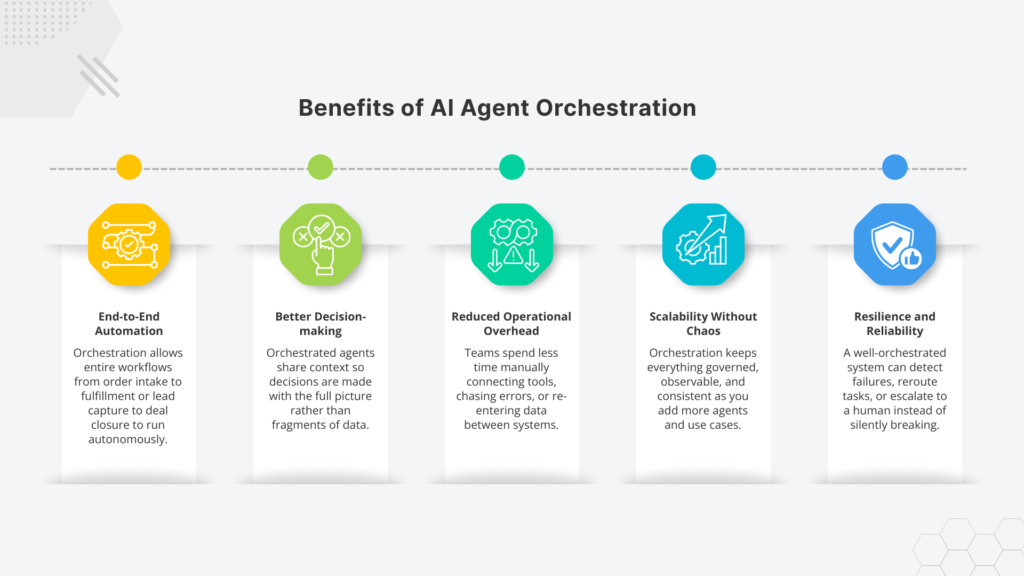
- Faster, End-to-End Automation
Instead of automating isolated steps, orchestration allows entire workflows from order intake to fulfillment, or from lead capture to deal closure to run autonomously across systems and agents.
- Better Decision-Making
Orchestrated agents share context, meaning decisions are made with the full picture rather than fragments of data.
- Reduced Operational Overhead
Teams spend less time manually connecting tools, chasing errors, or re-entering data between systems.
- Scalability Without Chaos
As you add more agents and use cases, orchestration keeps everything governed, observable, and consistent instead of turning into an unmanageable web of scripts and APIs.
- Resilience and Reliability
In non-orchestrated systems, failures often stay hidden until they become expensive. Orchestration exists to catch these before they compound. A well-orchestrated system can detect failures, reroute tasks, or escalate to a human, rather than silently breaking a process.
How AI Agent Orchestration Works: A Simplified View
- A trigger occurs — a new customer order, a support ticket, a data update.
- The orchestration layer evaluates the request and determines which agent(s) should handle it.
- Agents are activated (or “spun up” if inactive), each performing their specialized task — data extraction, classification, decision-making, or system updates.
- Outputs are synthesized — the orchestration layer merges, validates, or ranks results from multiple agents into one coherent action or response.
- The workflow continues or completes, with logging and traceability at every step for auditing and improvement.
This loop can happen in milliseconds for simple tasks or unfold across several steps and systems for complex, multi-agent workflows.
Common Challenges in AI Agent Orchestration
- Integration complexity — agents often need to talk to ERPs, CRMs, data warehouses, and legacy systems that weren’t built for AI
- Governance and control — knowing which agent did what, and why, is critical for compliance and trust
- Latency and cost management — coordinating multiple agents shouldn’t slow down the process or blow-up compute costs
- Security — agents acting autonomously need strict permission boundaries to avoid unintended actions
These challenges are exactly why purpose-built orchestration platforms, rather than custom-built glue code that are becoming the preferred approach for enterprises scaling their AI initiatives.
What to Look for in an AI Agent Orchestration Platform
If you’re evaluating solutions, prioritize platforms that offer:
- Low-code/no-code workflow building, so business teams aren’t fully dependent on developers
- Pre-built connectors to common enterprise systems (ERP, CRM, eCommerce, HR, finance)
- Real-time visibility and traceability into every agent action and data payload
- Scalability to handle volume spikes without data loss
- Flexible deployment — cloud, hybrid, or on-premise, depending on your infrastructure
Building Orchestration for the Enterprise
AI agents are only as powerful as the coordination layer behind them. Deploying agents in isolation might solve narrow problems, but it’s orchestration that turns individual agents into a connected, decision-driven system capable of running real enterprise workflows end to end.
As more organizations scale their AI initiatives, the winners won’t be the ones with the most agents, they’ll be the ones who orchestrate them best: with shared context, clear governance, reliable integrations, and the ability to scale without adding chaos. Getting orchestration right now sets the foundation for a genuinely autonomous enterprise later.
Orchestration Platforms like Aekyam are built precisely for this shift, giving enterprises a single, intelligent layer to unify agents, systems, and data, so automation scales with control, not complexity.
Aekyam unifies applications, data, systems, and AI agents into a single, intelligent ecosystem moving businesses away from fragmented, manually stitched automations toward autonomous, decision-driven workflows. Instead of just connecting systems the way traditional integration tools do, Aekyam orchestrates end-to-end processes with AI-powered automation, enabling context-aware decisions and smart outcomes at enterprise scale.
Request for a demo or get in touch with our team of experts to explore how Aekyam’s AI Orchestration Platform can bring your systems, data, and agents together, get in touch for a demo.
Frequently Asked Questions
1. What is the difference between an AI agent and AI agent orchestration?
The difference between an AI agent and AI agent orchestration is that an AI agent is a single autonomous system designed to perform a specific task, like extracting data or answering queries. Orchestration is the coordination layer that manages how multiple agents work together. The orchestrator dynamically identifies the best-suited agent for each task based on real-time data and workload, then keeps everyone in sync.
2. Is AI agent orchestration the same as workflow automation?
Not quite. Traditional workflow automation follows fixed, rule-based sequences. AI agent orchestration is more dynamic it involves autonomous agents making context-aware decisions, adapting to changing data, and collaborating with each other, not just executing predefined steps.
3. Do I need multiple AI agents to benefit from orchestration?
Orchestration delivers the most value when you have several agents (or plan to scale to several) across different functions. Even with two or three agents, a coordination layer prevents duplicated work, data conflicts, and broken hand-offs.
4. Is AI agent orchestration secure?
Yes, when implemented correctly. A good orchestration platform enforces permission boundaries, logs every agent action, and provides traceability so you always know what an agent did, when, and why which is essential for compliance and audits.
5. Can AI agent orchestration work with legacy systems?
Yes. Most enterprise orchestration platforms, including Aekyam, offer pre-built connectors and hybrid deployment options specifically to bridge modern AI agents with legacy ERPs, CRMs, and on-premise systems.
6. How long does it take to implement AI agent orchestration?
Timelines vary based on the number of systems and agents involved, but low-code/no-code platforms significantly shorten implementation time compared to custom-built integrations, since business teams can configure much of the workflow themselves.
7. What industries benefit most from AI agent orchestration?
Industries with complex, multi-system operations retail, manufacturing, automobile, pharma, healthcare, and travel/hospitality see some of the biggest gains, particularly in areas like order management, supply chain, and customer experience.
8. Does orchestration replace human decision-making?
No. Well-designed orchestration includes human-in-the-loop checkpoints for high-stakes or ambiguous decisions, so humans stay in control of critical outcomes while agents handle repetitive, well-defined tasks.
Share
Read Similar Blogs