


Introduction
Every enterprise runs on dozens, sometimes hundreds, of applications that were never built to talk to each other. Your ERP doesn’t know your e-commerce platform exists. Your CRM has no idea what’s happening in your warehouse management system. Someone has to bridge that gap, and for years, that someone was an engineer writing custom scripts.
That approach doesn’t scale. Every one-off connection becomes tech debt: undocumented, brittle, and dependent on whoever wrote it. As the number of systems grows, so does the maintenance burden, until integration work quietly becomes one of the largest line items in IT.
An API integration platform exists to fix this. This blog covers what one actually is, how it differs from the middleware you might already have, why AI is changing what these platforms can do, how to evaluate one, and where the value shows up first. Along the way, it will also explore deeper guides on evaluation criteria, AI agents, industry use cases, and security so you can go as deep as you need on any single topic.
What Is an API Integration Platform?
An API integration platform is a managed layer of software that connects applications, databases, and AI agents through their APIs, letting you automate data exchange and business processes without hand-coding every connection. It replaces custom point-to-point scripts with reusable, monitored, and governed integrations that your whole team can see and maintain.
Think of it like a translator working a busy conference room. Instead of every pair of delegates learning each other’s language, everyone speaks through the translator, who handles the nuance, catches misunderstandings, and keeps a record of what was said. Your applications don’t need to understand each other directly. The platform does that work.
How It Differs From Basic Automation Tools
Basic automation tools connect two apps for a single trigger-action workflow: a form submission creates a record, a new row sends an email. This kind of platform operates at a different scale. It manages authentication across dozens of systems, handles retries and rate limits, transforms complex data structures, and gives you visibility into every transaction, and not just the ones that fail.
Core Components of an API Integration Platform
Every capable platform is built from a handful of core parts, regardless of vendor or industry focus.
Connectors and a Reusable Marketplace
Pre-built connectors handle the authentication and data structure quirks of common applications, so your team doesn’t rebuild that logic from scratch for every project. A strong integration marketplace with reusable adapters is often the difference between a project that takes days and one that takes months.
Workflow and Orchestration Engine
This is the logic layer: the sequence of steps, conditional branches, and error handling that turns a raw connection into an actual business process. Orchestration is what separates “the systems can talk” from “the process runs itself.”
Data Mapping and Transformation
Systems rarely use the same field names, formats, or structures. The platform needs to translate between them reliably, including handling edge cases like missing fields or unexpected data types without breaking the whole workflow.
Monitoring, Logging, and Observability
When something fails at 2 a.m., you need to know which record failed, why, and how to fix it without digging through raw logs. Request-level visibility per connection is table stakes for any platform running production workloads.
Picture an order that fails to sync between your e-commerce platform and your fulfillment system. Without observability, someone finds out when a customer calls asking where their package is. With it, the platform flags the specific record, shows the exact error. In AI-assisted platforms, it suggests the likely fix before a human even opens a ticket.
API Integration Platform vs. Middleware and ESBs
Legacy middleware and enterprise service buses (ESBs) technically do the same job: connecting systems. However, they were built for a different era of software, with on-premises deployment, custom adapters, and manual data transforms as the default. Modern platforms in this category are cloud-native, ship with reusable connector catalogs, and increasingly use AI to accelerate mapping and troubleshooting.
The practical differences show up in deployment time, maintenance overhead, and how much specialized skill each connection requires.
Why AI Is Changing What These Platforms Do
The integration layer is becoming the control point for AI agents, not just application data. As agents move from answering questions to taking actions like, processing a refund, updating a shipment, reserving inventory, they need the same authentication, rate limiting, and audit trail that human-triggered integrations have always required, plus new safeguards for autonomous decision-making.
This shift is already showing up in the numbers: Gartner’s forecast of 80%+ GenAI API adoption by 2026 means most enterprises will need an integration layer that can safely expose data and actions to AI agents. Platforms with generative AI–powered integration built in are positioned to handle this without a separate AI integration project.
How to Choose an API Integration Platform
Feature checklists are a poor way to compare platforms, because most vendors check the same boxes on paper. What actually separates platforms in production is control over integration logic, the depth (not just count) of the connector catalog, how completely they handle authentication, reliability under load, observability, deployment and compliance options, security posture, pricing that holds up at scale, AI-agent readiness, and how easy it is to leave if you need to.
API Integration Platform Use Cases by Industry
The value this technology delivers looks different depending on your industry.
Retailers use it to unify e-commerce, POS, and fulfillment data for real omnichannel operations.
Healthcare organizations use it to meet interoperability mandates and give patients API-based access to their own records.
Manufacturers use it to connect shop-floor systems with ERP for real-time monitoring.
Financial services firms treat APIs as a top strategic priority, not a back-office utility.
Security and Governance Considerations
More integrations mean more surface area for something to go wrong: an exposed credential, an undocumented API, an AI agent with more access than it needs. Governance isn’t a one-time setup step; it’s an ongoing discipline that has to scale alongside your integration footprint.
The Practical Benefits of an API Integration Platform
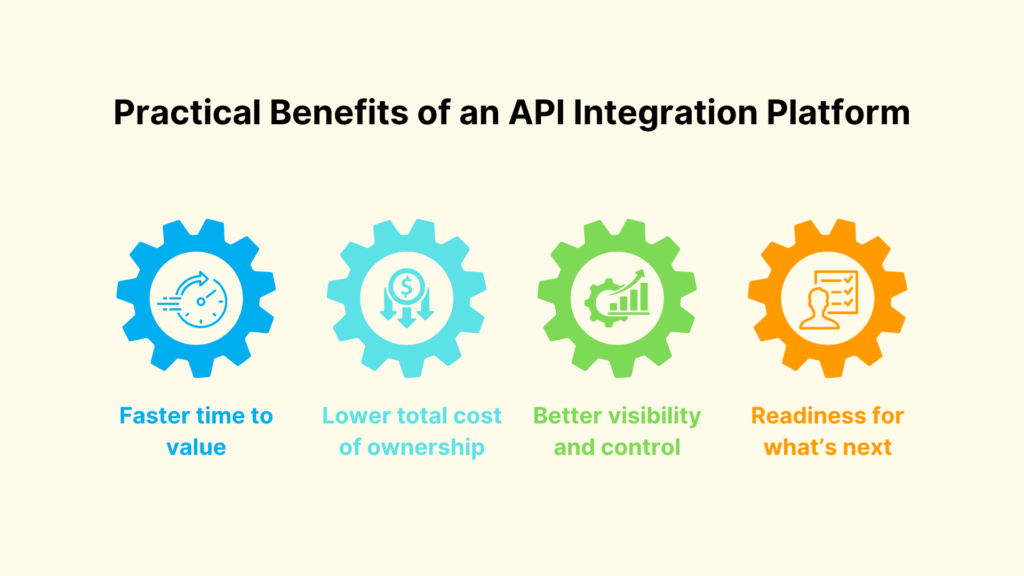
Beyond the technical capabilities, the reasons organizations actually invest in one tend to fall into four categories.
Faster time to value. Reusable connectors and AI-assisted mapping turn integration projects that used to take months into projects measured in days or weeks, which means new applications and data sources start delivering value almost immediately after adoption.
Lower total cost of ownership. Custom point-to-point code requires ongoing maintenance from whoever wrote it. A managed platform shifts that burden to reusable, vendor-maintained connectors, freeing your engineers to work on things that differentiate your business instead of re-solving the same authentication problem for the tenth time.
Better visibility and control. Centralized monitoring means your team can see every integration’s health in one place, instead of piecing together what’s happening from application logs scattered across a dozen systems.
Readiness for what’s next. Whether that’s a new SaaS acquisition, an AI agent that needs to take action on your data, or a compliance requirement that shows up with six months’ notice, a well-architected integration layer absorbs new demands instead of requiring a redesign every time something changes.
API Integration Platform vs. Traditional Middleware: Quick Comparison
| Factor | Traditional Middleware / ESB | Modern API Integration Platform |
|---|---|---|
| Deployment | On-premises, custom setup | Cloud-native, days not months |
| Connector reuse | Custom adapters per system | Reusable connector marketplace |
| Data mapping | Manual XML/XSLT transforms | AI-assisted mapping and error handling |
| Maintenance model | Centralized IT team, high skill barrier | Distributed ownership, lower skill barrier |
| AI-agent support | Not designed for it | Built-in authorization and observability for agents |
| Typical use | Large, static enterprise systems | Fast-changing SaaS and hybrid environments |
Where to Go From Here: Building Your Integration Roadmap
An API integration platform isn’t just a technical upgrade; it’s the infrastructure that decides how fast your organization can adopt new applications, new data sources, and now, new AI agents. The platforms winning today combine reusable connectors, strong governance, and generative AI to cut the time between “we need this integration” and “it’s live in production.”
Aekyam’s AI-powered orchestration platform brings all of this together in one place: reusable connectors, workflow orchestration, and generative AI that accelerates integration development instead of adding another tool to manage. If you’re evaluating your options, start with the criteria in our evaluation framework, then see how your top use cases map to what’s possible today.
Ready to see it in action? Request an Aekyam demo or explore pricing to find the right fit for your team.
Frequently Asked Questions
Is an API Integration Platform the Same as an iPaaS?
Not exactly, though the terms overlap heavily. iPaaS (integration platform as a service) describes the delivery model: cloud-hosted, subscription-based, and managed by the vendor. “API integration platform” describes the function: connecting systems through their APIs. Most modern iPaaS products, including Aekyam’s AI workflow orchestration platform, are API integration platforms delivered as a service, which is why the two terms are often used interchangeably.
How much does an API integration platform cost?
Pricing typically depends on the number of connectors, transaction/API call volume, and deployment tier (starter, business, enterprise). Most vendors use tiered subscription pricing rather than flat licensing, with enterprise plans priced on usage volume and support level. Expect a range from a few hundred dollars a month for small-team plans to five- or six-figure annual contracts for high-volume enterprise deployments. Always request a quote based on your actual API call volume, since list prices rarely reflect real-world usage costs.
How long does it take to implement an API integration platform?
A single integration using a pre-built connector can go live in days. A full platform rollout across multiple systems, including data mapping, testing, and governance setup, typically takes 4 to 12 weeks depending on the number of systems, data complexity, and whether custom connectors are needed. This is significantly faster than legacy middleware projects, which often take several months.
Do I need coding skills to use an API integration platform?
No. Most modern platforms offer low-code or no-code interfaces for building workflows, mapping data, and configuring connectors, so business teams can build integrations without engineering support. Coding knowledge is still useful for edge cases, custom connectors, or complex transformation logic, but it isn't a requirement to get started.
Do small businesses need an API integration platform?
Not always. A small business connecting two or three simple apps for basic workflows can often get by with lightweight automation tools. An API integration platform becomes valuable once you're managing multiple systems, need reliable error handling and audit trails, or plan to expose data to AI agents or customer-facing applications, regardless of company size.
How do I migrate from legacy middleware to a modern API integration platform?
Migration typically happens in phases: inventory existing integrations and their dependencies, prioritize migrating the highest-maintenance or highest-risk connections first, run the new platform in parallel with the old system to validate outputs, then decommission the legacy middleware connection by connection. Running both systems in parallel during transition reduces the risk of business disruption.
What happens if an integration fails mid-process?
A properly configured platform detects the failure, logs the specific record and error at the point of failure, and can trigger automatic retries or fallback logic before alerting a human. This prevents silent failures, like an order that never syncs to fulfillment, from going unnoticed until a customer complains.
Can AI agents use an API integration platform directly?
Yes. Modern platforms are increasingly built to let AI agents call APIs to take actions, such as processing a refund or updating inventory, using the same authentication, rate-limiting, and audit-logging infrastructure applied to human-triggered workflows, plus additional authorization safeguards for autonomous decision-making.
Share
Read Similar Blogs