


Introduction
Every vendor’s website says the same three things: hundreds of connectors, enterprise-grade security, and easy setup. None of that tells you whether the platform will actually hold up once you’re running real production traffic through it.
This framework is built from what engineering teams actually check when evaluating an API integration platform, not what’s on the pricing page. Ten criteria, in the order that tends to matter most once you get past the demo.
To get a better understanding of what an API Integration Platform is and why it might be necessary for your enterprise, read our complete guide to API Integration Platforms.
Why Evaluation Criteria Matter More Than Feature Lists
A feature list tells you what a platform can technically do. It doesn’t tell you what happens when a webhook silently fails, when your usage grows 10x, or when you need to move off the platform in two years. The questions below are designed to surface exactly those scenarios before you sign a contract, not after.
The 10-Point Framework
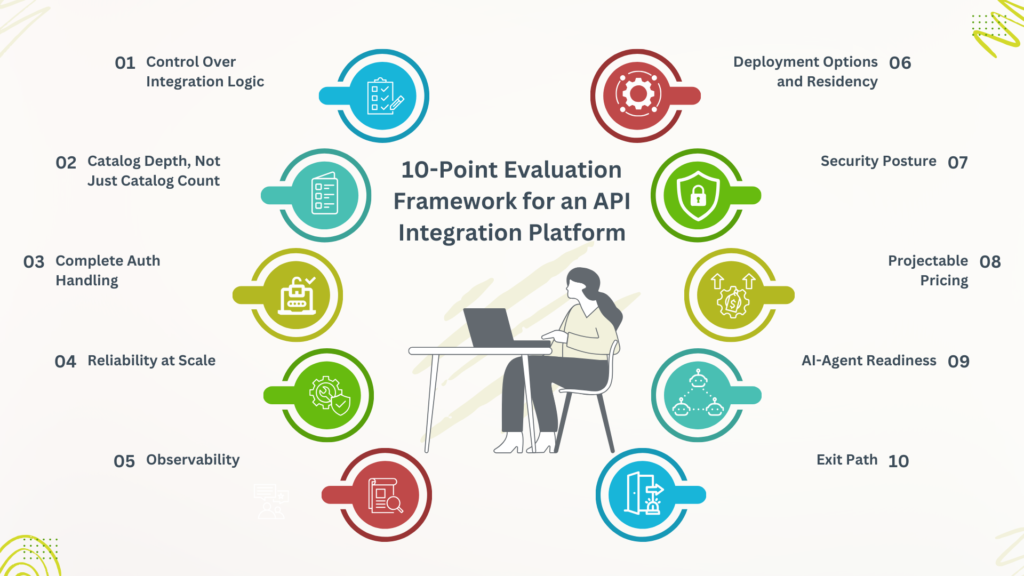
1. Control Over Integration Logic
Ask whether you can edit integration code directly or whether you’re waiting on the vendor’s roadmap for a custom field or endpoint. Standard schemas rarely cover every edge case your business needs, so the ability to modify logic independently matters more than it looks on a demo call.
2. Catalog Depth, Not Just Catalog Count
A platform advertising 500 connectors is a meaningless number if 400 of them only cover the basics. For each connector on your actual roadmap, check endpoint coverage, supported authentication modes, and how quickly the vendor adds support for something you need that isn’t there yet. A marketplace built around reusable, actively maintained connectors is worth more than raw volume.
3. Complete Auth Handling
OAuth implementations vary more than most buyers expect. Ask how the platform manages token lifecycle, whether it detects revoked access before it causes a failure, what the re-authentication experience looks like for end users, and whether it supports non-OAuth schemes like API keys and custom headers.
4. Reliability at Scale
Webhook delivery isn’t always guaranteed, so ask how the platform detects missed events and reconciles data afterward. Check backfill limits, how rate limits are handled per connection, and whether one noisy tenant can degrade performance for everyone else on a shared instance.
5. Observability
Request-level logging, per connection, is non-negotiable for production use. You need searchable payloads, error messages that identify exactly which record failed and why, and the ability to pipe that data into monitoring tools you already use.
6. Deployment Options and Data Residency
For regulated industries, this is often a pass/fail requirement rather than a preference. Healthcare organizations need business associate agreements; teams with EU customers need data handling that meets GDPR requirements. Confirm this early — it’s expensive to discover a disqualifier after months of evaluation.
7. Security Posture
Look at how credentials are encrypted at rest, whether OAuth consent screens are branded in a way that builds customer trust, and how the vendor has handled past security incidents. A platform’s response to a breach tells you more than its marketing claims about security.
8. Projectable Pricing
Model your usage 12–18 months forward at roughly 10x current scale, and check whether the pricing model, per-connection, per-task, or concurrency-based, still makes sense at that volume. A platform that looks affordable today can become the most expensive line item in your stack once you scale. Compare options on Aekyam’s pricing page using this same forward-looking approach.
9. AI-Agent Readiness
Two questions matter here: can AI agents call your integrations as scoped, permissioned tools, and can coding agents build new connectors using the platform’s APIs. This criterion barely existed two years ago; now it’s standard due diligence.
10. Exit Path
Check whether your credentials and integration configurations are portable if you ever need to switch vendors. Platforms with exportable configurations and transparent architecture give you leverage; platforms that lock your logic into a proprietary format don’t.
Who Should Be in the Room
A common mistake is running the entire evaluation through procurement or a single architect, without input from the engineers who will actually build and maintain integrations day to day. Include at least one integration engineer, someone from security or compliance, and whoever owns the budget. Each will surface different failure modes: the engineer catches gaps in criteria 1 through 5, security catches gaps in 6 and 7, and the budget owner stress-tests criterion 8 against real growth projections.
What are some common evaluation mistakes?
Two mistakes show up repeatedly in platform evaluations. The first is over-indexing on the demo environment, which is curated to look flawless, instead of running a proof of concept against a messy, real production use case with genuine edge cases. The second is skipping reference calls with existing customers a five-minute conversation with a team running the platform at your scale often surfaces more than a week of vendor calls.
How Long Should Evaluation Take?
For a mid-sized enterprise, plan on four to eight weeks: enough time to run a proof of concept against two or three of your actual production use cases, not just the vendor’s demo environment. Rushing this step tends to surface the gaps in points 1, 4, and 6 above only after you’ve already committed budget.
Should You Pick the Platform With the Most Connectors?
Not on its own. A large connector count is easy to market and hard to verify in practice. Prioritize catalog depth for the specific systems on your roadmap over raw connector count, a platform with 50 deeply supported connectors that match your stack beats one with 500 shallow ones that don’t.
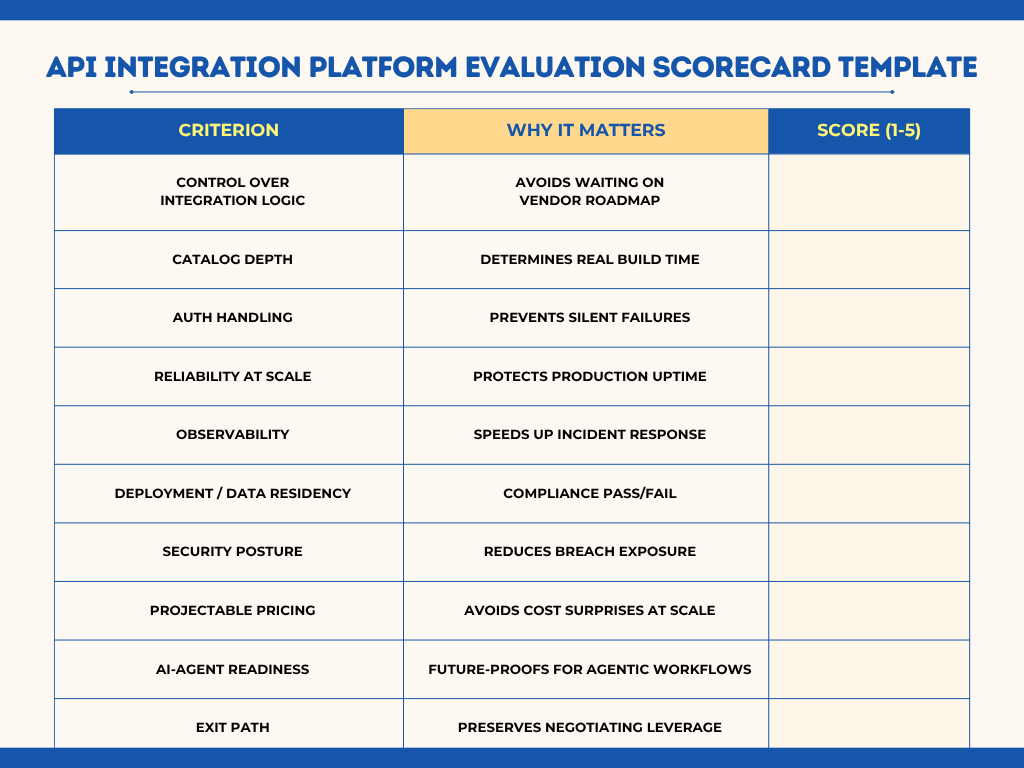
Use the following API Integration Platform Evaluation Scorecard to rate potential vendors on a scale of 1–5 across the most critical evaluation criteria. The higher the score, the better aligned the platform is with your business and integration needs.
Turning the Framework Into a Decision
No platform will score a perfect 5 across all 10 criteria, the goal is knowing which trade-offs you can live with. Weight the criteria against your own roadmap: a team building agentic AI workflows should weight criterion 9 heavily; a healthcare organization should weight criterion 6 just as hard.
Once you’ve scored your shortlist, compare it against how each platform handles your top use cases in practice, And if you’re still deciding whether a modern platform is the right move at all versus what you already run, see API Integration Platform vs. Middleware and ESBs.
This is exactly the kind of evaluation Aekyam is built to hold up under. As an AI-powered workflow orchestration platform, Aekyam is designed to address the gaps this framework is meant to catch, so you can judge that for yourself rather than take our word for it.
If you’re running this evaluation for your own stack, talk to our team or book a demo to see how Aekyam measures up.
Frequently Asked Questions
How do we know if we actually need an API integration platform versus simpler automation tools?
If your integrations involve production data, need audit trails, or require handling failures gracefully, a dedicated platform is worth the investment. Simpler no-code automation tools are fine for internal, low-stakes workflows but tend to break down under real production load.
What should we ask a vendor directly during a sales call that isn't on their website?
Ask how they handle a connector that breaks due to an upstream API change, what their actual incident response time was for the last major outage, and whether you can speak to a customer running at your scale, not just their reference customer of choice.
How much should we budget for implementation on top of the platform's list price?
Beyond subscription costs, budget for engineering time to build and test custom connectors, any professional services the vendor requires for setup, and the internal time needed to run a proper proof of concept before committing.
What's a common reason teams switch platforms after already picking one?
The most frequent trigger is discovering pricing doesn't scale the way it looked at signup, followed closely by hitting a hard limitation, often around custom logic or a connector, that only surfaces once you're deep into production use cases.
How technical does our team need to be to evaluate a platform properly?
You don't need deep integration expertise across the whole team, but at least one person should be able to read API documentation and test edge cases directly, rather than relying entirely on vendor demos and sales claims.
Share
Read Similar Blogs