


Introduction
Retail moves fast. A product sells out in a store, a promotion goes live online, a customer returns an item at the counter. Each of these changes the business in seconds, but in many retail systems the rest of the business finds out hours later.
That gap is where the trouble starts. Many retailers still depend on batch integration, which updates data on a schedule, such as hourly or overnight. The result is customers ordering items that are already gone, prices that differ between the website and the store, and teams making decisions on yesterday’s numbers. Each of these costs money through canceled orders, lost sales, extra support calls, and frustrated shoppers.
The Data Problems Retailers Face Today
Most retail data problems are not caused by a lack of information. They are caused by data that arrives too late, sits in separate systems, or conflicts across channels.
- Data silos across channels
POS, e-commerce, ERP, warehouse management, CRM, loyalty, and marketing systems often maintain separate versions of the same information.
Example: A store sells the last five units of a product, but the website still shows 12 available because the POS updates e-commerce inventory only overnight. Customers continue ordering an item that is no longer available.
- Delayed inventory counts
Batch updates often run hourly, nightly, or after a scheduled sync. In retail, even a short delay can create overselling, canceled orders, stockouts, and avoidable support calls.
Example: During a weekend promotion, online demand rises quickly. By the time the nightly inventory sync identifies the spike, popular sizes are already unavailable in stores.
- Inconsistent pricing and promotions
When pricing rules are managed separately by channel, customers may see one price online and another at the store.
Example: A shopper adds an item to an online cart at a promotional price, visits the store, and is told the offer does not apply in-store. The promotion feels unreliable.
- Fragmented customer profiles
A shopper may exist as three separate records: an email subscriber, an online buyer, and an in-store loyalty member. Without a unified profile, personalization becomes generic and marketing becomes repetitive.
Example: A customer returns an item in-store, but the online support team cannot see the return. The customer must repeat the same information twice.
- Manual reporting
When teams export data from multiple systems and combine it manually, reporting becomes slow and error-prone.
Example: A merchandising team spends Monday morning reconciling weekend sales from three spreadsheets. By the time they identify a fast-selling product, the replenishment window has narrowed.
Real-time data integration closes that gap by keeping every system up to date as things happens. This blog covers the challenges that retailers face without real-time data integration, how it differs from batch integration and the benefits retailers can experience with real-time data integration.
What Is Real-time Data Integration?
Real-time data integration is the continuous connection of retail systems so inventory, orders, prices, customer activity, and fulfillment updates move between channels within seconds. Instead of waiting for a nightly upload, a sale, return, price change, or inventory movement can update connected systems in seconds.
This wasn’t always possible. When retail moved more slowly and technology was less advanced, companies relied on batch integration, which processes data in grouped intervals, such as hourly or overnight.
What is Batch integration and how it is different than Real time data integration?
Batch integration is a process where data is processed in scheduled batches, and not continuously. It is the foundation of modern retail IT architecture and was used widely, until advanced cloud technology and real-time approaches became mainstream.
Now, let’s understand how real-time integration and batch integration are different from each other.
Real-time vs. Batch Integration
Real-time integration updates data continuously. Batch integration updates it at set intervals. Both have a role; the right choice depends on how quickly a decision must be made.
| Factor | Real-time integration | Batch integration |
|---|---|---|
| Latency | Seconds or near-instant updates | Minutes, hours, or once daily |
| Data freshness | Reflects the current state of the business | Reflects the last scheduled sync |
| Best use cases | Inventory availability, order status, fraud alerts, dynamic pricing, BOPIS | Financial reconciliation, payroll, historical reporting, bulk data loads |
| Complexity | Higher initially; requires reliable event flows and monitoring | Lower initially; simpler scheduled jobs |
| Cost profile | May require more upfront investment, but can reduce costly errors and lost sales | Often lower for predictable, low-urgency workloads |
| Customer impact | Enables accurate availability and immediate responses | Can create outdated product, price, or order information |
Batch is still suitable for workloads that do not require immediacy, such as month-end financial reporting or loading large historical datasets. The goal is not to eliminate batch everywhere; it is to use real-time integration where delay creates customer friction, inventory errors, or revenue loss.
Why batch integration falls short
Batch integration worked when retail was slower and channels operated independently. Data was collected, held, and sent on a schedule, and that was good enough.
Today, customers expect accurate availability, consistent pricing, and instant order updates across web, app, store, and delivery. Batch integration can’t reliably support decisions where minutes matter, such as:
- Preventing overselling
- Routing an order to the best fulfillment location
- Detecting suspicious transactions
- Updating a customer after a return
How Does Real-time Data Integration Work?
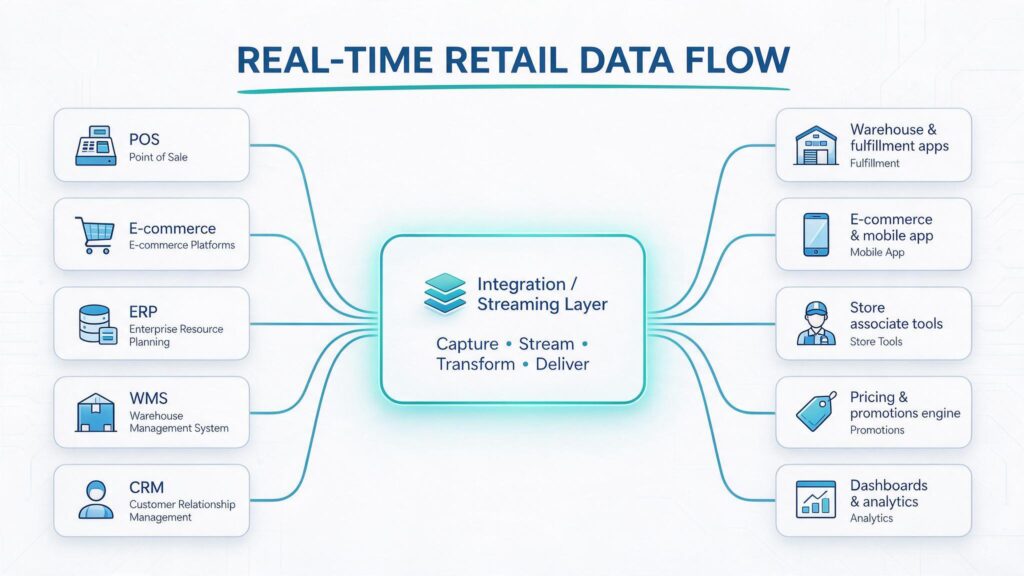
It works in four basic steps:
- Capture: A system records an event, such as a POS sale, online order, warehouse pick, return, or price update.
- Stream: The event is sent through an integration layer instead of waiting for a scheduled batch job.
- Transform: Data is standardized so systems can understand it—for example, product codes, units, currencies, or customer identifiers.
- Deliver: Updated data reaches the systems and people that need it: e-commerce product pages, warehouse apps, store tools, dashboards, and marketing platforms.
The result is a shared, current view of inventory, orders, customers, and pricing across the retail business.
Key Benefits of Real-time Data Integration for Retailers
- Accurate inventory and fewer stockouts or overselling
Real-time integration synchronizes inventory across stores, warehouses, marketplaces, and e-commerce channels as transactions occur. When an item sells in-store, the website, warehouse system, and planning tools can update immediately.
This helps retailers:
- Show reliable “in stock,” “low stock,” or “out of stock” messages.
- Prevent customers from ordering products that are no longer available.
- Trigger replenishment before shelves go empty.
- Route online orders to the store or warehouse best positioned to fulfill them.
Real-time visibility should include on-hand stock, units in transit, units reserved for open orders, and units available for immediate fulfillment.
- Personalization at the moment of intent
When POS, e-commerce, CRM, and loyalty data are connected, retailers can respond to customer intent while it is happening. A shopper browsing winter jackets can receive relevant recommendations, while a loyalty member can receive an offer based on recent purchases rather than an outdated segment.
This makes personalization more relevant and consistent across channels.
- Dynamic pricing and promotions
Real-time data allows pricing and promotion engines to respond to current demand, inventory levels, competitor activity, and channel performance.
Example: If a product is selling faster than forecast and warehouse stock is low, the system can reduce or pause a discount before stock runs out. If a product is overstocked, the system can trigger a targeted markdown or bundle offer.
Pricing rules, approval limits, and audit trails should be built into the integration so automation supports pricing strategy rather than replacing it.
- Fraud detection and loss prevention
Fraud often appears through patterns: unusual order values, rapid repeat purchases, mismatched billing and delivery details, abnormal returns, or suspicious POS activity. Real-time integration allows these signals to be evaluated as transactions occur.
Instead of reviewing fraud after orders have shipped, retailers can flag, hold, or require additional verification for high-risk orders. This reduces chargebacks, return abuse, and inventory shrink.
- Faster, smarter supply chain decisions
Connected data helps supply chain teams see demand signals, stock movements, fulfillment delays, and supplier constraints in one place.
For example, if a product begins selling rapidly across several stores, the system can identify the locations likely to run out first and recommend a stock transfer or replenishment order.
- Better customer experience
Customers judge retail brands by small operational moments: whether an item is available, whether order status is accurate, and whether returns are handled smoothly.
Real-time integration improves:
- BOPIS: Accurate store-level availability before a customer travels to pick up an order.
- Order tracking: Updated status across online, app, store, and delivery systems.
- Returns: Immediate inventory and refund updates, regardless of where the purchase or return happened.
- Store service: Associates can see live stock, customer history, and order details.
What are Some Real-World Retail Use Cases for Real-time Data Imtegration?
Grocery: Preventing empty shelves
Problem: Online availability is updated overnight, so fast-moving grocery items often appear available after they have sold out.
Solution: POS sales, warehouse receipts, and e-commerce inventory are integrated in real time. Low-stock thresholds trigger replenishment alerts.
Result: More accurate online availability, fewer wasted pickup trips, and faster replenishment of high-demand items.
Fashion: Avoiding overselling during launches
Problem: A limited collection launches online, website traffic spikes, and inventory updates lag behind sales.
Solution: E-commerce orders, POS sales, and warehouse reservations stream into one inventory view. The website updates availability as units are sold or reserved.
Result: Fewer canceled orders, better launch performance, and less customer disappointment.
Big-box retail: Smarter fulfillment routing
Problem: Online orders are fulfilled from a central warehouse even when a nearby store has the item in stock, increasing delivery time and cost.
Solution: Real-time order, inventory, and location data determine the best fulfillment point based on stock, distance, labor capacity, and delivery promise.
Result: Faster delivery, lower fulfillment cost, and better use of store inventory.
Marketplace: Consistent seller and customer data
Problem: Seller inventory feeds arrive at different intervals, causing unavailable products to remain listed.
Solution: Seller inventory updates, order events, and product status changes are streamed into a central commerce platform.
Result: Fewer invalid listings, faster seller updates, and a more trustworthy shopping experience.
Common Challenges and How to Overcome Them
| Challenge | Why it matters | How to overcome it |
|---|---|---|
| Legacy systems | Older POS, ERP, or warehouse systems may not provide modern APIs or event streams. | Start with high-value data flows; use APIs, connectors, middleware, or event queues where needed; modernize incrementally. |
| Poor data quality | Duplicate products, inconsistent SKUs, and incomplete customer records undermine integration. | Set data standards, use master data management, validation rules, and clear ownership for product, customer, inventory, and pricing data. |
| Cost concerns | Streaming infrastructure, integration development, and monitoring require investment. | Prioritize use cases with clear ROI, such as inventory accuracy, overselling prevention, BOPIS, and fraud reduction. |
| Skills gaps | Teams may understand retail operations but not APIs, event-driven architecture, or data governance. | Use managed integration platforms, train internal teams, and begin with a limited pilot before scaling. |
| Security and compliance | Retail data often includes payment, personal, and behavioral information. | Encrypt data in transit and at rest, restrict access by role, log activity, and align controls with PCI DSS, GDPR/CCPA, and India’s DPDP Act where applicable. |
Security should be designed into the integration layer from the start, not added after go-live.
How to Know If Your Business Needs Real-time Data Integration
Your business may need a real-time data integration tool if delays between systems are already affecting sales, operations, or customer experience.
Key signs your business needs a real-time data integration tool:
- Your teams constantly work with outdated data. Sales, inventory, or customer reports are accurate only after a manual export or overnight sync.
- Your systems do not communicate with each other. POS, e-commerce, ERP, WMS, CRM, and marketing tools require repeated manual updates.
- Inventory information is never quite accurate. Customers encounter stockouts, canceled orders, or products listed online that are unavailable in-store.
- Order processing takes longer than it should. Orders sit in queues because warehouse, store, payment, and delivery systems do not update one another quickly.
- Customer-facing information is inconsistent. Prices, promotions, loyalty benefits, delivery estimates, or return statuses differ by channel.
If several of these signs feel familiar, real-time integration is likely the bridge between your current retail systems and the omnichannel experience customers expect.
Ensuring Retail Success With Real-time Data Integration
Real-time data integration helps retailers connect the systems customers and employees rely on every day. The three biggest takeaways are:
- Accuracy drives revenue: Live inventory and order data reduce overselling, stockouts, and canceled orders.
- Speed improves experience: Customers receive reliable availability, order updates, BOPIS, returns, and personalized offers.
- Connected data enables better decisions: Pricing, replenishment, fraud prevention, and fulfillment become proactive rather than reactive.
Retailers do not need to connect every system at once. Start with the data flow that creates the most customer friction—usually inventory and orders—prove the value, then expand to pricing, CRM, supply chain, and analytics.
This is where Aekyam helps. By integrating sources such as POS, e-commerce, ERP, WMS, OMS, CRM, and marketplace platforms, Aekyam turns disconnected retail systems into a unified, real-time data foundation. Retailers can sync inventory across channels, process and route orders faster, unify customer profiles, and deliver consistent experiences across online, in-store, and fulfillment operations.
With Aekyam, retailers can reduce stockouts and overselling, enable reliable BOPIS and returns, improve order visibility, and support smarter pricing, replenishment, and supply chain decisions. The approach is practical: start with the highest-impact data flows, integrate them securely, validate data quality, and scale as the business grows.
Ready to ensure retail success with real-time data integration? Book a demo with Aekyam or talk to our team of experts to see how your inventory, orders, channels, and customer data can work together in real time.
Frequently Asked Questions
Do small and mid-sized retailers need real-time integration?
Yes, especially if they sell through more than one channel. A smaller retailer may not need an enterprise-scale platform, but it still benefits from accurate inventory, consistent pricing, and faster order updates. Start with the highest-impact connection, such as POS-to-e-commerce inventory.
What retail systems typically get integrated?
Common systems include POS, e-commerce platforms, ERP, WMS, OMS, CRM, loyalty programs, payment gateways, marketplaces, marketing automation tools, and analytics platforms.
How does real-time data improve inventory accuracy?
When a sale, return, transfer, receipt, or reservation occurs, the change is shared immediately across connected systems. This prevents one channel from selling inventory that another channel has already sold or reserved.
Is real-time data integration expensive?
It can require upfront investment, but costs vary based on the number of systems, data volume, legacy complexity, and whether you use a managed platform. The business case often comes from fewer stockouts, less overselling, lower manual work, and improved conversion.
How long does implementation take?
A focused pilot—such as syncing POS and e-commerce inventory—can often be implemented in weeks. A broader omnichannel integration across ERP, WMS, CRM, marketplaces, and analytics may take several months, depending on system readiness and data quality.
Is real-time integration secure and compliant with privacy regulations?
It can be, when designed with strong controls. Use encryption, role-based access, audit logs, tokenization where appropriate, vendor due diligence, and privacy-by-design practices. Compliance requirements may include PCI DSS for payment data, GDPR/CCPA for applicable personal data, and India’s DPDP Act for businesses within its scope.
Share