


Introduction
If you have worked in enterprise IT for more than a few years, you’ve probably inherited an ESB or a middleware layer that “just works” until it doesn’t. It’s the system nobody wants to touch because the one engineer who understood it left the company three years ago.
When people search for an API integration platform, they’re often trying to figure out whether what they already have counts or whether it’s time to replace it. This blog breaks down the real differences: what each approach is built for, where the line actually falls, and when keeping your existing middleware still makes sense.
What Counts as “Middleware” and an “ESB” Today
Middleware is the broad category: any software layer that sits between applications and handles communication. An enterprise service bus (ESB) is a specific, older architectural pattern, a centralized hub that routes messages between systems, usually deployed on-premises, configured through custom adapters, and maintained by a specialized integration team.
Point-to-Point Integration and Its Limits
Before ESBs, the alternative was point-to-point integration: every system connects directly to every other system it needs to talk to. This works fine for two or three applications. Add a tenth system, and you’re maintaining dozens of individual connections, each one a potential point of failure with no shared visibility.
Where API Integration Platforms Diverge
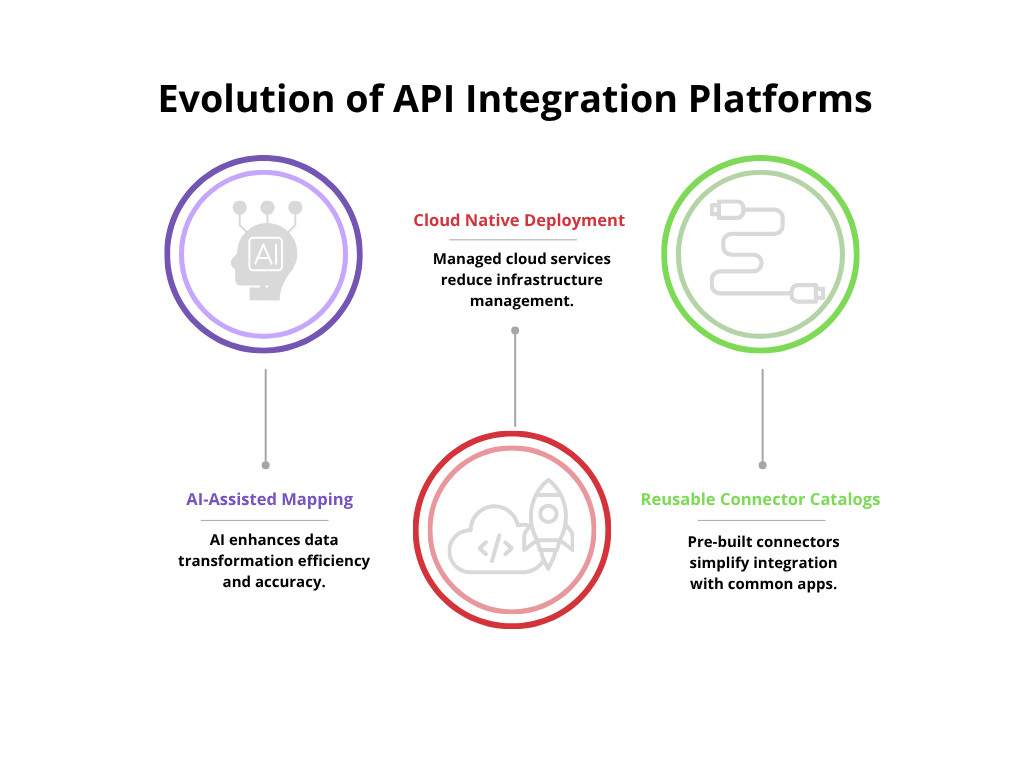
Modern platforms in this category grew out of the same problem ESBs were built to solve, but with a different set of assumptions baked in from day one: cloud-first deployment, SaaS-heavy environments, and the expectation that new integrations get added weekly, not annually.
Cloud-Native Deployment vs. On-Premises ESB
An ESB typically runs on infrastructure you own and patch. A modern platform runs as a managed cloud service, which means new connectors, security patches, and scaling capacity arrive without a change request to your infrastructure team. This alone often cuts integration project timelines from months to weeks.
Reusable Connector Catalogs vs. Custom Adapters
ESBs require a custom adapter for each system, built by someone who understands both the ESB’s framework and the target application’s API. Modern platforms ship with a marketplace of pre-built connectors that already handle authentication, pagination, and rate limits for common applications, so your team configures rather than codes.
AI-Assisted Mapping vs. Manual XML/XSLT Transforms
Classic middleware handles data transformation through hand-written XSLT or custom mapping scripts. They are powerful, but slow to write and painful to debug. Newer platforms use AI to suggest field mappings and flag likely errors before they reach production, which matters more as the number of integrations grows past what any one person can hold in their head.
Migrating Without a Risky Rip-and-Replace
Teams that do decide to move away from an ESB rarely do it all at once, and for good reason: a big-bang cutover risks breaking integrations that the business depends on every day. A more common pattern is the strangler approach: route new integrations through the modern platform from day one, then migrate existing ESB flows one at a time, starting with the ones that are easiest to test and lowest-risk if something goes wrong.
This also gives your team time to build confidence and expertise with the new platform before it’s carrying critical traffic. By the time you migrate the integrations that actually matter most, the process is routine rather than a high-stakes cutover.
When Middleware Still Makes Sense
Middleware earns its keep when you have a small, well-understood set of systems that rarely change, strict on-premises requirements, or deep investment in an existing ESB that’s genuinely stable. If your integration needs are static and your team already has the specialized skills to maintain it, there’s no urgent reason to migrate. The calculation changes fast once you start adding new SaaS tools or want to expose data to AI agents
What a Hybrid Environment Looks Like in Practice
A hybrid setup isn’t two disconnected systems running in parallel forever, it’s a deliberate division of labor. A common pattern: the ESB continues handling a handful of stable, high-compliance flows, such as core financial reconciliation, while the API integration platform owns everything newer, SaaS connections, customer-facing integrations, and any workflow that touches an AI agent. A thin routing layer or shared identity system keeps both sides consistent, so a change in one doesn’t silently break the other.
The key discipline is deciding, in writing, which category new integrations fall into by default, so teams aren’t debating it project by project. Most organizations land on “new integrations go through the modern platform unless there’s a specific compliance reason not to,” which naturally shrinks the ESB’s footprint over time without a forced migration deadline.
What Happens to Institutional Knowledge Locked in an Old ESB?
This is the quiet risk of long-lived middleware: the mapping logic and business rules often exist only in one engineer’s head, or in custom code with no documentation. Before migrating anything, invest time in documenting what each existing integration actually does: inputs, transforms, and edge cases, even if you’re not moving it yet. That documentation is valuable regardless of which platform you end up running it on.
ESB vs. API Integration Platform: Side-by-Side
| Factor | ESB / Legacy Middleware | API Integration Platform |
|---|---|---|
| Deployment | On-premises, IT-managed | Cloud-native, managed service |
| New connector time | Weeks to months (custom build) | Hours to days (pre-built) |
| Data mapping | Manual XML/XSLT | AI-assisted mapping |
| Skill requirement | Specialized integration engineers | Broader team can configure |
| Best fit | Static, high-compliance systems | Fast-changing SaaS and AI workflows |
Choosing the Right Layer for Your Architecture
Neither approach is universally “better”. They are built for different rates of change. If your systems and requirements are stable, a well-run ESB can keep working for years. If you are adding new applications regularly, or planning to expose data to AI agents, a modern API integration platform will save your team far more time than it costs.
Aekyam’s AI workflow orchestration platform is designed to sit comfortably alongside legacy systems while giving you the reusable connectors and AI-assisted mapping that a traditional ESB cannot offer. For the bigger picture on what an API integration platform includes, start with our complete guide.
Talk to our team of experts or request for a demo to understand what’s right for your tech stack.
Frequently Asked Questions
Is an ESB outdated?
Not necessarily outdated, but purpose-built for a narrower use case than they used to cover. ESBs still make sense for small, stable system landscapes with strict on-premises requirements. They become a bottleneck once an organization starts adding new SaaS tools regularly or needs to connect data to AI agents.
Can I keep my ESB and still use an API integration platform?
Yes — this is the most common setup, not the exception. Organizations typically keep the ESB running stable, high-compliance flows like financial reconciliation, while routing new SaaS connections and AI-agent workflows through the API integration platform instead.
How do you migrate from an ESB to an API integration platform without breaking things?
Most teams avoid a full cutover and use a "strangler" approach instead: new integrations go through the modern platform from day one, and existing ESB flows are migrated one at a time, starting with the easiest and lowest-risk ones. This limits the risk of a big-bang cutover breaking something the business depends on.
Do I need to replace my ESB completely?
No. There's no requirement to fully replace an ESB — many organizations run a hybrid setup indefinitely, with a default rule that new integrations go through the modern platform unless there's a specific compliance reason to use the ESB instead.
What's the risk of sticking with an old ESB?
The biggest risk is usually institutional knowledge, not the technology itself — mapping logic and business rules often exist only in one engineer's head or in undocumented custom code. If that person leaves, the integration becomes a black box that's expensive and risky to touch.
Do I need specialized engineers to run an API integration platform, like I do with an ESB?
No — that's one of the main differences. ESBs typically need integration engineers who understand the ESB's framework and each target system's API. API integration platforms are designed so a broader team can configure connectors rather than write custom adapter code.
How long does an ESB-to-platform migration take?
There's no fixed timeline — it depends on how many integrations you have and how business-critical they are. Because most teams migrate incrementally rather than all at once, it's typically measured in a rolling series of smaller migrations rather than a single project deadline.
How much does an API integration platform cost compared to maintaining an ESB?
Pricing varies by vendor and volume, but the cost structure shifts: ESBs carry ongoing infrastructure and specialized-engineer overhead, while API integration platforms move toward a managed-service model with pre-built connectors that cut custom development time. Aekyam's 10-point evaluation framework is built to help walk through this comparison for your specific environment.
What's a good alternative to a traditional ESB?
A modern, cloud-native API integration platform is the most common alternative — it covers the same core job (connecting systems and routing data) but with pre-built connectors, AI-assisted mapping, and a managed-service model instead of custom on-premises infrastructure.
Share
Read Similar Blogs