


In the present rapidly advancing digital world, cloud technology has a cornerstone for modern businesses to stay agile. It helps businesses to stay ahead in the competitive market. As organizations rely on multiple cloud applications for CRM, logistics or sales, the need for integration has grown. Connecting these systems ensure they stay in-sync and work together seamlessly to ensure smooth business operations.
What is Cloud Integration?
To put it simply, cloud integration means connecting several cloud-based applications, services and an on-premises system. This process of integration ensures that systems and applications are synchronized, enhancing operational efficiency.
Initially, cloud technology was all about advancing its storage capabilities and computing power. This version focused on basic data transfers with a limited scope. It was to mainly address the need for simple data movement between system and storage.
With technological evolution, the cloud computing scene advanced. The growing needs of business operations made cloud technology one of the strongest pillars for modern businesses to rely upon. These needs significantly transformed cloud computing paving the way for a more advanced network of cloud technologies.
The Importance of Cloud Integration in Modern Businesses
Cloud Integration emerged as a solution for data silos, which isolated the data from applications and software. This siloed data became a hurdle for syncing data across applications and systems. This was necessary for organizations to function smoothly and enable cross functional collaboration.
The widespread adoption of SaaS applications also led to the rising demand of cloud integration. Organizations use multiple applications for their businesses. Hence, synchronization between them is crucial.
Moreover, at present, businesses are relying on a mix of SaaS applications and on-premise applications. This prompts the need for progressive cloud integration methods.
Types of Enterprise Integration

To understand how cloud integration works, it is also important to understand what are the types of integration that can be achieved through cloud integration:
Cloud-to-Cloud Integration: With cloud-to-cloud integration, you can connect multiple cloud services or applications enabling them to work together. This type of integration is essential for organizations using multiple cloud services and applications.
Cloud-to-on-Premise Integration: Cloud-to-on-Premise integration involves connecting cloud-based services with the on-premise system or services. This is crucial for organizations that operate in hybrid environments, and use a mix of cloud and on-prem services and applications.
Hybrid Cloud Integration: Combining the Best of Both Worlds- Refers to integrating applications and services from different cloud environments (usually a public cloud) with an on-premise cloud service.
Key Benefits of Cloud Integration
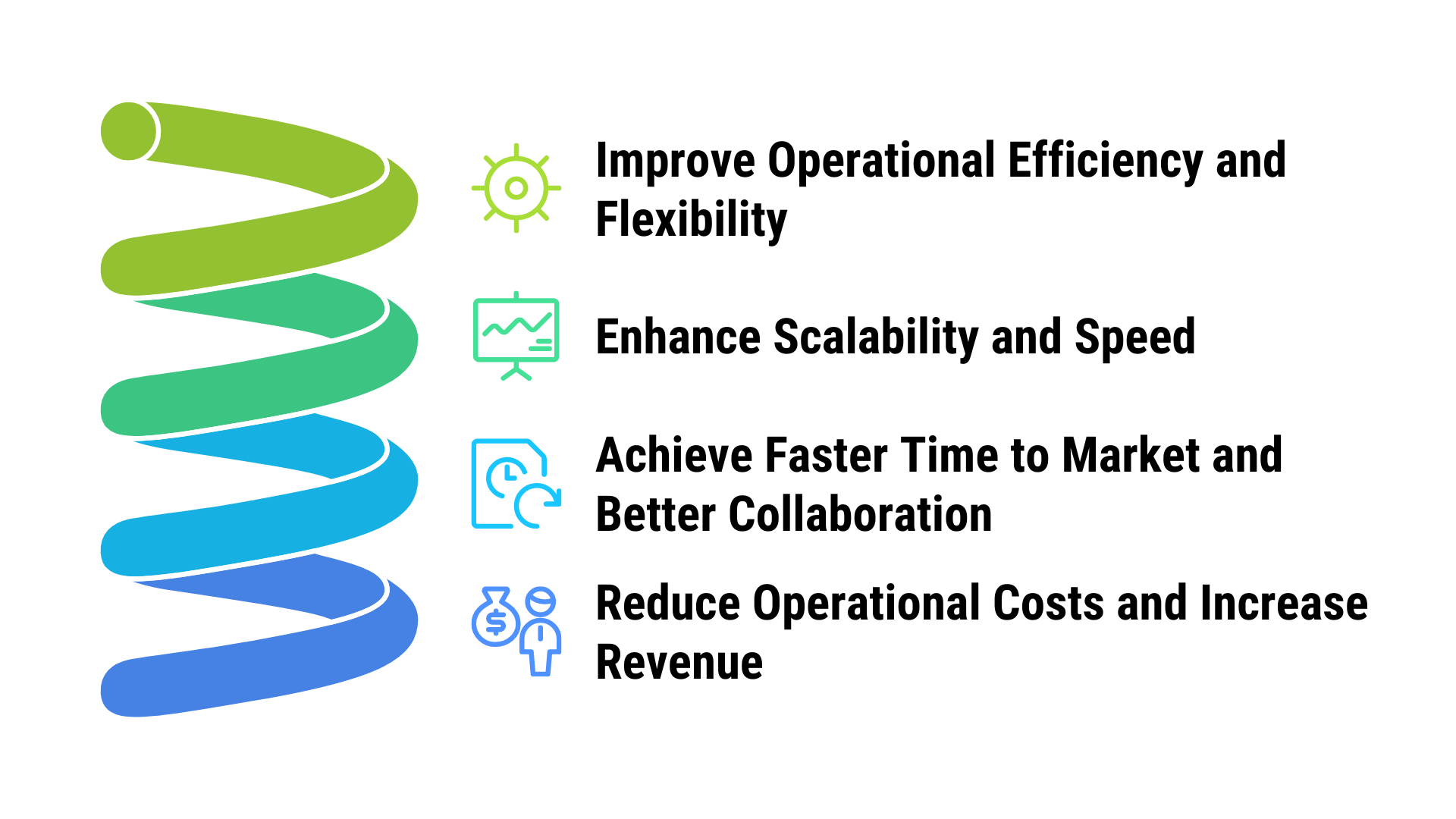
Now let’s look at the benefits cloud integration:
- Improved Operational Efficiency and Flexibility- Cloud integration streamlines business operations and enables seamless workflows. It also automates data flows between applications, reducing manual intervention and eliminating the chance of errors. This also allows businesses to focus on higher value tasks.
Cloud integration also empowers flexibility shaping organizations for growing business needs.
- Enhanced Scalability and Speed- As business grows so does business needs, storage requirements and processing. Cloud Integration enables businesses and organizations to scale their storage needs without any extra expenses.
Organizations are also able to access everythig since everything is available on cloud. This empowers employees to work better and faster.
- Faster Time to Market and Better Collaboration- With pros like, flexibility, scalability and operational efficiency, businesses might require less time to market. Cloud infrastructure promotes improved collaboration with data being available anywhere to anyone in an organization.
- Reduced Operational Costs and Increased Revenue- Cloud integration reduces costs by eliminating the need for expensive IT Infrastructure and maintenance. Cloud providers handle hardware and software upkeep, lowering operational overhead.
Most cloud services also follow a pay as you go model, so organizations only pay for what they use. Additionally, no-code low-code platforms reduce the need for developer resources.
Altogether, these factors help organizations control cost. These savings can then be invested for more strategic initiatives which has potential of driving growth.
Common Challenges in Cloud Integration:
- Overcoming Technical and Functional Barriers- Cloud integration involves multiple cloud services, on-prem systems and other platforms. This can pose a number of technical and functional challenges.
Integration across diverse platforms involves different cloud environments, be it private cloud or public cloud. They have different architectures, and protocols making integration a challenge. It can also lead to latency and performance issues impacting user experience.
- Addressing Security Issues and Data Compliance- Security is always of paramount concern when integration is concerned. Integrating multiple cloud applications, on-prem systems, and third-party sources increases the risk of unauthorized access and data breach. There might be a lot of data compliance standards that need to be met.
- Managing Complexity and Standardization Issues- Cloud Integration can become complex due to setup, deployment, and technical requirements. This is why standardization is a must. The absence of it can lead to issues such as inconsistencies in data format and while generating workflows.
Cloud Integration Tools and Platform
Now it is time to dive into the practical steps of how we can make cloud integration possible. Among the most sought-after options for cloud integration in businesses these days are iPaaS (Integration Platform as a Service).
An iPaaS platform to put it simply, is a cloud platform that integrates cloud applications, services or on-prem services and applications across multiple systems in an organization.
With an iPaaS, organizations or employees in an organization will be able to collaborate and connect with each other, eliminating isolated pockets of information known as data silos.
Use Cases and Industry Application of Cloud Integration:
The uses of cloud integration can be witnessed in multiple fields:
Retail Industry: In the retail industry, management of inventory is of prime importance. Cloud Integration helps retailers connect their inventory systems with online stores. This is to ensure that the stock levels are updated regularly. This also ensures that in case of stockout there are immediate responses.
Pharma Industry: Pharma companies need to access data and reports of the patients and provide them to healthcare workers. This is to ensure that the healthcare workers have all the necessary information to treat a patient.
Automobile: With cloud integration, automobiles can now be tracked and recovered if stolen. In many cases they can even be controlled by a phone or an app. A good example would be Ford’s “Fordpass”, cloud-based mobility services.
Travel: Travel agencies need to be able to connect with the customers in a more personalized way. Cloud integration travel agencies are getting access to customer data from sources like mobile, web, app and websites. This enables them to provide personalized travel recommendations, vacation packages, tailored itineraries etc.
Future Trends in Cloud Integration
- Growth of Hybrid and Multi-cloud Strategies: Businesses are rapidly switching to cloud-based strategies from traditional IT infrastructure. Multi cloud and Hybrid Cloud strategies are being utilized on a wider range as a more modern approach into cloud strategies.
A Hybrid cloud strategy involves connecting a private cloud, often referred to as an on-premises data center with one or more public cloud or third-party cloud providers.
Multi-cloud strategy involves integrating multiple public cloud services from different cloud providers.
Both strategies are extremely opted for to avoid situations like vendor-lock-in, improving stability and optimizing the performance.
- Advancements in AI and Machine Learning for Cloud Integration: AI and ML have already started to be integrated into cloud integration. Therefore, it is expected that cloud platforms will increasingly integrate AI and ML capabilities. This will enhance automation of processes and improve decision-making.
- The Rise of Serverless and Microservices Architecture: Serverless and Microservices Architecture provides better flexibility and allows users to create an application and deploy without managing the infrastructure. Without having to manage the infrastructure and only focus on the development of the app, the development processes get faster.
Microservices help businesses to provide small packages of their services to customers. This increases demand and provides cost efficient results to the customers as well.
How to get started with Cloud Integration?

Steps to Plan and Execute a Successful Cloud Integration Plan:
- Planning: Planning is the first and foremost step in executing a cloud integration project. This involves researching and listing out your business requirements, goals and needs. This initial plan will provide businesses with an idea of what they might be looking for in their model.
- Choosing a Cloud Type: The next important step is to choose a cloud type for your business needs. One can choose from public cloud, private cloud, hybrid cloud and multi cloud; any which can work best as per business goals.
- Identifying Security Issues and Potential Risks: Before implementation, identifying security issues and potential risks must be the top priority. Additionally, there should be encryption measures and access controls implemented.
- Data Migration Plan: Creating a plan of all the data that needs to be migrated from the system to the cloud is also a necessary step.
- Planning Out the Budget: After assessing the requirements, a proper budget plan should be put in place. This will allow the businesses to be prepared with the budget and costs.
- Implementation and Testing: Before choosing on implementation, there must be a proper implementation plan in force. This plan identifies the key steps involved in the process of implementing a cloud solution. Once implemented, it must be thoroughly tested, to ensure that the integration process is working seamlessly.
- Monitor and Optimize: After implementation, the next step is monitoring if the integration strategy is working up to the mark. It is also necessary to continuously optimize your integration plan whenever possible so as to increase efficiency and improve operations.
- Training Workforce: Training an organization’s workforce to use a cloud model successfully is also a crucial step. Hence, conducting a thorough training of the workforce employed is necessary after implementing any new technology.
Finding the right Cloud Integration partner:
All the above-mentioned points would turn out to be useless, if a business fails to find the right cloud integration partner for their business. To delve more deeply into this, let’s look at how a right cloud integration partner should be like:
- The platform should be suited to your business needs be it a small business or a large enterprise.
- The platform should have robust security so that any data being passed through it is secured and is not susceptible to any breach or cyber threat.
- The platform should be flexible and scalable to be able to manage the needs of growing businesses.
- A good cloud integration platform will have a collection of connectors, enabling your business to connect with multiple applications and services.
But coming across such a cloud integration platform can be a task. Or is it?
Achieving Seamless Connectivity with Cloud Integration:
Cloud Integration has empowered modern businesses to connect multiple disparate systems and applications enabling them to achieve not only seamless connectivity but also syncing applications and systems ensuring that these systems are able to communicate efficiently.
With cloud integration businesses achieve:
- An enhanced operational efficiency and improved collaboration
- They become more flexible
- They can scale their systems
- The processes take place faster since everything is synced
- The time to market is significantly reduced along with operational costs, leading to an increase in revenue
But in order to utilize these benefits to the fullest, the first and foremost step is to opt for the right cloud integration solution.
Aekyam is a comprehensive iPaaS Solution that enables seamless connectivity across multiple applications and systems of your organization. Here’s what Aekyam offers:
- Simplified integration
- In-built connectors to connect with multiple applications and cloud services
- Data in motion visibility to track how data travels within your system
- Robust architecture for unmatched scalability & flexibility
- Data security
- Low code-no code interface
How Aekyam supports industry specific needs with cloud integration?
Aekyam as an iPaaS is designed to address your cloud integration needs and optimize your business operations. Be it retail, pharma, travel or automobile, Aekyam’s top notch integration capabilities are able to meet the integration needs of all industries.
Aekyam’s platform is AI-powered and comes with data in motion visibility, which allows businesses to track how data flows through their system. Any error with data processing is identified and reprocessed to ensure data accuracy.
With Aekyam businesses can seamlessly bring together their services and applications on one platform ensuring seamless communication. This means that the business operations take place efficiently and without any hurdles.
Be it inventory management in retail, connected systems for automobiles, enhanced patient data management for healthcare or personalized travel recommendation for travel, Aekyam enables businesses to harness the full potential of cloud.
Why choose Aekyam for Cloud Integration?
Aekyam is an advanced solution for Cloud Integration. It is not only a cost-effective solution but comes with a range of pre-built connectors and adapters that simplify the process of integration. With a low code-no code interface, Aekyam is empowering small- and large-scale businesses without much technical prowess to advance their business without the need of having to spend much.
What Aekyam prides itself on is its data in motion visibility which is the ability to track data. What’s more? In case of any error in the data, it is reprocessed or recalled ensuring data accuracy. Aekyam’s self-suite platform comes with drag and drop features for workflows integration and data in motion visibility.
Get in touch with our team of experts today, to transform your enterprise with intelligent cloud solutions.
Share
Read Similar Blogs