


Why This Matters Right Now
Customer patience is shorter than ever. Loyalty is thinner. People expect quick, helpful answers at any hour, and they switch brands fast when they don’t get them.
This is where conversational AI interfaces earn their place. They let customers and staff talk to your systems in everyday language, by typing or speaking, and get clear answers in seconds. No menus to dig through and no long hold times.
A few years ago, this felt like a nice extra. Today it’s a baseline expectation. The good news: you do not need to be a developer to understand how it works or what it can do for you.
This blog keeps things simple. You will learn what conversational AI interfaces are, why they matter, how they work, the main types, and the benefits you can expect. By the end, you will be ready to make a confident, informed decision.
What Are Conversational AI Interfaces?
Conversational AI interfaces are systems that let people communicate with software using natural language. You ask a question the way you would ask a colleague, and the system understands and replies.
Two technologies power this. Natural language processing (NLP) helps the system read meaning, not just words. Machine learning helps it get better over time. Together, they turn a clunky exchange into something that feels like a real conversation.
Think of it like the difference between a vending machine and a helpful shop assistant. A vending machine only reacts to fixed buttons. A good assistant understands what you actually want, even if you phrase it loosely, and points you to the right answer.
How Is This Different From a Basic Chatbot?
A basic chatbot follows fixed rules. It only handles the exact phrases it was scripted for, so it breaks the moment you ask something unexpected.
A conversational AI interface is more flexible. It reads intent, picks up context, and learns from each chat. Ask the same thing in three different ways, and it still understands. That’s the line between a script and a genuine conversation.
Why Conversational AI Interfaces Matter for Business Today
The shift is already here. Around 80% of companies are using or planning to use AI chatbots for customer service, and many see strong, measurable gains.
The numbers tell a clear story. AI can cut customer service operating costs by 30% to 50%, and Gartner expects conversational AI to save roughly $80 billion in labour costs by 2026. Investment is climbing too, with 64% of leaders planning to spend more in 2026.
Always On, Always Personal
These systems don’t sleep. They handle many chats at once, across web, SMS, WhatsApp, and social channels, with no queues and no time-zone gaps.
They also personalize at scale. By reading past behavior and live context, they tailor each reply to the person in front of them. That’s the kind of service customers now expect by default.
Is Conversational AI Worth the Investment?
For most businesses, yes, and the payback is quick. Companies often reach positive returns within three to six months, mainly because the cost per interaction drops so sharply.
There’s a deeper benefit too. Every conversation becomes data. You can spot common problems, find gaps in your knowledge base, and move from reacting to issues to preventing them. The smartest results come from a hybrid setup, where AI handles routine questions and people step in for the complex ones.
How Conversational AI Interfaces Work
It looks simple on the surface, but a lot happens behind the scenes. Every smooth reply is the result of a few connected steps working in sync.
The Four Core Steps
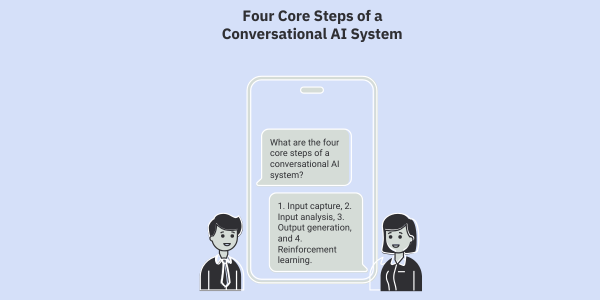
- Input capture. The system takes in what the user types or says.
- Input analysis. NLP breaks down the message to find intent, context, and tone.
- Output generation. The system builds a relevant, useful reply.
- Reinforcement learning. It learns from each exchange to improve the next one.
Here’s a quick example. When a customer types “I would like a call,” the system reads the intent as interest, not small talk, and responds accordingly. Over time, this closed feedback loop makes it sharper and more accurate.
Why Backend Connection Is the Real Power
A chat window on its own is limited. The real value shows up when the interface connects to your business systems through APIs. Then it can check an order, book an appointment, or process a payment, not just talk about it. This is where generative AI-powered intelligent integration turns a friendly front end into something that gets real work done.
Types and Common Use Cases
Conversational AI shows up in a few familiar forms. Each suits a different need, and many businesses use more than one.
- The most common type. They answer questions, suggest products, and book appointments. AI-powered versions improve with every chat instead of staying static.
- Voice assistants. Tools like Alexa and Google Nest let customers shop and search hands-free. They’re especially helpful for people who find typing or screens difficult.
- Smart IVR systems. Modern voice menus understand natural speech and adapt to your tone. They cut wait times and resolve more issues on the first call.
Where Businesses Use It Most
Retail and e-commerce. Personalized shopping, product suggestions, and fraud checks. Retail leads all sectors in adoption.
Customer service. AI handles routine questions and routes tricky ones to the right person, freeing staff for higher-value work.
Healthcare. Voice and chat assistants manage scheduling and medication reminders, which lowers no-shows and improves follow-through.
These patterns repeat across enterprise automation use cases in banking, insurance, manufacturing, and logistics, as well.
Key Benefits for Business Owners
Here’s what you stand to gain, in plain terms.
- Lower costs. Service costs can fall by up to half. AI absorbs the high-volume, repetitive work that eats budgets.
- More done with the same team. These systems handle many more tickets without extra headcount, and they never clock off.
- Better customer experience. Instant, personalised replies across every channel lift satisfaction and conversions.
- Smarter decisions. Conversation data surfaces real trends, so you can fix root causes, not just symptoms.
- One consistent voice. Customers get the same quality of help on your website, phone, SMS, or social channels.
AI vs. Human Agent: A Quick Comparison
The point is not to replace people. It is to let AI handle volume so your team can focus on what needs a human touch. The contrast helps explain why adoption is moving so fast.
| Factor | AI Interface | Human Agent |
|---|---|---|
| Cost per interaction | $0.25 - $0.50 | $3 - $6 |
| Availability | 24/7, no breaks | Set shifts and hours |
| Simultaneous chats | Many at once | One at a time |
| Best suited for | Routine, high-volume queries | Complex, sensitive cases |
| Typical payback | 3 - 6 months | Ongoing salary cost |
Looking Ahead
Three things stand out. Conversational AI interfaces cut costs, lift customer experience, and turn everyday chats into useful business data. Adoption is no longer optional for businesses that want to stay competitive.
By 2030, this technology is set to act less like a feature and more like core infrastructure, the default way people deal with businesses. The real question isn’t whether to adopt it, but how well you connect it to the systems behind the scenes.
That connection is where many tools fall short and where Aekyam’s AI workflow orchestration platform helps. It links conversational interfaces to your backend systems, so even non-technical teams can automate workflows and turn natural-language requests into real action.
Thinking about your first step? Map out one high-volume, repetitive process, and explore how an application orchestration platform could automate it end to end. Start small, measure the results, and scale what works.
Get in touch with our team of experts for more information.
Share
Read Similar Blogs