


Choosing an enterprise application integration platform used to be a relatively contained decision. You evaluated connectors, assessed reliability, compared pricing, and picked the vendor with the best coverage for your tech stack.
That approach no longer works. The platforms available today range from simple data-sync tools to full AI orchestration environments and the gap between them is enormous. Pick the wrong one and you’ll spend the next 18 months patching around its limitations as your AI initiatives stall.
This guide gives you a practical framework for evaluating integration and AI orchestration platforms in 2026, the questions to ask, the criteria that matter, and the signals that separate platforms built for the future from those still optimized for the past.
Why Standard Evaluation Criteria Aren't Enough Anymore
Most integration platform RFPs ask the same questions: How many pre-built connectors do you offer? What’s your uptime SLA? What does pricing look like at scale? These are reasonable questions, but they tell you almost nothing about whether a platform can support AI-driven enterprise workflows.
Here’s the context that changes everything: 95% of IT leaders report that integration is the primary barrier to AI adoption in their organization. And Gartner projects that 40% of enterprise applications will embed task-specific AI agents by end of 2026. If you’re evaluating an integration platform without asking how it handles AI agents, you’re solving for last year’s problem.
The evaluation framework below adds five criteria that most procurement processes skip and that determine whether your integration investment holds up as AI reshapes how enterprise systems operate.
Context: There are over 900 integration software solutions in the market today. Approximately 260 are specialized iPaaS platforms. The quality variance between them is significant and largely invisible in standard feature comparisons.
The 5-Criteria Evaluation Framework
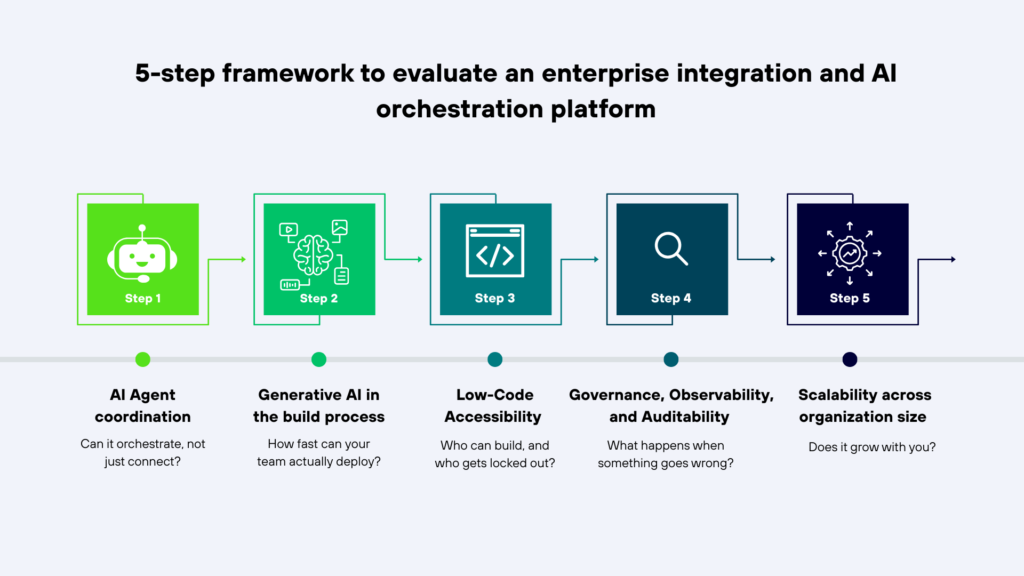
- AI Agent Coordination — Can It Orchestrate, Not Just Connect?
The most important question you can ask a vendor: does your platform coordinate AI agents across systems, or does it simply connect systems for data movement?
These are fundamentally different capabilities. Data connectivity moves information between endpoints based on rules. AI agent coordination manages dynamic, context-aware workflows where agents reason, adapt, and take action sometimes in ways that weren’t pre-coded.
A platform with genuine AI workflow orchestration capability handles agent-to-agent handoffs, manages context across multi-step workflows, enforces governance rules in real time, and adapts when agents surface exceptions. If a platform can’t clearly explain how it handles these scenarios, it’s an integration tool — not an orchestration platform.
- Generative AI in the Build Process — How Fast Can Your Team Actually Deploy?
Integration projects have historically been slow. Mapping fields, writing transformation logic, testing edge cases — a single complex integration can take weeks of specialist time. That pace doesn’t work when your business is demanding new AI capabilities every month.
Evaluate whether the platform uses generative AI in the integration development process itself not just in the workflows it powers. Can GenAI suggest data mappings? Flag potential conflicts? Auto-generate workflow components based on plain-language descriptions? Platforms that apply AI to the build process compress deployment timelines dramatically and reduce dependence on specialized integration talent.
Ask vendors to show you a live example of AI-assisted workflow creation — not a slide deck about it.
- Low-Code Accessibility — Who Can Build, and Who Gets Locked Out?
Enterprise integration has traditionally been a job for specialists. That creates bottlenecks. Operations teams identify a process that needs automation; IT queues it behind fifteen other projects; six months later, the workflow is live but the business context has already shifted.
Modern platforms break that pattern with low-code visual builders that let business analysts, operations leads, and IT generalists create and modify workflows without writing code. Evaluate how far the low-code layer actually goes — can non-developers build production-grade workflows, or does anything complex require a developer handoff?
The best platforms combine low-code accessibility with full developer extensibility. Look for workflow automation tools built for cross-functional teams — not just IT departments.
- Governance, Observability, and Auditability — What Happens When Something Goes Wrong?
Governance is usually an afterthought in integration evaluations. It shouldn’t be — especially as AI agents start taking actions across enterprise systems.
When an AI agent creates a record, triggers an approval, or routes a payment, you need to know exactly what it did, why it did it, and what the downstream effects were. That requires centralized logging, real-time monitoring, and clear audit trails — built into the platform, not bolted on later.
Ask vendors: How does your platform handle a workflow failure at step 7 of a 12-step process? What does error recovery look like? Who gets alerted? How is the audit trail maintained? These questions reveal whether governance is structural or cosmetic.
- Scalability Across Organization Size — Does It Grow With You?
Many integration platforms are optimized for one end of the market. Tools built for SMBs become painful to manage at enterprise scale. Platforms built for large enterprises price and complexity-out smaller organizations before they’re ready.
The right platform scales in both directions. Evaluate whether the vendor can demonstrate integration deployments across different organization sizes — not just reference customers in your current segment, but companies that started where you are and grew significantly on the same platform. Re-platforming is expensive. A platform that grows with you is a compounding asset.
Platform Capability Comparison
Here’s how traditional iPaaS platforms compare to a purpose-built AI orchestration platform like Aekyam across the criteria that matter most in 2026:
| Capability | Traditional iPaaS | Aekyam |
|---|---|---|
| Data connectivity between apps | Strong | Strong |
| AI agent coordination | Not designed for it | Native capability |
| Generative AI-assisted build | Rarely | Built-in |
| Low-code workflow design | Limited | Full visual builder |
| Multi-agent orchestration | No | Yes |
| Real-time adaptability | ️ Rule-based only | Context-aware |
| Governance & observability | ️ Varies | Centralized |
| Scales from SMB to enterprise | Often one or the other | Designed for both |
| Pre-built integration marketplace | ️ Varies by vendor | Yes |
How Do You Know if Your Current Platform Is Holding Back Your AI Strategy?
There are four signals worth paying attention to.
- Your AI pilots are succeeding in demos but struggling to connect to production systems.
- Integration timelines are consistently the longest item on your AI project plans.
- AI agents you’ve deployed are operating in silos, unable to act across multiple systems in a single workflow.
- Your team is spending significant time manually reconciling data that AI should be handling automatically.
If two or more of those are true, your integration infrastructure is the constraint, not your AI models or your team’s capability.
What Should You Ask a Vendor in a Demo?
Go beyond the standard feature tour. Ask them to show you:
- How the platform handles a workflow where an AI agent encounters an unexpected exception?
- How would a non-developer build a new integration from scratch using AI assistance?
- How are audit logs generated and accessed when something fails?
- How the platform scales when transaction volume doubles?
The answers and the vendor’s comfort level with these questions will tell you more than any feature list.
How Long Does It Typically Take to Get Value from a New Integration Platform?
With platforms that combine a pre-built connector marketplace with low-code workflow design and GenAI-assisted build, deployment timelines have compressed significantly. Teams that previously spent weeks on a single integration are now completing initial workflows in days.
The more relevant question is: how long does it take to deploy your highest-priority workflow? Start there in your evaluation not with a full platform migration plan. The best platforms are designed for incremental adoption.
Making the Right Decision
The enterprises that get integration right in 2026 won’t just have cleaner data flows. They will have the operational infrastructure to actually deploy AI at scale, connecting agents, humans, data, and systems into workflows that adapt and deliver in real time.
That’s exactly what Aekyam is built for.
As an enterprise AI orchestration platform, Aekyam goes beyond connecting applications. It unifies your apps, data, systems, and AI agents into a single ecosystem, so workflows don’t just run, they think. With pre-built integrations, built-in anomaly detection, real-time payload visibility, and end-to-end data traceability, Aekyam gives enterprises the foundation to move from fragmented operations to truly intelligent, agentic automation.
The evaluation framework above gives you a structured way to compare platforms on criteria that matter, not just what’s easy to compare, but what’s hard to change after you’ve committed. So when you’re evaluating, the question worth asking isn’t just “does this platform integrate well today?” It’s “will this platform be ready for where AI is taking us tomorrow?”
If you’re in the middle of an integration platform evaluation, or just starting to build the business case for one, request a demo of the Aekyam platform to see how AI orchestration works in practice across your industry’s specific workflows. Or get in touch with our team of experts for more information.
Share
Read Similar Blogs