

Your IoT devices are generating data around the clock. Sensors on the factory floor. Trackers in your supply chain. Smart equipment sending signals every few seconds. But here’s the problem: all that data is useless if it’s trapped inside isolated systems.
Most enterprises hit the same wall. IoT data sits in one silo. Your ERP lives in another. Your CRM doesn’t talk to either. You end up with mountains of device data and no clear way to act on it.
That’s where IoT in iPaaS changes the game. An Integration Platform as a Service (iPaaS) acts as the central layer that pulls IoT data in, routes it to the right systems, and triggers the right actions automatically.
In this blog, we talk about what IoT-iPaaS integration is, how it works today, who benefits most, and where the technology is headed next.
What Is IoT in iPaaS?
The early days of IoT and iPaaS were marked by distinct use cases and audiences. IoT focused primarily on connecting devices, enabling remote monitoring, and enhancing operational efficiency across industries like manufacturing, healthcare, and logistics. With sensors and devices generating data in real-time, IoT helped businesses monitor equipment, track assets, and, in certain cases, even predict maintenance needs. However, this technology was largely self-contained, with data often remaining isolated within specific IoT applications or platforms.
In contrast, iPaaS emerged as a tool to solve enterprise integration challenges. Designed to streamline data flows across disparate systems, iPaaS aimed to eliminate silos and make it easier for organizations to unify applications and automate workflows. Initially, iPaaS was primarily used to integrate traditional enterprise systems like CRMs, ERPs, and databases, with limited focus on IoT-specific data sources.
Why IoT Data Can't Live in Silos
IoT devices produce high-frequency, high-volume data. A single factory sensor might send thousands of readings per hour. Without integration, that data piles up in isolated databases that your business systems can’t access or act on.
Siloed IoT data leads to delayed decisions, missed maintenance windows, poor visibility across operations, and wasted investment in smart devices that never deliver their promised value.
Integration is what turns raw device data into business intelligence. It’s the bridge between your physical operations and your digital systems.
How Does iPaaS Handle IoT Data?
iPaaS handles IoT data through a combination of protocol support, event-driven processing, and pre-built connectors.
On the protocol side, iPaaS platforms support common IoT communication standards like MQTT, CoAP, and AMQP. This means they can receive data directly from IoT devices without custom middleware.
On the processing side, iPaaS uses event-driven architecture. When a sensor triggers an event say, temperature crossing a threshold, the platform can immediately route that data, fire an alert, update a record, or kick off a workflow.
How IoT and iPaaS Came Together
The Early Gap — Two Separate Worlds
IoT and iPaaS started in completely different lanes. Early IoT deployments focused on connecting devices and monitoring equipment. It’s like predictive maintenance in manufacturing or asset tracking in logistics. The data usually stayed within the IoT application itself.
iPaaS, on the other hand, was built to connect enterprise systems. It linked CRMs to ERPs, databases to cloud apps, and APIs to each other. IoT wasn’t on the roadmap, it was too device-specific, too low-level.
The Developments That Bridged Them
As IoT matured, the limits of isolated device data became clear. Businesses wanted IoT data to flow into their existing systems not live in a separate silo. That demand pushed iPaaS providers to extend their platforms.
Here’s what made the convergence possible:
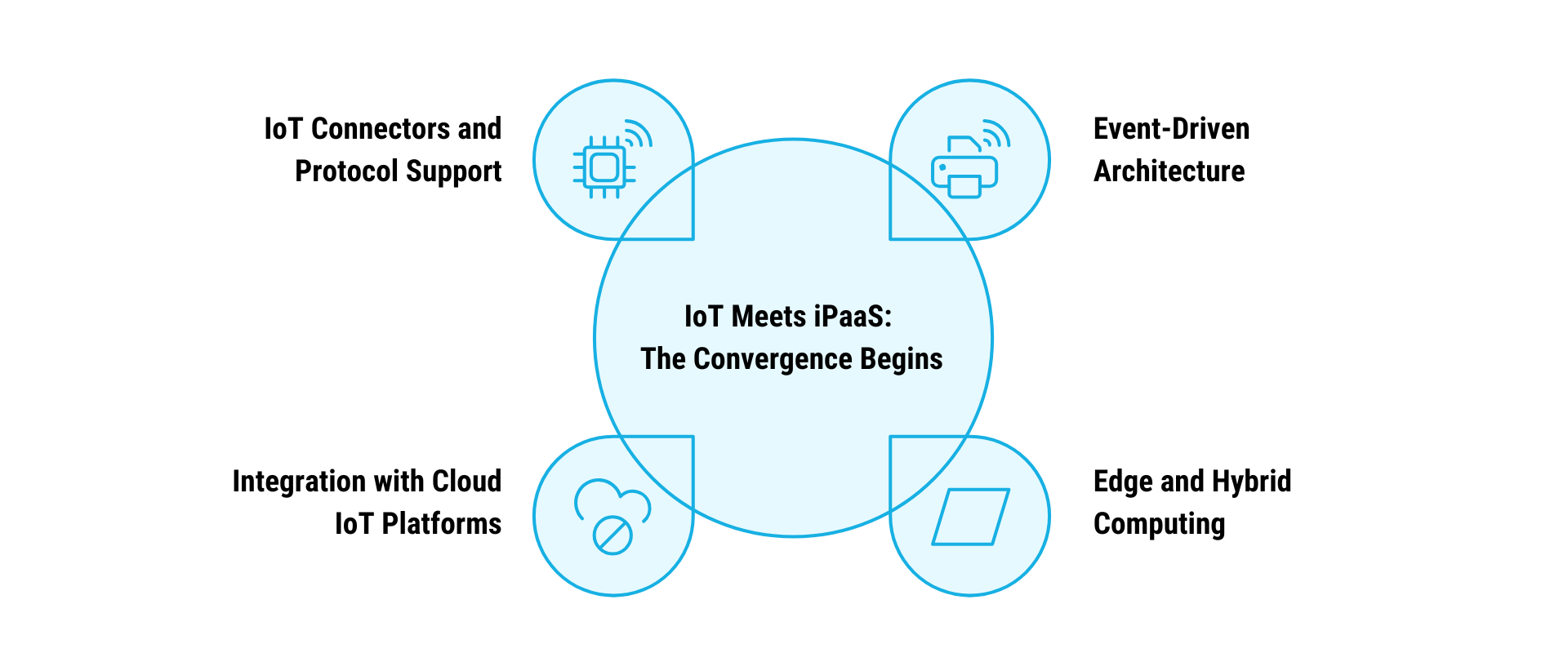
- IoT protocol support — platforms added native support for MQTT, CoAP, and HTTP, letting them ingest device data directly.
- Event-driven architecture — iPaaS adapted to handle the real-time, high-frequency nature of IoT data streams.
- Edge computing support — data processing moved closer to the device source to cut latency for time-critical operations.
- Cloud IoT connectors — tight integrations with major cloud IoT services made it easy to bridge device networks and enterprise cloud environments.
What IoT-iPaaS Integration Looks Like Today
Real-Time Data Flows Into Enterprise Systems
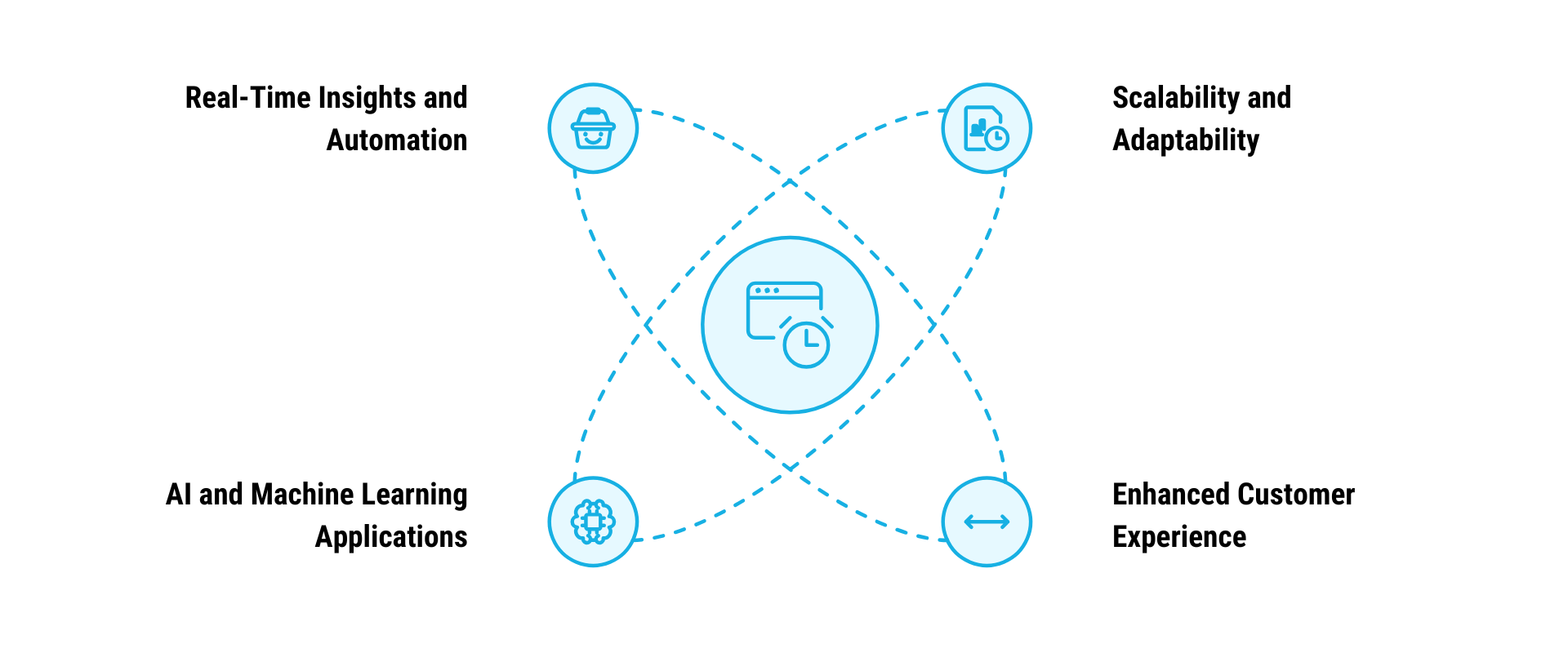
Today, IoT data moves seamlessly into ERP, CRM, analytics, and data warehouse systems automatically. A shipment scan updates your inventory system in seconds. A machine reading triggers a maintenance ticket without anyone lifting a finger.
The result is a unified digital ecosystem where devices, applications, and people operate from the same data in real time. For operations teams, this means fewer surprises and faster decisions. For customers, it means better service and proactive communication.
AI and Machine Learning Layered On Top
The next layer is intelligence. Many iPaaS platforms now embed AI and ML capabilities that apply directly to IoT data streams. Instead of just moving data, the platform analyzes it.
This opens up use cases like predicting equipment failure before it happens, flagging anomalies in sensor data, personalizing customer notifications based on real-time location or behaviour, and optimizing inventory levels dynamically based on demand signals from connected stores.
Scalability and Adaptability
As IoT deployments grow, iPaaS platforms scale elastically to handle millions of connected devices without rearchitecting the integration layer. When processes change or new devices are introduced, teams can modify workflows and reconfigure pipelines quickly keeping the integration backbone flexible as the business evolves.
Enhanced Customer Experience
When real-time device data flows into customer-facing systems, businesses shift from reactive service to proactive engagement. A retailer notifies customers the moment an order ships. A technician is dispatched before a fault is even reported. This anticipatory approach reduces friction, builds trust, and delivers experiences that set businesses apart.
What Industries Benefit Most from IoT in iPaaS?
Almost every industry with physical operations benefits, but some see the most immediate impact:
- Manufacturing — predictive maintenance, real-time equipment monitoring, quality control automation.
- Logistics and supply chain — shipment tracking, cold chain monitoring, automated exception handling.
- Retail — smart shelf management, footfall analytics, connected POS and inventory systems.
- Healthcare — connected medical devices, patient monitoring, compliance reporting.
- Automotive — connected vehicle data, dealer system integration, after-sales service automation.
Who Should Use iPaaS for IoT Integration?
IoT-iPaaS integration isn’t just for large enterprises. Here’s how it maps across different business sizes:
Large organizations deal with IoT at scale, thousands of devices, dozens of systems, global operations. iPaaS handles this through scalable architecture that adapts to data volume without custom engineering.
Enterprises also gain a competitive edge by feeding IoT data into decision-making tools. Real-time visibility across supply chains, automated responses to field events, and deeper customer insights all become operational realities not aspirational goals.
For smaller businesses, budget and speed matter most. iPaaS reduces integration costs by replacing bespoke custom builds with pre-configured connectors. You can plug in a new IoT device or cloud service without a six-month development cycle.
SMBs also benefit from the low-code nature of modern iPaaS platforms. You don’t need a full integration team to connect your devices to your business systems. You need the right platform.
IoT Solution Providers and IT Teams
Solution providers use iPaaS to accelerate how they build and deliver IoT products. Pre-built connectors and APIs shorten development timelines and reduce operational overhead for clients.
For IT teams, iPaaS centralizes IoT integration management. Instead of maintaining dozens of fragile point-to-point connections, you manage everything through one platform with visibility, controls, and error handling built in.
The Future of IoT in iPaaS
Edge-First and Multi-Cloud Integrations
Latency is still a challenge in IoT. For applications that require split-second decisions like safety systems or real-time robotics processing data in the cloud introduces too much delay.
iPaaS platforms are responding by deepening edge computing support. Data gets processed closer to where it’s generated. At the same time, multi-cloud architectures are becoming standard, and iPaaS will increasingly serve as the connective tissue across cloud environments.
Autonomous Operations and Self-Healing Systems
The longer-term vision is systems that detect, diagnose, and fix problems without human input. iPaaS is central to this. When IoT data triggers an anomaly, the platform can automatically escalate, reroute, or resolve the issue all within seconds.
Think of a cold chain logistics scenario. A temperature sensor in a truck detects the cooling unit is failing. The iPaaS platform instantly alerts the driver, re-routes the shipment, notifies the warehouse, and updates the customer all autonomously.
What Security Challenges Come with IoT Integration?
IoT integration introduces real security risks. More devices mean more entry points. More data flows mean more exposure. Here’s what enterprises need to plan for:
- Device authentication — every device connecting to the platform must be verified and authorized.
- Data encryption — IoT data in transit should always be encrypted, especially for sensitive verticals like healthcare or finance.
- Compliance readiness — as IoT data often contains operational or personal signals, platforms must support regional data residency and regulatory compliance requirements.
- Anomaly detection — platforms need built-in monitoring to flag unusual data patterns that could indicate a breach or device compromise.
Future iPaaS platforms will bake these controls directly into the integration layer so security isn’t an afterthought, it’s built into the workflow.
The Bottom Line
IoT in iPaaS is no longer a niche capability, it’s a core part of how modern enterprises connect physical operations to digital systems. The combination gives you real-time data flows, intelligent automation, and the scalability to grow without rebuilding.
If your IoT data is sitting in silos, you’re leaving operational efficiency on the table. The right integration platform closes that gap, connecting your devices to your systems and your systems to smarter decisions.
Aekyam is built for exactly this. As an AI-powered orchestration platform, it helps enterprises connect IoT data with the applications, workflows, and teams that depend on it without the integration complexity. Ready to see it in action?
Book a demo and see how Aekyam connects your IoT ecosystem — or explore our platform overview to learn more.
Share
Read Similar Blogs


Lorem ipsum dolor sit amet, consectetur adipiscing elit. Ut elit tellus, luctus nec ullamcorper mattis, pulvinar dapibus leo.