

Your legacy system is still working. But is it working for you?
For many enterprises, the honest answer is: barely. The system runs. Orders get processed. Data gets stored. But behind the scenes, that same system is quietly draining your IT budget, trapping your data in silos, and blocking you from adopting AI, cloud, or any modern automation.
According to a 2025 survey of 500+ U.S. IT professionals, legacy systems consume between 60 and 80 percent of IT budgets. That is money not going into innovation, customer experience, or growth.
Legacy system integration is the process of connecting your older infrastructure with modern applications, without replacing everything from scratch. When done right, it unlocks the data and capabilities already sitting in your systems.
This blog dives deep into legacy system integration and breaks down the challenges and the practical strategies to tackle them. This will help making informed decisions from the start.
What Is Legacy System Integration — And Why Does It Still Matter?
Legacy system integration means connecting your older technology, whether that’s on-premises ERP, mainframes, or proprietary databases with modern platforms like cloud services, APIs, or automation tools. The goal is not always to replace the old system. Often, it is to make it talk to the new ones.
This matters because most enterprises cannot afford a full replacement. In many cases, they do not need to. What they need is a bridge.
What counts as a legacy system?
A legacy system is any technology that is outdated relative to your current business needs. It might still function, but it lacks the APIs, security standards, or flexibility that modern environments require. Common examples include COBOL-based mainframes in banking, older ERP platforms in manufacturing, and decade-old EMR systems in healthcare.
The problem is not just age. It is that these systems were designed to work alone not as part of a connected, data-driven enterprise.
Why do companies still depend on them?
It is rarely ignorance. Companies stick with legacy systems for very practical reasons:
- The system still works and replacement feels risky.
- Full modernization is expensive and slow.
- Institutional knowledge is tied to the existing platform.
- Regulatory compliance is built around the current setup.
But the cost of standing still is rising. When 87% of IT decision-makers say modernization is now essential, staying put is no longer a neutral choice, it is a strategic risk.
The Top Legacy System Integration Challenges
Integration does not fail because people are not trying hard enough. It fails because the challenges are structural. Here is what you are up against.
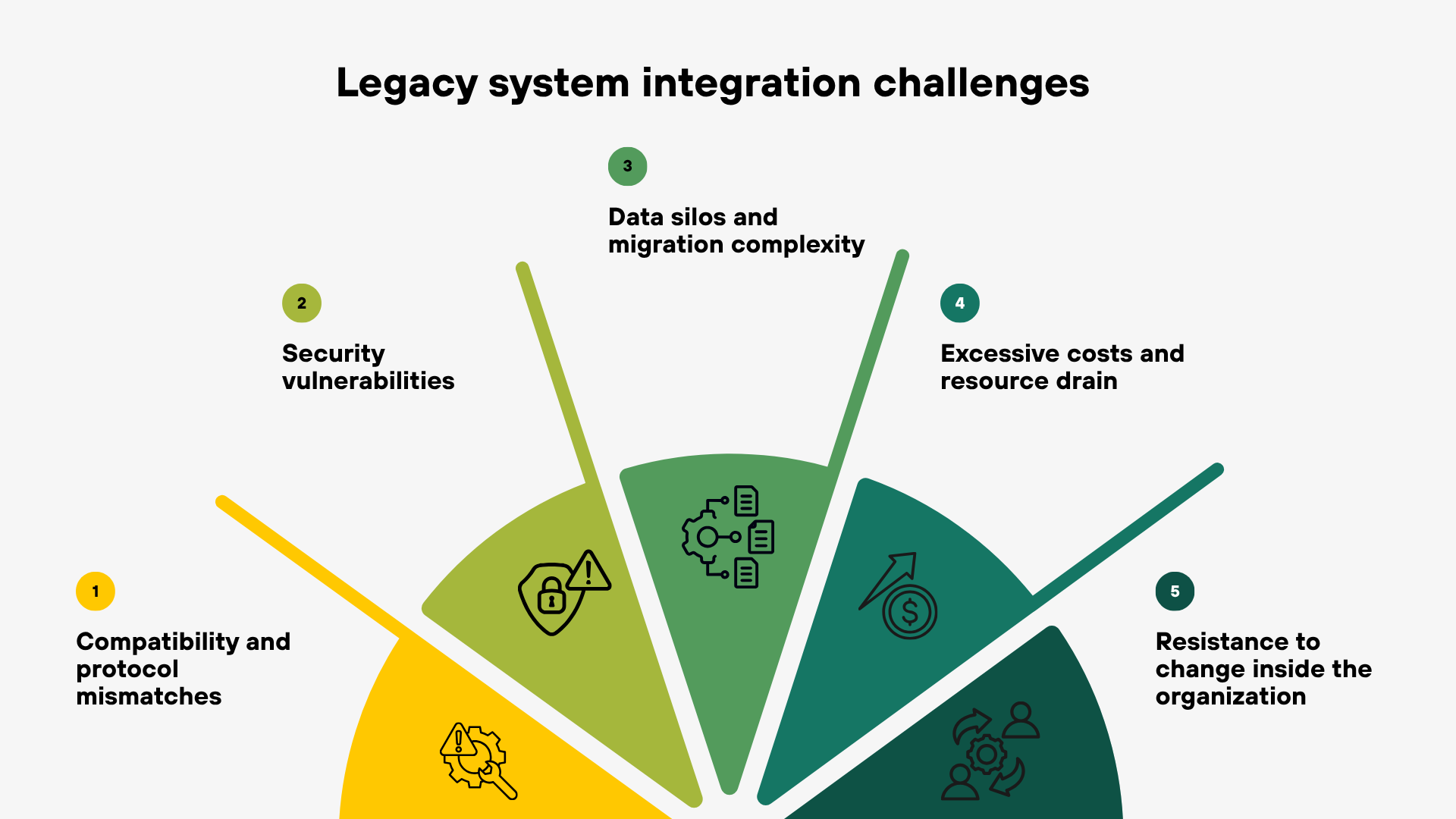
- Compatibility and protocol mismatches
Legacy systems often communicate using old protocols think SOAP, FTP, or proprietary interfaces that simply do not speak the same language as modern REST APIs or cloud services. This gap creates communication failures, data loss, and inefficient transfers.
Bridging this gap usually requires building middleware or adapter layers that translate between old and new. It is solvable but it takes planning.
- Security vulnerabilities
Older systems were not built with today’s threat landscape in mind. They often lack modern authentication, encryption, or patch support. When you connect a legacy system to a modern network, you are potentially creating new attack surfaces.
In a 2025 survey, 43% of IT professionals said security vulnerabilities are their biggest concern with legacy software. This is not theoretical it is a live risk for every connected system.
- Data silos and migration complexity
Legacy systems often store data in formats that no longer match modern databases. Migrating that data, mapping fields, converting types, cleaning errors is painstaking work. 80% of organizations cite data silos as their biggest barrier to AI and automation adoption.
Without solving the data layer, even the best integration architecture will underperform.
- Excessive costsand resource drain
Legacy integration is not cheap. You need specialists who understand old tech, additional infrastructure, and often extended downtime windows. Large IT projects already run 45% over budget on average. Legacy complexity makes that worse.
The irony: the cost of not integrating lost productivity, missed automation opportunities, compounding technical debt often exceeds the integration cost itself.
- Resistance to change inside the organization
This one is underestimated. Technical problems are solvable. Cultural ones take longer. When teams have worked with the same system for years, change feels disruptive, even when it is clearly necessary.
Resistance shows up as passive non-cooperation, delayed timelines, or reluctance to allocate resources. Without leadership alignment and clear communication about the benefits, even technically sound integration projects stall.
How Do You Integrate a Legacy System with Modern Technology?
There is no single answer, but two strategies consistently deliver results.
Option 1 — Use middleware and integration platforms
Middleware platforms sit between your legacy systems and modern applications, handling translation, routing, and data transformation. This is the most practical path for most enterprises.
The best platforms offer:
- Pre-built connectors for common enterprise applications, reducing build time significantly.
- Low-code or no-code tools so business teams can configure workflows without deep coding skills.
- Real-time monitoring and observability so you can track data flows and catch issues early.
- Cloud-agnostic deployment so you are not locked into one infrastructure.
- AI-assisted development to accelerate integration configuration.
Platforms with a built-in integration marketplace can cut integration setup from days to hours. That is not a small gain, it is a fundamental shift in how fast your team can move.
Option 2 — A phased integration approach
Do not try to integrate everything at once. Break the project into stages:
- Start with your highest-priority systems the ones creating the most friction or risk.
- Validate each integration before moving to the next.
- Build in feedback loops so each phase informs the next.
This approach reduces disruption, keeps stakeholders engaged, and delivers value faster. It also gives your team time to learn before tackling more complex integrations.
What Are the Risks of Not Integrating Legacy Systems?
The status quo carries its own risks; they just build slowly. Here is what you are accepting if you delay:
- Data remains trapped in silos, blocking AI adoption and real-time decision-making.
- Security vulnerabilities compound as legacy systems age without patches.
- Operational costs rise as maintenance consumes more of the IT budget.
- New applications underperform because they cannot connect to core systems.
- Your team spends time on manual workarounds instead of meaningful work. Research shows knowledge workers lose up to 12 hours per week chasing data across disconnected systems.
Inaction is not neutral. It is a slow accumulation of risk that eventually forces a more disruptive and expensive fix.
Legacy Integration: The Numbers That Matter
The data tells a consistent story: integration is urgent, under-resourced, and high-ROI when done well.
| Statistic | Source | Business Impact |
|---|---|---|
| 62% of U.S. organizations still run legacy software | Saritasa / 2025 Survey | Widespread technical debt across industries |
| Legacy systems consume 60–80% of IT budgets | MyShyft / Gartner | Less money for innovation and AI adoption |
| 95% of enterprises struggle to integrate data across systems | MuleSoft 2025 Report | Data silos block intelligent automation |
| 80% of businesses face disruption during upgrades | MoldStud / Deloitte | Poor planning amplifies integration risk |
| 87% of IT leaders say modernization is essential | NetGuru 2025 Survey | Modernization urgency is near-universal |
| ROI of 288–362% from mainframe modernization | Kyndryl 2025 Report | Strong financial case for integration investment |
How to Choose the Right Legacy System Integration Strategy
Strategy comes before tools. Before you evaluate platforms or write a single line of middleware, you need clarity on what you are trying to achieve.
Key questions to ask before you start
- Which systems are creating the most friction, risk, or cost right now?
- What data needs to flow and in which direction?
- What is your tolerance for downtime during integration?
- Do you have internal expertise, or do you need a partner?
- What regulatory or compliance requirements apply to the data in these systems?
Your answers shape everything: the approach, the timeline, the tooling, and the team you will need.
What to look for in an integration platform
Not all integration platforms are built for legacy environments. When evaluating options, prioritize:
- Pre-built connectors for your existing systems: do not build what you can reuse.
- Protocol flexibility: support for older formats alongside modern REST and GraphQL.
- End-to-end data visibility so you can monitor what is flowing and catch errors fast.
- Low-code configuration so your team is not dependent on scarce specialist developers.
- Scalability: the platform should grow with you, not create a new bottleneck.
Explore enterprise integration use cases to understand how different industries are solving these challenges today.
Conclusion
Legacy system integration is hard. But it is not as hard as managing the compounding cost of doing nothing.
The organizations moving fastest are not the ones that ripped and replaced everything. They are the ones that built a bridge, connecting what works in their legacy systems to the modern tools they need to compete. A phased approach, the right middleware, and strong stakeholder alignment are the foundation.
Aekyam’s AI workflow orchestration platform is built for exactly this: connecting legacy and modern systems with pre-built connectors, AI-assisted integration, and full data observability.
Ready to see how it works for your environment? Request a demo and talk to the team.
Share
Read Similar Blogs