


What Is Pushing Enterprises to Adopt AI Workflow Automation Now?
A combination of rising operational pressure, shifting data complexity, and shrinking margins is making AI workflow automation a business necessity rather than a future consideration. Enterprises that were comfortable with rule-based systems two years ago are now finding those systems inadequate for the volume and variety of work they need to process today.
For a complete view on AI Workflow Automation and how it changes the present business landscape, read our comprehensive guide on AI Workflow Automation.
Below mentioned are a few reasons pushing that shift:
Rising Costs and Talent Gaps
Labor costs have increased significantly across knowledge-intensive functions such as finance, compliance, customer service, and operations. At the same time, the talent required to manage high-volume, repetitive cognitive work is either expensive or difficult to retain. AI workflow automation addresses both problems by handling tasks that previously required human judgment at scale, including document review, data extraction, exception classification, and decision routing. The result is a meaningful reduction in cost-per-transaction without a proportional increase in headcount.
The Pressure to Do More with Less
Enterprise leadership is being asked to deliver more output from the same or smaller operational budgets. Traditional automation helped with volume but not with variety. AI workflow automation changes that equation by handling not just high-volume repetitive tasks but also the variable, unstructured, and exception-heavy work that used to require dedicated teams. Organizations that have adopted it are processing more work, faster, with fewer manual touchpoints across the process.
How the Volume and Complexity of Data Has Changed
Enterprises today are dealing with data volumes and formats that did not exist at scale five years ago. Customer messages arrive through chat, email, voice, and social channels simultaneously. Contracts, invoices, and claims come in dozens of unstructured formats. Regulatory filings, supplier communications, and internal reports all require interpretation before they can be acted on. Rule-based systems were never designed to handle this variety. AI workflow automation processes all of it by understanding context, extracting meaning, and routing work correctly regardless of format or source.
What Are Enterprises Actually Trying to Fix with AI Workflow Automation?
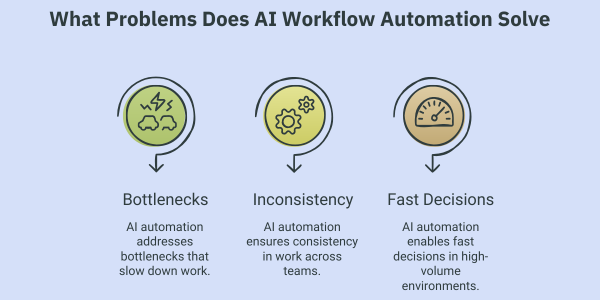
Enterprises are turning to AI workflow automation to solve three operational problems that rule-based systems have consistently failed to address at scale:
- Bottlenecks that slow work down
- Inconsistency in how work gets done across teams
- Inability to make fast decisions in high-volume environments.
Let’s explore them in detail below.
Bottlenecks Slowing Operations Down
Most enterprise bottlenecks occur at the same point in a workflow: where structured automation ends and human review begins. This handoff is where work stacks up, delays accumulate, and errors are introduced. AI workflow automation eliminates this handoff for the majority of cases by extending automation beyond structured data into the unstructured, ambiguous, and exception-heavy work that previously required a human to process. The result is end-to-end workflow coverage without the queues.
Inconsistency in How Work Gets Done Across Teams
When work is routed through humans, outcomes vary. Different team members interpret the same input differently, apply rules inconsistently, and escalate at different thresholds. Over time, this creates measurable quality and compliance risk. AI workflow automation applies the same logic to every input, every time, regardless of volume or time of day. It does not have bad days, overlook edge cases due to fatigue, or apply rules differently based on individual judgment. The consistency it delivers is particularly valuable in regulated industries where process standardization carries legal weight.
Slow Decisions in High-Volume Environments
In environments where thousands of decisions need to be made daily, such as loan approvals, insurance triage, order processing, or customer query resolution, the speed of each individual decision compounds into significant operational throughput. AI workflow automation makes these decisions in real time, drawing on structured rules, machine learning models, and contextual data simultaneously. What once required a team of analysts working through a queue can now happen in seconds, at any volume, without degradation in accuracy. Read our blog on What are the benefits of AI Workflow Automation to know how it can help your business evolve in the current dynamic landscape.
Why Is Legacy Automation No Longer Enough for Modern Enterprises?
Legacy automation is no longer sufficient because the nature of enterprise work has changed faster than rule-based systems can adapt. The gap between what traditional automation can handle and what enterprises actually need to process is widening every quarter.
The Limits of Rule-Based Systems in Dynamic Environments
Rule-based systems are designed for stability. They perform well when every input matches the expected format and every process follows the defined sequence. Modern enterprise environments do not offer that stability. Processes change, data sources multiply, customer expectations shift, and regulatory requirements evolve. Every change requires someone to rewrite the automation logic. At scale, this becomes a continuous maintenance effort rather than a one-time implementation. The system that was supposed to save time ends up consuming it.
The Maintenance Burden That Comes with Them
The hidden cost of rule-based automation is the ongoing effort required to keep it running as business conditions change. Every new document format, every process update, every exception type that falls outside the original rules requires developer intervention. In fast-moving enterprises, this maintenance load grows until it becomes a bottleneck of its own, with automation teams spending more time fixing existing workflows than building new ones. AI workflow automation reduces this burden because models adapt to new patterns rather than requiring explicit reprogramming.
The Gap Between Expected and Actual ROI
Most enterprises that invested in rule-based automation expected it to deliver sustained cost savings and efficiency gains. Many found that the initial gains eroded over time as maintenance costs rose, exceptions multiplied, and the scope of what could actually be automated plateaued. AI workflow automation addresses this ROI gap by expanding the automatable surface area of enterprise operations, handling the complex, variable, and judgment-heavy work that traditional tools could never reach, and improving over time rather than degrading.
Read our blog on the differences between traditional workflow automation and AI workflow automation to know what the right fit for your business might be.
What Does the Shift to AI Workflow Automation Look Like Across Industries?
The shift is already underway across multiple sectors, and the enterprises moving fastest are those where data volume, process complexity, and competitive pressure all converge. The benefits they are capturing are real, measurable, and compounding.
Which Sectors Are Moving Fastest and Why
Financial services are leading the adoption curve. Banks and insurance companies process enormous volumes of unstructured data, face strict regulatory requirements, and operate in environments where decision speed directly affects revenue and risk. AI workflow automation allows them to process loan applications, claims, and compliance documents at a speed and consistency that rule-based systems cannot match.
Healthcare is accelerating rapidly, driven by the volume of clinical documentation, prior authorization workflows, and patient communication that needs to be processed without increasing administrative headcount. Retail and e-commerce are adopting AI workflow automation to handle order management, supplier communication, and customer service at seasonal volumes that would require unsustainable staffing under traditional models. Manufacturing and logistics are using it to manage supplier exceptions, quality documentation, and demand signals that arrive in formats no rule-based system could reliably parse.
What Early Adopters Are Gaining
Enterprises that moved early on AI workflow automation are seeing measurable gains across three dimensions. Processing speed has improved dramatically for document-heavy workflows, with tasks that once took days now completing in hours or minutes. Error rates in data extraction and classification have dropped significantly, reducing downstream rework and compliance risk. Operational capacity has expanded without proportional headcount growth, allowing teams to take on higher-value work while automation handles the volume. The compounding effect of these gains is that early adopters are now widening the gap between themselves and competitors who have not yet made the shift. Read our blog on Exploring real-world use cases of AI Workflow Automation across industries to know exactly how it is impacting different industries.
Why Waiting on AI Workflow Automation Is a Risk Enterprises Can No Longer Afford
Delaying the move to AI workflow automation is no longer a neutral decision. Every quarter that an enterprise continues to rely on rule-based automation, the operational gap between its capabilities and what its competitors are deploying grows wider. The cost of catching up increases as competitors build institutional knowledge, refine their models, and integrate AI more deeply into their operations.
The compounding nature of AI improvement makes early adoption disproportionately valuable. Models get more accurate as they process more data. Workflows become more reliable as edge cases are logged and learned from. Teams that have been working alongside AI automation for two years are more effective at using it than teams just starting out. Waiting means starting behind.
There is also a customer expectation dimension. Enterprises that have deployed AI workflow automation are delivering faster responses, more consistent service, and lower error rates. Customers who experience this level of service raise their baseline expectations. Enterprises still operating on manual queues and rule-based routing are being compared to those standards and falling short.
The shift to AI workflow automation is not a future investment. It is a present operational requirement for enterprises that want to remain competitive in the environments they are already operating in.
Aekyam is an enterprise AI Orchestration platform that makes this transition practical. It connects your applications, data, and AI into a single workflow layer, replacing rule-based rigidity with intelligent automation that handles unstructured data, learns from exceptions, and scales as your operations grow. Whether you are starting with a single process or orchestrating automation across the enterprise, Aekyam gives you the infrastructure to move from where you are today to where your business needs to be.
Request a demo or connect with the team to transform your business operations.
Frequently Asked Questions
1. How should I enable real-time decision making for my business?
The most effective way to enable real-time decision making is to replace manual review queues with AI workflow automation that processes inputs and applies decision logic the moment data arrives. The system classifies, routes, and resolves cases automatically, with human review reserved only for low-confidence outputs.
2. How can I enable instant loan approvals?
Instant loan approvals become achievable when AI workflow automation handles the entire process, from reading the application and extracting financial data to cross-referencing policy rules and returning a decision in seconds. Only cases that fall outside automated thresholds are passed to a human reviewer.
3. How can I ensure real-time, conversational, 24/7 support for my business?
Reliable 24/7 support becomes possible when you deploy AI workflow automation with NLP that reads incoming messages, interprets customer intent, and responds in real time across any channel. Human agents step in only when a query falls outside what the system can confidently resolve.
4. How can I control rising operational costs?
Most cost growth in process-heavy functions comes from the manual work involved in handling exceptions and reviewing documents. AI workflow automation takes over this work, reducing cost-per-transaction across high-volume workflows without requiring additional headcount.
5. How can I enable my system to understand natural language?
Adding NLP models to your automation stack is the most direct way to enable natural language understanding. These models read free-form text from emails, contracts, and chat messages, extract the relevant information, and route each input to the correct workflow automatically, regardless of format.
6. How does Aekyam make the shift to AI-driven workflow automation easier for enterprises?
Aekyam simplifies the transition by connecting to your existing systems through pre-built connectors, deploying AI models tailored to your workflows, and building the orchestration layer that ties everything together. There is no need to rebuild existing infrastructure, as Aekyam extends what you already have, starting with your highest-impact workflows and scaling from there.
Share
Read Similar Blogs