


ShapeThe Integration Crisis No One Talks About
IT is a quiet crisis happening in enterprise IT right now.
Companies are investing heavily in AI: models, copilots, agents, automation. Leadership has signed off. The roadmaps look ambitious. But then, six months in, the results are underwhelming. The AI is not delivering what the demos promised.
The culprit is never the AI itself.
According to recent research, the average enterprise manages 900 applications, and most of them remain disconnected from each other. When AI agents cannot access the right data, they operate on incomplete information, leading to bad decisions.
This is the integration problem. This is why the iPaaS you choose is not just a technical decision. It is the foundation for everything else that runs on.
The global integration platform as a service market It has grown exponentially over the years and promises further advancement for the future. The growth reflects how central integration has become for enterprise operations. However, market size alone does not tell you which platforms are built for the AI era, and which are retrofitting AI onto architectures designed for a simpler time.
That distinction matters enormously. Here is how to make it.
What "AI-Powered iPaaS" Actually Means
Before we get into the features, let us be honest about a terminology problem.
Every integration platform today claims to be AI-powered. That label is being applied to everything from a basic autocomplete in a workflow builder to a machine learning model embedded in core platform architecture. The gap between those two things is enormous.
Real AI orchestration means the platform does not just move data between systems. It makes intelligent decisions about how that data moves, when workflows run, and what happens when something breaks. It coordinates AI agents, sequences tasks dynamically, and adapts in real time based on system conditions.
For example: If we consider traditional integration as a well-designed road network, it gets traffic from A to B efficiently. AI orchestration is the smart traffic management system layered on top. It monitors conditions across the whole network, rerouting in real time, and optimizing flow continuously.
How is AI orchestration different from traditional workflow automation?
Traditional automation is rule-based. You define the logic: if X happens, do Y. That works, until conditions change; edge cases arise, or volume spikes unexpectedly. The rules do not adapt. They just fail.
AI orchestration introduces dynamic decision-making. The platform evaluates real-time conditions, predicts failure points before they occur, re-sequences tasks based on current system health, and suggests improvements based on historical patterns. It is not just executing your instructions. It is actively optimizing outcomes.
This is the distinction that separates platforms that will serve you well in an AI-first enterprise from those that will quietly become the bottleneck in your AI strategy.
The Six Features That Define a Genuinely AI-Ready iPaaS
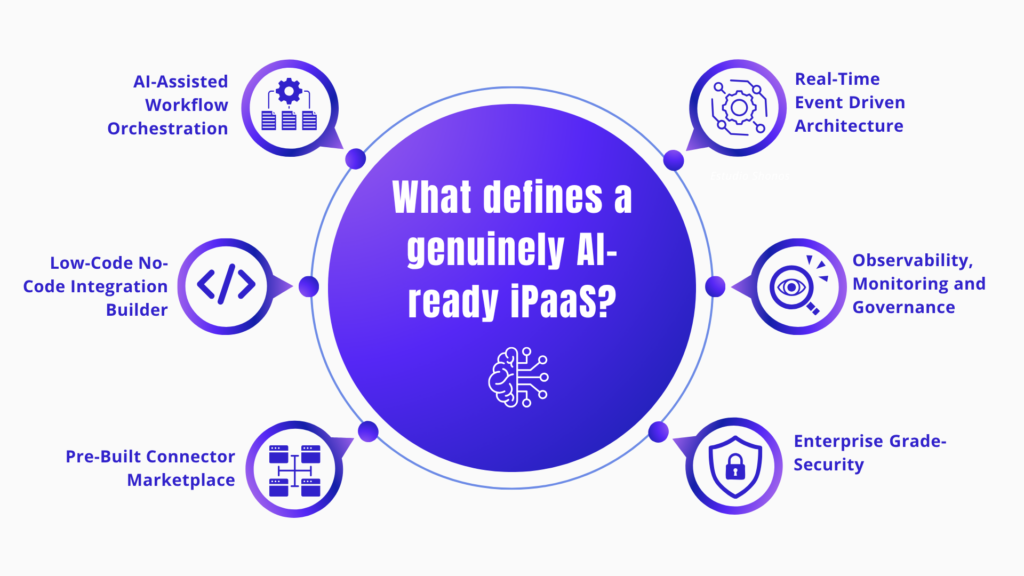
- AI-Assisted Workflow Orchestration
This is the feature to interrogate most rigorously because it is also the most misrepresented.
Genuine AI-assisted orchestration means the platform supports event-condition-action triggers that fire automatically based on real-time data events, and not on scheduled intervals. It means adaptive scheduling that adjusts sync frequency based on volume and system health. It means workflow recommendations that suggest optimal task sequencing to minimize latency and resource use. It also means self-healing pipelines that detect failures, auto-retry steps, and reroute backup flows without waiting for a human to notice something is wrong.
When you are evaluating an AI workflow orchestration platform, do not accept a demo of the happy path. Ask what happens when a downstream system goes down mid-workflow. Ask how the platform handles a 10x volume spike. The answers will tell you whether you are looking at genuine orchestration or clever marketing.
In supply chain and coordination environments, where a missed event can mean a stockout, a delayed shipment, or a compliance failure, this capability is not a differentiator. It is the price of an entry.
- Low-Code / No-Code Integration Builder
The era of integration as an IT-only function is over. It ended when SaaS adoption accelerated past the point where centralized IT teams could keep pace.
Gartner estimated that by 2025, 70% of new applications would be built using low-code or no-code tooling. That trend has fully reached integration. Business teams now need to build and modify their own workflows, on their timelines, without waiting for an IT resource to become available.
The best platforms deliver this without compromising on governance. A visual, drag-and-drop builder handles the interface. The platform manages the complexity underneath. Be it, API authentication, data transformation or error routing, everything is handled. Your teams define what they want to happen. The platform figures out how.
The critical balance to look for:
- Low-code access paired with guardrails
- Role-based permissions
- Approval of workflows for production changes
- Audit logs that show who built what and when
Citizen developers can move fast. Governance keeps them from moving recklessly.
Can non-technical teams really build enterprise integrations?
Yes, and they are already. The question is not capability. It is safety.
The right enterprise automation platform makes integration accessible to business users. They maintain controls that prevent well-intentioned workflows from creating security gaps or data quality issues. When that balance is right, IT shifts from a bottleneck into an enabler. They empower teams to set up the governance framework and let them operate within it.
- Pre-Built Connector Marketplace
Every integration built from scratch is a one-time cost that becomes a recurring maintenance burden. Over time, custom-built connectors become technical debt, which is a competitive disadvantage.
A mature integration marketplace changes this dynamic. Pre-built, maintained connectors for the tools your business already runs, mean you are deploying integrations, not building them.
The productivity difference is significant. Teams with access to a rich connector library routinely cut integration setup from multiple development days to a matter of hours. At scale, across a portfolio of 50 or 100 integrations, that gap compounds into months of saved engineering time.
When evaluating a marketplace, count connectors but do not stop there. Depth matters as much as breadth. A connector that handles only basic field mapping is different from one that supports custom objects, bidirectional sync, real-time webhooks, and complex field transformation logic. Audit the connectors for your most critical systems before signing anything.
- Real-Time, Event-Driven Architecture
In an AI-first environment, this is not negotiable. It is where many legacy platforms quietly fall short.
AI models need current data to work on.
Here is a concrete scenario: a procurement AI assistant is asked to flag reorder needs across 200 SKUs based on current stock levels and incoming demand signals. If the integration layer is running overnight batch syncs, that AI is working with yesterday’s inventory. Its recommendations could be materially wrong in ways that cost real money.
Real-time, event-driven architecture means the platform ingests live event streams such as order placements, inventory movements, shipment updates, sensor readings, and routes them through processing pipelines the moment they occur. The AI gets the context it needs. The decisions it makes are based on what is happening, not what was happening when the last batch ran.
Look for platforms that support multi-cloud and hybrid deployments alongside real-time event processing. Large enterprises operate across multiple cloud environments and on-premises systems. Your integration platform needs to work across all of it without architectural compromises.
- Observability, Monitoring and Governance
Scales create complexity. Complexity creates risks. Observability is how you manage that risk without slowing down.
At minimum, a production-grade iPaaS should give you real-time dashboards showing workflow status across all active integrations, full audit trails that let you trace any data event through every system it touched, alerting on anomalies, and the ability to drill into individual workflow runs to diagnose failures. The best platforms layer AI-assisted anomaly detection on top of this, flagging patterns that suggest a problem before it becomes a failure.
Governance becomes especially important as AI agents enter the picture. Gartner projects that by 2028, a significant share of enterprise breaches will involve AI agent abuse, from both internal and external actors. That is not a reason to avoid AI agents. It is a reason to deploy them on platforms that include built-in guardrails: role-based access controls, human-in-the-loop approval workflows for high-impact actions, and immutable logs of agent behavior.
Platforms that offer cross-team workflow automation with full visibility across teams and workflows give you the operational confidence to scale AI-augmented processes without losing control of them.
- Enterprise-Grade Security
The security conversation around iPaaS has changed significantly as platforms have moved from managing simple data syncs to orchestrating AI agents across sensitive systems.
Zero-trust is now the baseline architecture, and not a premium feature. Every API call, every agent in action, every data access request should be authenticated and validated regardless of where it originates. Network perimeter security alone is insufficient when your integration platform is the connective tissue linking dozens of systems, data sources, and AI models.
Look for platforms with zero-trust authentication, encryption, and sector-relevant compliance frameworks such as, HIPAA for healthcare, GDPR for any European data handling, industry-specific standards for financial services and manufacturing. Platforms that treat security as an optional add-on are platforms designed for a threat environment that no longer exists.
A Side-by-Side Look: What's Actually Changed
| Feature | Traditional iPaaS | AI-Orchestrated iPaaS |
|---|---|---|
| Workflow execution | Fixed trigger-action rules | Dynamic, condition-based sequencing |
| Error handling | Alerts requiring manual response | Self-healing pipelines with auto-rerouting |
| Builder access | Developer-dependent | Low-code / no-code for business teams |
| Connector setup | Custom builds per integration | Pre-built marketplace with maintained connectors |
| Data processing | Scheduled batch sync | Real-time, event-driven streaming |
| Monitoring | Basic logs and status alerts | AI-assisted anomaly detection and observability |
| Security model | Perimeter-based access control | Zero-trust, encrypted, role-based governance |
| AI agent support | Not designed for it | Built-in guardrails, audit trails, approval flows |
The Strategic Choice Underneath the Technical One
Here is the thing about iPaaS selection that often gets lost in feature comparisons and vendor demos: you are not just choosing a tool. You are choosing an architectural foundation.
The platform you select will determine how fast your teams can respond to change, how effectively your AI investments perform, and how much of your engineering capacity gets consumed by maintenance versus innovation. Get it right, and integration becomes a competitive advantage. Get it wrong, and it becomes the ceiling on everything else you are trying to build.
The features outlined above are not aspirational. They are the practical requirements for any integration platform that will serve as an AI-augmented enterprise.
Platforms like Aekyam are designed with this reality in mind with AI orchestration built into the core architecture, a low-code builder accessible to business teams, a pre-built connector marketplace, real-time event processing, and enterprise governance in a single, unified platform.
If you are making this evaluation now, request a demo and stress-test the platform against your most complex integration scenario or contact our team of experts for more guidance.
Share
Read Similar Blogs