
Modern shopping malls are living ecosystems. They are a mix of retail, dining, entertainment, and property management, all working together. For mall operators expanding through new property acquisitions is a task. Every time a new mall joins the portfolio, it adds an entirely new set of assets to manage and to track.
That means keeping a track of what’s vacant, when leases expire, who the tenants are, and what type of businesses they run.
The challenge? Most of these billion-dollar properties are still running on outdated digital systems.
Data is scattered across multiple disconnected tools such as:
- Parking systems
- Restaurant POS terminals
- Cinema software
- Leasing databases
- Maintenance platforms
None of these systems “talk” to each other. As a result, a lot of manual work is required making it nearly impossible to get a clear, real-time picture of their assets.
Our three-phase blueprint solves this problem by moving from fragmentation to full intelligence: Integration, Automation, and Analytics.
Phase I: The Crux of Connection - Integration
The first and foremost step to digital maturity is establishing a unified digital backbone. Without this critical layer, automation or predictive intelligence is fragile.
Our first proposition is uncompromising: pure integration.
The goal is to elevate the core ERP system to its rightful place as the single, centralized data store. This requires every digital silo across the property to connect and feed data directly and automatically into this central hub. This includes:
- Real-time transactional data from parking and restaurant systems
- Experiential data from cinema and events
- Inventory and leasing information
However, the primary objective isn’t just moving files; it is making disconnected systems talk to each other. Once this integration is achieved, the mall owner gains a single, accurate source of truth:
- Vacancy status of a shop
- Terms of a lease
- Daily sales performance of the tenant
All of these are suddenly correlated and immediately accessible at the centralized reservoir.
Phase II: Eliminating Tedium - Automation
With a centralized, reliable data platform in place, the immediate, logical next step is the implementation of Automation. This bridges the distance between simply collecting data and using it to reduce time-consuming tasks.
Automation targets the core of operational inefficiency across the entire ecosystem:
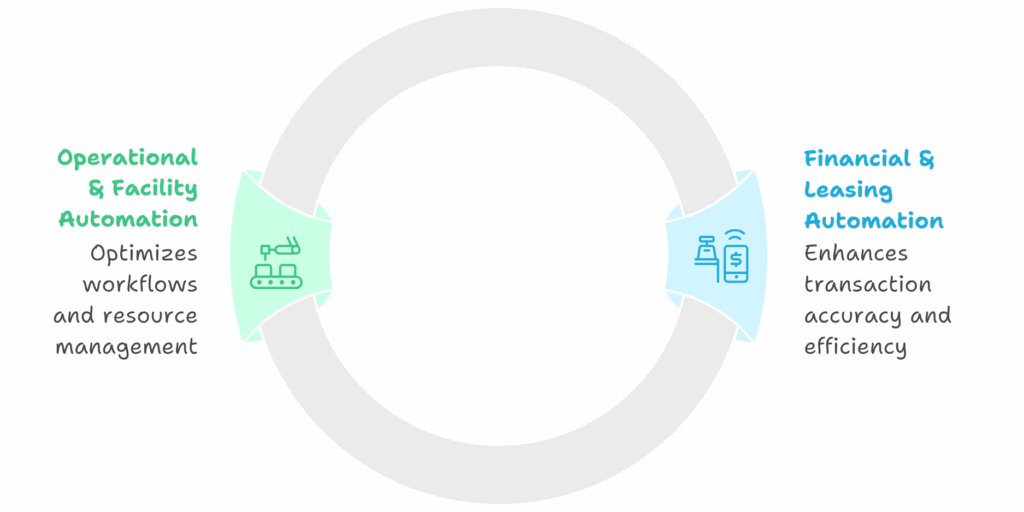
- Financial & Leasing Automation: Once a lease is finalized in the ERP, the system autonomously takes over. Monthly rent invoices are generated payment reminders are sent. It can also trigger late notices and compliance actions based on set rules. It further simplifies tenant onboarding. Lease details can be directly pulled from documents and sales payments can also be handled with manual effort.
- Operational & Facility Automation: Beyond the tenant lifecycle, maintenance and security related issues are also automated. For instance, work orders for maintenance can easily be triggered through data usage or flagged metrics. It can also automatically adjust HVAC settings based on real-time footfall data from various floors.
This shift minimizes human error, ensures rules are followed consistently. It frees up teams to focus on higher value tasks, instead of time-consuming ones. Automation ensures that compliance is proactive, not reactive.
Phase III: Predictive Power - Intelligence and Analytics
The final and most transformative phase is the application of advanced Intelligence and Analytics. This is where the integrated and automated turns into clear, actionable insights.
It’s no longer enough to know that a tenant is “doing badly.” Mall owners need to understand the trend and the context. Intelligence provides this through key performance indicators (KPIs) and comparative analysis:
- Contextual Performance Analysis
- Health Ratio Deep Dive: The “Health Ratio” (a tenant’s rent as a percentage of their sales) is a critical KPI. If a tenant’s ratio spikes to an unsustainable level, the immediate action is to ask the following questions:
- Is the issue unique to that brand?
- Is the entire industry segment (e.g., luxury footwear) experiencing a regional or national downturn?
- Is that specific floor or wing of the mall underperforming?
Intelligence helps you compare trend data across segments, floors, and time periods to answer these questions. It shows who is in a downward spiral versus who is just experiencing a seasonal dip.
- Optimizing the Tenant Mix: Beyond tracking tenant performance, the intelligence uses footfall and sales conversion metric to guide leasing decisions. It can suggest the right tenants for empty shops by matching demographic footfall patterns to ideal retail categories. The system can automatically flag if a certain brand is overrepresented and helping create a better mix.
- Measuring Real ROI on Experiences
- Marketing & Footfall Conversion: Malls spend heavily on marketing campaigns and celebrity events. But is it helping the ROI? By integrating data from cameras (footfall tracking) with POS data (sales conversion), mall owners can see what’s working and what’s not. Did the music festival increase footfall? Did the increased footfall convert into sales? This AI-driven analysis shifts marketing from a guess to a measurable, strategic investment.
By progressing through these three stages—Integration, Automation, and Intelligence—mall management can move beyond manual processes. The outcome of this progression is a truly intelligent asset, that can predict risks, identify opportunities, and ensure sustained profitability.
This entire retail real estate journey can be unified by Aekyam AI Orchestration Platform:
- Aekyam starts simple with foundational integration
- Layers automation and deep intelligence
- Lastly, ensures that the entire complex ecosystem operates as one seamless, high-performance unit
The era of running a complex, multi-property asset on spreadsheets is over. The time for intelligent retail real estate operations is now.
Embracing the Future of Integration and Automation
The convergence of Gen AI and iPaaS is ushering in a new era of integration and automation. With the evolution of this power duo, it promises even greater potential to streamline operations, enhance agility, and drive intelligent decision-making across the enterprise.
Here’s what Aekyam’s cutting-edge Gen AI iPaaS delivers:
- Goes far beyond traditional integration
- Leverages Generative AI to simplify, accelerate, and optimize the integration lifecycle
- Automates complex workflows
- Intelligent data-mapping
- Enables natural language-driven integration building
In short, Aekyam transforms how businesses connect and operate.
With Aekyam organizations can:
- Eliminate manual bottlenecks
- Reduce integration timelines
- Adapt swiftly to changing demands, while maintaining high performance and reliability
- Enable both technical and non-technical users to collaborate because of its intuitive, AI-augmented environment.
For organizations ready to move forward, now is the time to explore what a Gen AI iPaaS can unlock. With Aekyam, you’re not just adopting a platform but you’re building a smarter, more agile foundation for growth and long-term innovation.
Ready to start you integration journey? Contact us today to learn how we can help you.
Share
Read Similar Blogs