

Supply chain disruptions cost millions annually. This financial impact makes AI orchestration implementation essential for business survival. Supply chain practitioners now identify AI as the primary catalyst for operational transformation. More specifically for its ability to automate complex pattern recognition and predictive analytics.
What separates successful implementations from failed pilots? The organizations achieving cost reductions and high delivery reliability improvements follow proven frameworks that address both technical requirements and organizational readiness. This roadmap provides those frameworks, focusing on practical implementation strategies that deliver measurable business results rather than theoretical possibilities.
In this article, you’ll discover how to build your supply chain AI roadmap systematically, overcome common deployment obstacles, and deploy AI orchestration and automation platforms that transform operational performance. The approach emphasizes actionable steps based on real-world implementations rather than conceptual guidance.
Building Your AI Supply Chain Readiness Foundation
Your supply chain AI roadmap begins with systematic assessment of current capabilities. Organizations must audit existing AI tool usage during the initial weeks, documenting workflows, measuring time spent on context switching, and identifying consistency gaps. This baseline assessment reveals where AI orchestration implementation delivers maximum value.
Data quality controls your success trajectory. Supply chain AI initiatives face a harsh reality: many fail to scale beyond testing phases due to data readiness issues rather than model complexity. Clean, structured, and consistent data forms the prerequisite for any AI orchestration and automation platform to function reliably.
Technical infrastructure encompasses three critical components:
- API management: Rate limiting, error handling, and cost monitoring capabilities
- Data management: Brand asset storage, version control, and security protocols
- Integration architecture: Webhook systems, monitoring dashboards, and logging capabilities
Security and compliance establish non-negotiable requirements. Data encryption, privacy by design, output monitoring, content filtering, and adherence to frameworks like GDPR create the operational foundation. Governance frameworks establish oversight rules, transparency standards, and auditability across multiple autonomous agents.
What role does team readiness play in implementation success?
Organizations frequently underestimate the cultural adaptation required to manage AI systems effectively. Training programs, reskilling initiatives, and change management become essential elements for successful AI adoption in supply chain operations. Technical capabilities alone cannot drive transformation without organizational readiness to embrace new operational models.
Team preparation parallels technical preparation in importance. The most sophisticated AI orchestration platform fails without teams equipped to interpret outputs, make strategic decisions, and maintain system performance over time.
Creating Your AI Orchestration Implementation Plan
Successful AI orchestration implementation requires a structured five-phase approach spanning 18-36 months, depending on your organization’s data maturity and complexity. Organizations with strong existing infrastructure complete implementations in 18-24 months, while complex situations requiring legacy system integration extend to 36+ months.
Executive sponsorship determines project viability. Organizations must allocate 3-5% of annual revenue for meaningful AI transformation, with dedicated budget authority to drive changes across organizational silos. Change management alone requires 25-30% of your total project budget for maximum adoption success.
Concrete, measurable targets replace vague objectives. Reduce forecast error by 25% within 12 months or cut inventory holding costs by specific dollar amounts. AI projects typically require 6 to 18 months to yield noticeable results, making realistic timeline expectations essential.
Implementation phases break down systematically:
- Phase 1: Foundation and Strategy (3-6 months) – establish direction and organizational readiness
- Phase 2: Data and Infrastructure Preparation (6-12 weeks) – build technical foundation
- Phase 3: Pilot Development and Testing (8-16 weeks) – validate approaches with clear business value
- Phase 4: Scaling and Integration (6-18 months) – expand successful pilots enterprise-wide
- Phase 5: Optimization and Innovation (Ongoing) – continuous improvement and advanced capabilities
An AI Steering Committee with C-level executives provides strategic direction and resource allocation. This governance structure ensures alignment between technical capabilities and business objectives while maintaining momentum through implementation challenges.
The key differentiator lies not in the phases themselves, but in the rigor with which organizations execute each stage. Companies that skip foundational work or rush through data preparation typically encounter costly setbacks during scaling phases.
Common AI Orchestration Implementation Obstacles
The gap between pilot success and production deployment catches most organizations unprepared. Research reveals 88% of POCs never reach widescale deployment, while 95% of AI pilots generate no return. Root causes split between technical failures and organizational resistance – with resistance often proving more difficult to resolve.
Data fragmentation creates your largest technical barrier. A concerning 67% of organizations don’t trust their data enough to use it effectively, and 63% remain unsure if they have the right data management practices for AI. Information trapped across legacy ERP systems, customized CRM platforms, and isolated departmental databases prevents models from generalizing properly across business operations.
Critical implementation obstacles include:
- Trust deficits: Over 80% of supply chain decision-makers report frustration with AI-powered tools during disruptions
- Integration complexity: Legacy systems lack API support and real-time capabilities needed for AI workloads
- Organizational silos: Fixed annual RFP cycles and static contracts reduce visibility across supply networks
- Human resistance: Employees mistrust AI outputs or fear job displacement without proper change management
Human-in-the-loop oversight remains essential. AI handles routine tasks efficiently, but human experts must make judgment calls in edge cases and ethically complex scenarios. Without transparent governance and cross-functional collaboration, even technically sound pilots stall during scaling.
The organizations that succeed treat these obstacles as predictable challenges rather than insurmountable barriers. They address data quality early, invest in change management from project inception, and maintain human expertise as a core component of their AI systems rather than viewing it as a temporary necessity.
Building a Strong Foundation for AI Orchestration Success
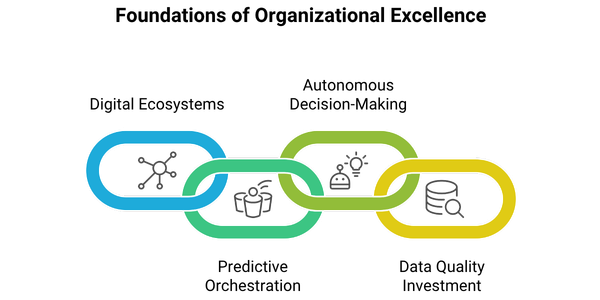
AI orchestration implementation success depends on three interconnected pillars: technical infrastructure, organizational commitment, and data foundation quality. Technical capabilities alone cannot drive the business transformations that leading companies achieve.
The path forward requires methodical execution. Conduct your readiness assessment first, establish concrete performance targets, and allocate appropriate resources for organizational change. Data fragmentation issues must be addressed early in the process, and human expertise remains essential for complex decision scenarios.
Organizations that approach AI orchestration as strategic transformation rather than technology adoption position themselves for sustained competitive advantage. The frameworks outlined here provide actionable steps based on proven implementations, not theoretical concepts.
This is where Aekyam adds real value.
Aekyam helps organizations bridge the gap between strategy and execution by unifying data, systems, and AI workflows into a single orchestration layer. It simplifies complexity, making it easier to assess readiness, break down data silos, and deploy AI agents that work seamlessly across your operations.
With Aekyam, you can:
- Gain a clear view of your current maturity and gaps
- Connect fragmented data sources into a unified foundation
- Accelerate pilot development with pre-built orchestration capabilities
- Scale AI initiatives with confidence and control
Your next step is to understand where you stand today—and identify the gaps that need to be addressed before moving into pilot development. With the right foundation and the right platform, you can move faster from ambition to impact.
Get in touch with our team to make your organization AI ready.
Share
Read Similar Blogs