


Every boardroom conversation today eventually circles back to AI. The pressure is real. Adopt it fast, show results faster, while maintaining what is already working.
But here is what nobody is talking about. Most enterprises are not failing at AI because they picked the wrong model. They are failing because they never built the foundation that AI needs to work on.
AI and Machine Learning are only as powerful as the data, systems, and workflows behind them. And that is exactly the conversation we need to have.
What Is AI/ML?
Let us cut through the buzzwords.
Artificial Intelligence (AI) is the broader field, building systems capable of performing tasks that normally require human intelligence. Example includes recognizing patterns, making decisions, understanding language, or predicting outcomes.
Machine Learning (ML) is how most modern AI works. Instead of being explicitly programmed with rules, ML models learn from data. Feed them enough examples, and they start identifying patterns, making predictions, and improving over time with minimal human intervention.
Together, AI/ML powers your business with intelligent demand forecasting, fraud detection, product recommendations, customer sentiment analysis, and intelligent chatbots. The technology is not new. What is new is how central it has become to staying competitive, and how badly most implementations fall short of their potential.
Why AI/ML Is a Business Imperative Right Now
The case for AI/ML is not about innovation anymore; it is about survival. Businesses that get AI right are compressing timelines, cutting costs, and finding revenue opportunities their competitors are still blind to.
Here is what is at stake:
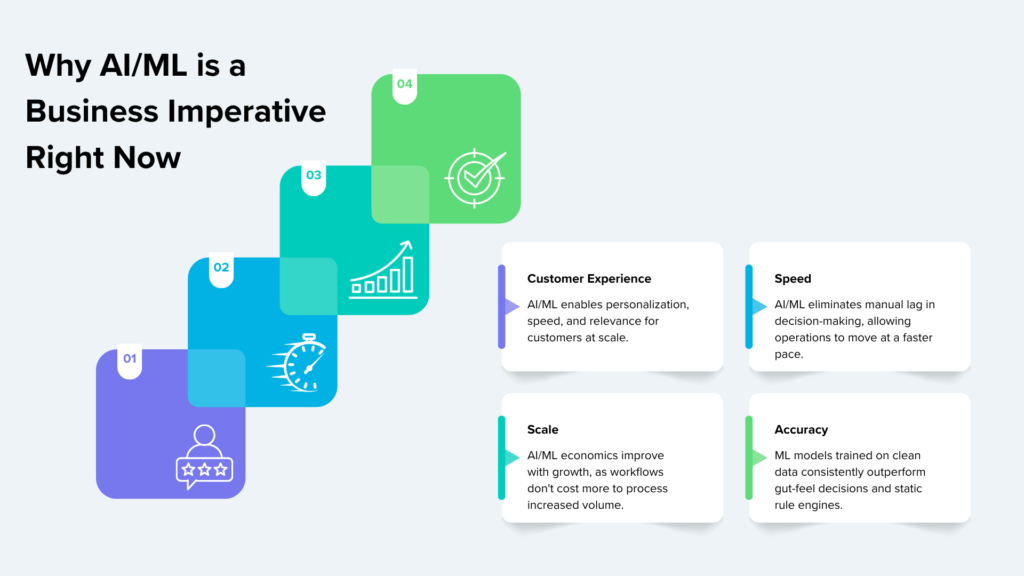
Speed. AI/ML eliminates the manual lag in decision-making. Your systems can process thousands of orders, flag anomalies, and trigger automated responses in real time. This ensures that your operations move at a pace no human team can match manually.
Accuracy. Whether it is inventory forecasting or customer segmentation, ML models trained on clean, connected data consistently outperform gut-feel decisions and static rule engines.
Scale. The economics of AI/ML get better as you grow. Unlike headcount, a well-built AI/ML workflow does not cost more to process twice the volume. It just performs.
Customer experience. Customers today expect personalization, speed, and relevance. AI/ML is what makes it possible to deliver that at scale without a dedicated team behind every interaction.
The businesses winning with AI/ML are not necessarily the ones with the most sophisticated models. They are the ones who built the right infrastructure around those models. That distinction matters enormously.
Where Enterprises Go Wrong with AI/ML
Despite the potential, most AI/ML projects underdeliver. The reasons are surprisingly consistent across industries.
The data is a mess — and nobody wants to admit it
AI models are not magic. They cannot conjure reliable outputs from unreliable inputs. Yet enterprises routinely launch AI initiatives on top of fragmented, siloed, inconsistent data and then wonder why the results do not hold up.
A retailer trying to build a demand forecasting model while their inventory data lives in three separate systems, updated at different intervals, with different field naming conventions, is not going to get accurate forecasts. They are going to get confidently wrong ones.
The fix is not a better model. It is unified, standardized, real-time data which is fundamentally an integration problem before it is an AI problem.
Teams treat AI as a destination, not a process
AI/ML is not a project you complete. It is a capability you build and continuously refine. Businesses that treat it as a one-time implementation deploy the model, declare success, move on, consistently see performance degrade as the real-world drifts away from the conditions the model was trained on.
Effective AI/ML requires feedback loops, retraining cycles, performance monitoring, and the ability to intervene when something goes wrong. Without those mechanisms built in, even a great model becomes a liability over time.
The automation goes unsupervised
Automating a decision-making process without building in human oversight is one of the fastest ways to damage customer trust or create compliance exposure. AI models can and do produce unexpected outputs — especially when they encounter data patterns outside their training distribution.
The enterprises that handle this well do not just deploy automation. They build monitoring, alerting, and exception-handling into every AI-driven workflow. They know what the model is doing, when it is doing something unusual, and how to course-correct quickly.
Nobody trained the people
Technology adoption fails when the humans using it do not understand it or trust it. AI/ML is no different. When business teams do not understand what an AI recommendation means, how it was generated, or what its limitations are, they either over-rely on it blindly or ignore it entirely. Neither outcome serves the business.
What Good AI/ML Implementation Actually Looks Like
Getting AI/ML right is less about finding the perfect model and more about building the right conditions for any model to succeed. Here is the framework that works:
Start with the problem, not technology. The most successful AI/ML implementations begin with a specific, measurable business problem, not a mandate to “do AI.” Define what success looks like before you write a single line of code or integrate a single tool.
Fix the data foundation first. Before any model goes live, your data needs to be unified, clean, and accessible in real time. This means breaking down silos between systems, standardizing data formats, and establishing governance around how data flows through your organization.
Build for observability from day one. Every AI/ML workflow needs visibility into what data it is consuming, what decisions it is making, and how those decisions are performing over time. Monitoring is not an afterthought; it is a core part of the system.
Keep humans in the loop. The goal of AI/ML is not to remove human judgement; it is to make human judgment more informed and more scalable. Design your workflows so that AI handles the volume and speed, and humans handle the edge cases and oversight.
Pilot, learn, and scale. Do not try to automate everything at once. Pick a contained use case, measure rigorously, learn from what works and what does not and expand from a position of demonstrated success.
Make it a culture, not a project. The organizations that win with AI/ML in long-term are the ones that build data literacy, celebrate evidence-based decisions, and continuously invest in the infrastructure that keeps their AI performing well.
This Is Exactly What Aekyam Is Built For
Every best practice above has one thing in common: it requires your systems, data, and workflows to be deeply connected and intelligently orchestrated. That is not an AI/ML problem it is an integration problem. And it is the problem Aekyam was designed to solve.
Aekyam is an enterprise AI Orchestration Platform that makes your AI/ML initiatives work by ensuring the data, systems, and processes powering them are unified, reliable, and intelligent.
Here’s how Aekyam’s specific capabilities directly address what AI/ML success demands:
Unified, AI-Ready Data
Aekyam connects your applications, databases, and data streams standardizing and synchronizing data across cloud, on-premises, and hybrid environments. When your inventory system, OMS, and CRM are all feeding clean, consistent data into your AI models, the outputs are dramatically more reliable. This is the foundation everything else sits on.
Real-Time Data Processing
AI/ML models trained on yesterday’s data make yesterday’s decisions. Aekyam’s real-time data processing ensures your models always operate on current information, critical for use cases like dynamic pricing, live inventory management, or real-time fraud detection.
Semantic Data Mapping and Mapping Recommendations
One of the most time-consuming parts of any AI/ML project is getting data from different systems to speak the same language. Aekyam’s AI-powered semantic data mapping automatically aligns fields and formats across disparate systems cutting integration setup time significantly and eliminating a major source of data quality errors.
Proactive Anomaly Detection
Aekyam does not just connect your systems it watches them. Built-in anomaly detection identifies when data flows behave unexpectedly, flagging issues before they corrupt your AI/ML pipelines. Combined with reprocess and replay capabilities, teams can correct errors at the source without manual reconstruction of lost data.
Agentic Automation with Human Oversight
Aekyam supports the deployment of AI agents that operate autonomously across your workflows while maintaining full payload traceability and monitoring, so your teams always know what is happening. You get the speed of automation without sacrificing control.
RAG and MCP for Grounded AI Outputs
Generic AI models give generic answers. Aekyam’s support for Retrieval-Augmented Generation (RAG) and Model Context Protocol (MCP) connects your LLMs to your actual enterprise knowledge so the AI your business relies on is answering based on your data, your context, and your reality.
Pre-Built Integrations via the Aekyam Marketplace
Getting your AI/ML stack connected to your existing enterprise applications should not take months. Aekyam’s Marketplace provides pre-built adapters across ERP, CRM, eCommerce, WMS, and more so you spend less time on plumbing and more time on outcomes.
ISO-Certified Security
AI/ML workflows handle sensitive data. Aekyam’s enterprise-grade security, including role-based access control, identity and access management, and encrypted data in transit and at rest, ensures your AI initiatives meet compliance requirements without adding operational overhead.
The Bottom Line
AI and Machine Learning are not going to become simpler or less important. The window to build a genuine competitive advantage with these technologies is open, but it will not stay open forever.
The enterprises that win will not necessarily be the ones with the most sophisticated models. They will be the ones who built the right foundation underneath those models, unified data, intelligent workflows, real-time visibility, and the operational discipline to keep it all performing.
If your AI/ML initiatives are underperforming, the answer is not a new model. It is a better integration layer.
That is what Aekyam delivers. Request a demo or contact our team of experts. Discover what your AI/ML stack is capable of when everything behind it is working the way it should.
Share
Read Similar Blogs