

Supply chain integration failures are bleeding money from businesses worldwide. 85% of companies report active financial losses tied directly to integration problems across their supply chain operations. The damage runs deep: 24% of organizations lose $500,000 or more each year, while 14% face losses exceeding $1 million annually. Operating expenses inflate by 3-5% when systems fail to communicate, and sales drop approximately 7%.
What does poor integration actually cost your organization? Enterprise integration costs extend far beyond the obvious disruption events. Supply chain integration problems create cascading financial damage that impacts revenue growth, operational efficiency, and customer relationships. Companies that ignore these integration costs face mounting pressure as competitors gain advantages through better-connected systems.
This article goes beyond pointing out the operational supply chain disruptions. It highlights the true financial impact of integration failures in supply chain operations. We’ll identify the core drivers behind supply chain integration costs and present proven strategies that deliver measurable ROI while protecting your bottom line from continued losses.
What is the Real Cost of Poor System Integration in Supply Chains
Poor system integration creates financial damage that spreads through every corner of your organization. The impact extends far beyond obvious disruption events, creating multiple layers of loss that compound over time.
Revenue Growth Suffers Most
Companies miss $1.6 trillion in annual revenue growth opportunities globally due to integration disruptions. Organizations lose between 7.4% and 11% of potential revenue growth when operational shocks hit. An overwhelming 94% of companies report that supply chain disruptions directly damage their revenue streams.
Integration failures drive operating costs up by approximately 11%. Sales growth drops 7% when systems cannot communicate effectively. The technology sector alone faces logistics disruption costs reaching $16 billion annually.
Customer Relationships Take Critical Hits
Integration breakdowns trigger increased customer complaints. Organizations also lose business directly due to logistics failures. The COVID-19 pandemic exposed this vulnerability when majority of US consumers switched brands or stores, with two-thirds citing product availability issues as the primary driver.
Customer tolerance proves surprisingly thin. Studies show 14% of customers abandon a retailer completely after just one late delivery. Another 16% walk away permanently after receiving a single incorrect order. These numbers reveal how integration problems create immediate, measurable customer defection that directly impacts long-term revenue potential.
Root Causes of Supply Chain Integration Challenges
Legacy infrastructure creates the foundation for most integration failures. Organizations allocate 70-80% of their IT budgets to maintaining outdated systems, leaving minimal resources for modernization efforts or innovation initiatives.
What drives these persistent integration problems? Data fragmentation emerges as the most destructive factor. Organizations report operational confusion and efficiency losses from fragmented data systems.
Your warehouse management system operates independently from transportation management, forcing teams to spend hours reconciling conflicting information rather than addressing operational challenges.
Manual processes amplify these inefficiencies. Data entry errors occur at a rate of 4%, creating 400 mistakes for every 10,000 transactions processed. Employees dedicate approximately 22% of their working time to manual data reconciliation, time that could address strategic priorities instead.
Siloed decision-making compounds these operational barriers:
- 70% of organizations identify isolated decision-making as a critical obstacle
- Retail teams make purchasing decisions without supplier input, creating operational ripple effects
- Only 20% of companies maintain real-time visibility across operations
- 58% cite manual workflows as their primary source of inefficiency
Supplier onboarding exemplifies these systemic problems. Manual onboarding processes extend timelines to six months, delaying access to essential components or new product launches. These bottlenecks directly impact enterprise integration costs while preventing organizations from realizing potential supply chain integration ROI.
Supply Chain Integration Strategies That Reduce Costs
Poor integration costs are reversible, but success requires structured implementation over rushed transformation attempts. Companies using modular integration strategies achieve ROI 40% faster than organizations attempting complete overhauls.
Start with focused implementation. Select one product family, manufacturing plant, or supplier segment where operational pressure creates clear business impact. Validate the data flows and performance metrics in this controlled environment before expanding. This approach minimizes financial risk while allowing teams to develop competency with new systems.
Integration platforms produce specific, measurable returns:
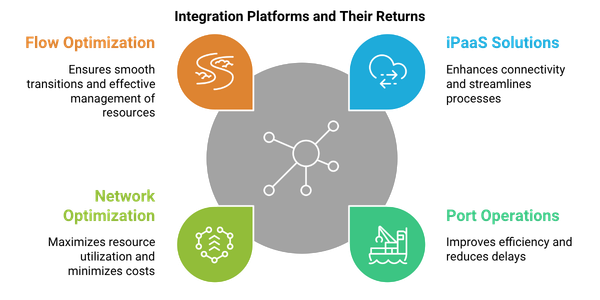
- iPaaS solutions: Connect disparate systems and normalize data formats across departments
- Port operations: Port operations reduce congestion and improve throughput times through unified platform integration
- Network optimization: Network design solutions offer the highest supply chain integration ROI per dollar invested
- Flow optimization: One European company achieved 18 million Euro savings within months of optimizing goods flow patterns
Align metrics across functions. Shared KPIs drive better outcomes than department-specific measurements. Procurement teams measuring only cost savings while logistics tracks freight spend separately creates local optimization that damages system performance. Focus on outcomes like on-time-in-full delivery and total cost-to-serve that require cross-functional coordination.
Turning Supply Chain Integration into Measurable Impact
Supply chain integration problems create measurable financial damage across revenue, operations, and customer retention. The solution requires focused execution rather than complex theory.
Three steps deliver results:
- Start with one critical area – Choose a product line, plant, or supplier relationship where integration failures cause visible pain points
- Prove the ROI first – Establish working data flows and measure performance improvements before expanding scope
- Align teams around shared metrics – Replace department-specific KPIs with system-wide measures like on-time-in-full delivery
Companies implementing structured integration approaches show results within months. Those attempting organization-wide transformations face extended timelines and resource strain. Focus on proving value in targeted areas, then scale based on demonstrated success.
This is where Aekyam plays a crucial role.
Aekyam enables seamless integration across fragmented systems by creating a unified layer for data, workflows, and decision-making. Instead of rebuilding everything from scratch, it connects existing systems, allowing organizations to quickly establish visibility, automate processes, and measure impact in real time.
With Aekyam, you can:
- Accelerate integration without heavy infrastructure changes
- Create reliable, real-time data flows across systems
- Enable cross-team alignment with shared, actionable insights
- Scale from pilot projects to enterprise-wide transformation with ease
Your integration costs will keep rising without deliberate action. Choose your starting point, prove the value—and let Aekyam help you scale what works.
Contact our team of experts to know how we can help you increase your ROI.
Share
Read Similar Blogs