

Your AI Agent Just Hit a Wall
Your AI agent can write code, analyze data, and draft customer responses. It can reason through complex problems and make decisions on its own. But when it needs to check inventory in your ERP, update a record in your CRM, or trigger a payment through your finance system, it hits a wall.
The reason is simple: agents can only act on systems they can access. Most enterprises are building AI agents without first building the integration layer; those agents need to function across the organization.
The result? Siloed pilots that never leave the demo stage. Compliance gaps that create legal risk. And AI that generates more work than it saves.
This blog explains why agentic AI depends on intelligent integration infrastructure, what governance requirements emerge when AI agents operate autonomously, and how to build the orchestration foundation that lets autonomous AI scale.
What Makes Agentic AI Different from Traditional Automation
Autonomous Decision-Making vs. Rule-Based Workflows
Traditional automation follows rules. You define the trigger, the conditions, and the action. The system executes exactly what you told it to, every time.
Agentic AI works differently. It starts with a goal and autonomously plans how to reach it. It reads the current state, decides which actions to take, executes those actions across multiple systems, and adjusts based on the results.
Here is a concrete example. A traditional workflow for a customer complaint might:
- Route the ticket based on keywords
- Assign it to a queue
- Send a templated response
An agentic AI handling the same complaint would:
- Read the sentiment
- Check the customer’s purchase history and tier
- Decide whether to escalate based on context
- Draft a personalized response
- Apply a discount if warranted
- Log the entire interaction
The agent adapts based on what it encounters. The workflow does not.
What Is the Difference Between AI Automation and Agentic AI?
In an iPaaS context, AI automation means AI helps build, monitor, or optimize integrations. It might suggest field mappings, flag errors, or generate code snippets. Humans still define the workflow logic. The automation is AI-assisted, not AI-driven.
Agentic AI goes further. An AI agent can define its own action sequence to reach a goal, interact with multiple systems dynamically, and adapt its behavior based on real-time context. It does not follow a predefined path.
This distinction matters because agentic workflows need fundamentally different infrastructure. When an agent autonomously decides which systems to access in what order and with what data, your integration platform must support dynamic routing, real-time access controls, and comprehensive audit trails. Traditional iPaaS was not built for this.
The Integration Dependency: Why AI Agents Need iPaaS
Real-Time System Access Is the Bottleneck
An AI agent’s capability is capped by the systems it can access in real time. If it can read from Salesforce but not write to NetSuite, it can analyze customer data but cannot act on it. If it can query your inventory system but not your logistics platform, it can detect stockouts but cannot trigger reorders.
This is where most agentic AI pilots fail. Organizations build impressive proofs of concept using agents that access a single system or a curated dataset. Then they try to go to production and suddenly the agent needs real-time connectivity to ERP, CRM, support platforms, data warehouses, and legacy systems, all with proper security, governance, and error handling.
Without a robust integration layer, the agent either operates in a silo limiting its usefulness or requires custom API development for every system it touches, which makes deployment prohibitively expensive.
iPaaS as the Nervous System for AI Agents
Think of integration platforms as the nervous system, and agentic AI as the brain. The brain reasons and decides, but it needs the nervous system to sense what is happening and act across the body.
A intelligent iPaaS gives AI agents governed, real-time access to enterprise systems without opening new security or compliance gaps. The platform handles authentication, data transformation, error handling, and audit logging. These are things every agent needs but should not have to build from scratch.
Modern integration platforms support event-driven architectures where AI agents subscribe to business events, process information across multiple models, and trigger actions across systems. For example, a supply chain disruption detected by one agent can automatically trigger inventory reallocation, customer notification, and supplier communication, all coordinated through a shared integration layer.
The Model Context Protocol (MCP) and Enterprise Integration
The Model Context Protocol (MCP), introduced by Anthropic in 2024, standardizes how AI systems interact with external tools, services, and data sources. It creates a consistent interface between AI models and enterprise systems, like how iPaaS creates consistent interfaces between applications.
Together, MCP and traditional integration protocols provide the connective tissue that lets AI agents sense, reason, and act across your full technology stack. Modern iPaaS platforms are embedding MCP support natively, allowing agents to query live data from connected systems without writing custom integration code for each deployment.
Platforms that combine MCP support with a strong library of pre-built connectors cut agent deployment time from months to weeks. Platforms that treat MCP as a bolt-on create the same fragmentation problems seen in traditional AI integration.
Governance Requirements for Agentic Workflows
25% of Breaches Will Trace to AI Agent Abuse by 2028
Gartner predicts that by 2028, 25% of enterprise breaches will be traced to AI agent abuse from external attackers and malicious insiders alike. The autonomous nature of AI agents introduces risks that traditional automation never created.
When a rule-based workflow breaks, it stops. When an AI agent encounters an unexpected situation, it might improvise and that improvisation could violate compliance policies, expose sensitive data, or execute unauthorized transactions.
The integration layer is where governance gets enforced. A well-architected iPaaS applies role-based access controls, full audit trails, and compliance guardrails at the workflow level, not just at the system perimeter. It tracks which agent accessed which data, what decisions it made, and what actions it took, creating an explainable chain of custody for every autonomous operation.
Guardian Agents: The Oversight Layer Enterprises Need
Gartner also predicts that by 2028, 40% of CIOs will require “Guardian Agents” oversight mechanisms that can autonomously track, review, and contain the actions of AI agents operating across enterprise systems.
Think of Guardian Agents as the supervisory layer above your operational agents. While operational agents execute tasks, Guardian Agents monitor their behavior, flag unusual patterns, enforce policy boundaries, and escalate exceptions to human reviewers with full context.
This oversight architecture requires the integration platform to support agent-to-agent communication, hierarchical policy enforcement, and real-time monitoring across distributed workflows. Platforms that treat governance as an afterthought will struggle here. Platforms built with governance, observability, and security at their core become the foundation for safe agentic deployment.
How Do You Prevent AI Agents from Making Unauthorized Decisions?
The answer is layered controls built into the integration layer. Modern iPaaS platforms offer several mechanisms:
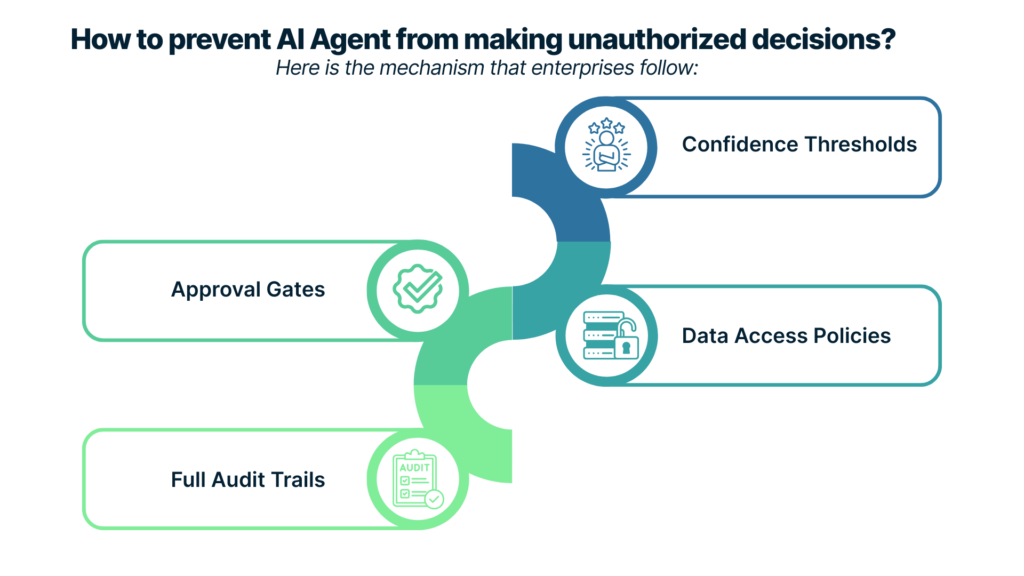
- Confidence thresholds: Decisions below a set confidence score route to a human for execution.
- Approval gates: High-impact actions like issuing refunds above a certain amount automatically pause for human review.
- Data access policies: Agents can only access the information their role permits.
- Full audit trails: Every data access, decision, and action is logged with complete context.
These capabilities need to be native to the workflow orchestration layer and not added later through separate compliance tools. When governance is embedded in the integration platform, it scales with your agent’s deployments rather than becoming a bottleneck.
The BOAT Convergence: Integration Meets Orchestration
Why Standalone RPA and BPA Cannot Handle Agentic Workflows
Traditional RPA and BPA platforms were built for deterministic processes, workflows where every step is predefined, and every decision point is mapped in advance.
Agentic AI introduces non-deterministic workflows. The agent decides its own path based on context. It might take different actions for similar inputs depending on learned patterns, current system state, or real-time priorities. Legacy automation platforms cannot orchestrate this kind of adaptive behavior.
Gartner introduced the BOAT framework, Business Orchestration and Automation Technologies, to describe the convergence of iPaaS, RPA, BPA, low-code platforms, and intelligent document processing into unified orchestration platforms that handle both deterministic processes and agentic workflows in a single architecture.
Gartner’s Prediction: 70% of Enterprises Will Pivot to Consolidated Platforms by 2030
Gartner predicts that by 2030, 70% of enterprises will consolidate onto a single automation platform that orchestrates business processes, AI agents, bots, APIs, and human actions up from just 5% today.
This matters for your integration strategy right now. The iPaaS platform you evaluate today needs to support agentic orchestration tomorrow. If its architecture cannot natively handle agent workflows, you will be replacing it before you have finished your current integration roadmap.
The platforms positioned to lead this convergence are built with AI-native architecture, strong governance controls, and unified orchestration from the start. Platforms treating agentic AI as a future add-on will struggle to compete.
Building an Integration Foundation for Agentic AI
Start with High-Impact, Bounded Workflows
Do not try to deploy enterprise-wide agentic automation on day one. Start with high-impact workflows that have clear boundaries, measurable outcomes, and limited system dependencies.
Good first candidates include:
- Invoice processing workflows that touch AP systems and ERP
- Customer support workflows that integrate ticketing platforms, CRM, and knowledge bases
- Inventory management workflows connecting supply chain systems with demand forecasting
Prove value in these bounded environments first. Use early deployments to establish governance patterns, build organizational confidence, and identify which use cases deliver the highest ROI for your environment, before expanding agent autonomy.
The Three-Layer Architecture: Data + Integration + Governance
Successful agentic AI deployment requires three infrastructure layers working together.
Data layer: Clean, accessible, well-governed data sources that agents can query in real time. Without trusted data, even the most sophisticated agents make poor decisions.
Integration layer: Comprehensive connectivity to enterprise systems through a unified iPaaS platform. This includes pre-built connectors for common applications, API management for custom systems, event-driven architecture for real-time workflows, and support for both traditional integration protocols and modern standards like MCP.
Governance layer: Built-in policy enforcement, audit trails, approval gates, and monitoring that apply consistently across all agent-driven workflows. This layer keeps agents within defined boundaries and creates the explainability enterprises need for compliance and risk management.
Most organizations underinvest in the integration and governance layers, then wonder why their AI agents cannot scale beyond the proof-of-concept stage. The 80% effort on data engineering and connectivity is not optional; it is the foundation that determines whether agentic AI delivers value or creates risk.
Pre-Built Connectors Accelerate Agent Deployment
A strong integration marketplace with pre-built connectors means your agents do not start from scratch every time they need access to a new system. Instead of spending weeks building custom integrations, you configure existing connectors and focus your energy on the agent’s decision logic.
The best marketplaces go beyond basic connectivity. They offer reusable integration patterns, pre-configured data models, and industry-specific adapters that account for compliance requirements unique to healthcare, finance, retail, and manufacturing. This accelerates deployment while reducing the custom code that becomes technical debt.
iPaaS Requirements: Traditional Automation vs. Agentic AI
| Capability | Traditional Automation | Agentic AI Requirements |
|---|---|---|
| Access pattern | Scheduled syncs or static triggers | Real-time, event-driven, dynamic routing |
| Decision authority | Predefined rules only | Autonomous within policy boundaries |
| Governance needs | Basic audit logs | Explainability, Guardian Agents, confidence thresholds |
| Error handling | Alert and stop | Self-healing with human escalation paths |
| Scalability pattern | Linear with workflow count | Elastic with agent complexity and system access |
The Bottom Line
Agentic AI is not just the next automation trend. It is a fundamental shift in how enterprises orchestrate work across systems, data, and people. But agents are only capable of the infrastructure they run on.
Your integration platform determines whether agents can access the systems they need, whether their actions stay within governance boundaries, and whether deployment scales from pilot to production. As MIT Sloan notes, 80% of AI effort is integration and data engineering, that is not a problem to solve; it is a reality to prepare for.
Three things matter most:
- AI agents need real-time access to enterprise systems. Building agentic workflows on legacy iPaaS recreates the bottlenecks you are trying to eliminate.
- Governance cannot be an afterthought. Platforms with built-in audit trails, policy enforcement, and Guardian Agent capabilities become the foundation for safe autonomous operations.
- The BOAT convergence is already underway. Your iPaaS platform today needs to support agentic orchestration tomorrow. Choosing a platform that treats AI agents as a bolt-on creates replacement cycles you do not need.
Aekyam is built for this era of intelligent automation, combining AI-native workflow orchestration, comprehensive system connectivity through a deep pre-built connector ecosystem, and a governance-first architecture designed for enterprises deploying autonomous AI at scale.
See how intelligent integration enables agentic AI. Request a demo or contact our team of experts to explore the platform overview. Learn how your integration strategy supports or blocks the AI agents you are building.
Share
Read Similar Blogs