


Introduction
It’s easy to nod along to what AI orchestration is and still not know where to actually use it. The concept is abstract; the value only becomes obvious when you see it applied to a real process.
So this blog is about the where. Which AI orchestration use cases actually move the needle, what results they produce, and why some processes are far better candidates than others. The short answer: orchestration shines where a process is high-volume, spans multiple systems, and has to handle exceptions, conditions that describe most of supply chain, and plenty of finance and service work too.
We’ll go domain by domain with the numbers attached. If you want the foundational concept first, start with what an AI orchestration platform is. Here, we get practical.
Why Supply Chain Is the Strongest Use Case
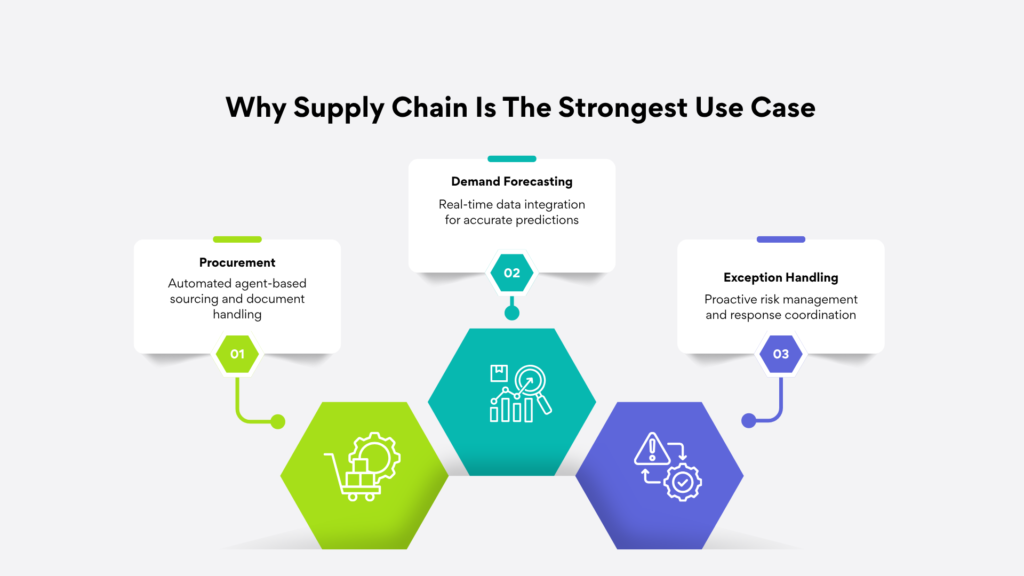
Supply chain operations are where orchestration generates the most reliable returns, and the reason is structural. These decisions are high-volume, time-critical, and rules-bound — exactly the conditions where coordinated AI outperforms teams working from reports and spreadsheets.
The old problem is silos. Forecasting tools, ERP platforms, supplier systems, and logistics providers each hold a piece of the picture, and reconciling them by hand creates delays when speed matters most. Orchestration connects data to action — evaluating conditions in real time and coordinating a response before a disruption becomes a business problem.
Demand forecasting
Instead of static historical cycles, orchestrated systems ingest point-of-sale data, weather, and upstream supplier signals in real time. Research cited by McKinsey puts the improvement at a 20% to 50% cut in forecasting errors — which flows straight through to less overstock and fewer write-offs.
Procurement and sourcing
Procurement is full of exceptions — supplier non-responses, format variations, changing approval chains — which is exactly where orchestrated agents beat rigid automation. A sourcing agent can generate requests, match suppliers, handle documents, and analyze pricing, then hand off cleanly to the next step. McKinsey documents around 30% process-efficiency gains when agents coordinate across source-to-pay, the orchestration multiplier that single-point tools can’t replicate.
Exception handling and supplier risk
This is orchestration’s home turf. Systems can track thousands of supplier risk signals at once and flag vulnerabilities before they turn into disruptions, then coordinate a response — recalculating quantities, rerouting deliveries, validating changes — across the systems involved. See how these map to connected applications in enterprise application orchestration.
Beyond Supply Chain: Where Else Orchestration Pays Off
Supply chain is the headline, but the same pattern applies wherever processes are high-volume and multi-system.
Finance operations
Accounts payable, expense reporting, and financial analysis are clean orchestration targets because inputs and rules are well-defined. Orchestrated agents don’t just process transactions—they identify bottlenecks, flag compliance risks, and surface cost-saving opportunities before they escalate. McKinsey found that companies embedding AI across core operational processes report higher productivity gains than those limiting AI to isolated use cases, highlighting the value of coordinated, enterprise-wide automation
Customer service
Modern service workflows need coordination across systems — pulling customer history, checking inventory, updating records, and escalating complex issues while keeping full context. Orchestration handles the handoffs so the customer gets a seamless experience while agents work behind the scenes.
IT operations
When a ticket comes in, orchestrated agents can run diagnostics, update the record in real time, and resolve or escalate — all coordinated end to end. This is a fast-payback use case because the process is well-documented and high-volume.
How to Pick Your First Use Case
Not every process is a good starting point, and choosing badly is why many AI initiatives stall in pilot.
The pattern behind fast wins is scope discipline: start with one process that’s high-volume, repetitive, well-documented, and low-stakes enough that a wrong decision is recoverable. Invoice processing, ticket routing, and document handling fit perfectly. Narrow, clean use cases often return within a few months, while complex multi-system workflows mature over 12 to 18 months.
The strategic mistake is trying to boil the ocean. The compounding returns come later — once your first orchestrated workflow proves out, you connect it to the next, and agents start sharing context across processes. That’s when the multiplier kicks in. For a menu of proven starting points, browse the AI workflow orchestration use cases.
The Business Case for AI Orchestration
Three takeaways. Supply chain is orchestration’s strongest domain because its decisions are high-volume, time-critical, and rules-bound — but finance, service, and IT follow the same winning pattern. The reported returns are substantial and consistent, from double-digit cost reductions to triple-digit ROI. And the way to capture them is scope discipline: one clear process first, then connect outward.
The real payoff isn’t any single automated task — it’s the coordinated system that emerges as use cases link together. That’s what Aekyam is designed to orchestrate across your operations.
Want to map orchestration to your highest-value process? Request a demo or get in touch with our team of experts and, we’ll start with the one that pays back fastest.
Frequently Asked Questions
What are the best use cases for AI orchestration?
The best use cases are high-volume, multi-system processes that involve exceptions — supply chain forecasting, procurement, finance operations, customer service, and IT ticketing top the list. These work well because orchestration's core strengths, coordinating steps and handling exceptions across systems, deliver the most value where processes are complex and repetitive. Supply chain in particular produces the most consistent, multi-dimensional returns.
How does AI orchestration help supply chain operations specifically?
It connects fragmented supply chain systems — forecasting, ERP, supplier, and logistics data — into coordinated action instead of siloed reports. Orchestrated systems can improve demand forecasting, streamline procurement, monitor supplier risk, and handle disruptions by evaluating conditions in real time and triggering a coordinated response. The result is a supply chain that adapts to disruption rather than reacting to it after the fact.
What kind of ROI can businesses expect from AI orchestration?
Reported returns are strong but depend on scope and data readiness. AI-native supply chain orchestration has delivered cost reductions in the 23–31% range, finance deployments have cut processing time by around half, and enterprise agentic deployments average roughly 171% ROI, with about 74% of organizations reaching positive ROI within the first year. The most reliable predictor of a fast return is starting with one narrow, well-defined process.
How long before an AI orchestration use case pays for itself?
Narrow, high-volume processes with clean data — invoice processing, ticket routing, document handling — often pay back within a few months. More complex, multi-system workflows like full supply chain coordination typically reach full ROI over 12 to 18 months as monitoring and exception handling mature in production. Scope discipline at the start is what separates fast wins from initiatives that stall in pilot.
Which use case should we automate first?
Start with a process that's high-volume, repetitive, well-documented, and low-stakes enough that an incorrect decision is recoverable. Accounts payable, customer query routing, and document processing are common first choices for exactly these reasons. Prove out one process in production, then connect it to the next — the compounding value comes from linking use cases, not from automating one in isolation.
Do AI orchestration use cases apply outside of large enterprises?
Yes. The underlying pattern — high-volume, multi-system, exception-heavy processes — exists in businesses of every size. Smaller organizations often see faster relative gains because orchestration lets a lean team run workflows that would otherwise need far more people. Platforms that scale across business sizes make these use cases practical without an enterprise-scale IT department.
Why do connected use cases deliver more value than isolated automation?
Because the returns compound when agents share context and hand off work across processes — often called the orchestration multiplier. Automating a single task saves time on that task; connecting several tasks into an end-to-end workflow lets each step build on the last, which is where the larger, durable gains appear. Point automation improves one step, while orchestration improves the whole process.
Share
Read Similar Blogs