







Introduction
“What can we actually use this for?” is usually the real question behind “what is an API integration platform.” The honest answer depends heavily on your industry, because the systems, regulations, and bottlenecks look completely different across sectors.
This blog walks through concrete use cases in retail, healthcare, manufacturing, and financial services — where teams are getting value today, and what to look at first if you’re just getting started. For the underlying platform capabilities that make these use cases possible, see our complete guide to API integration platforms.
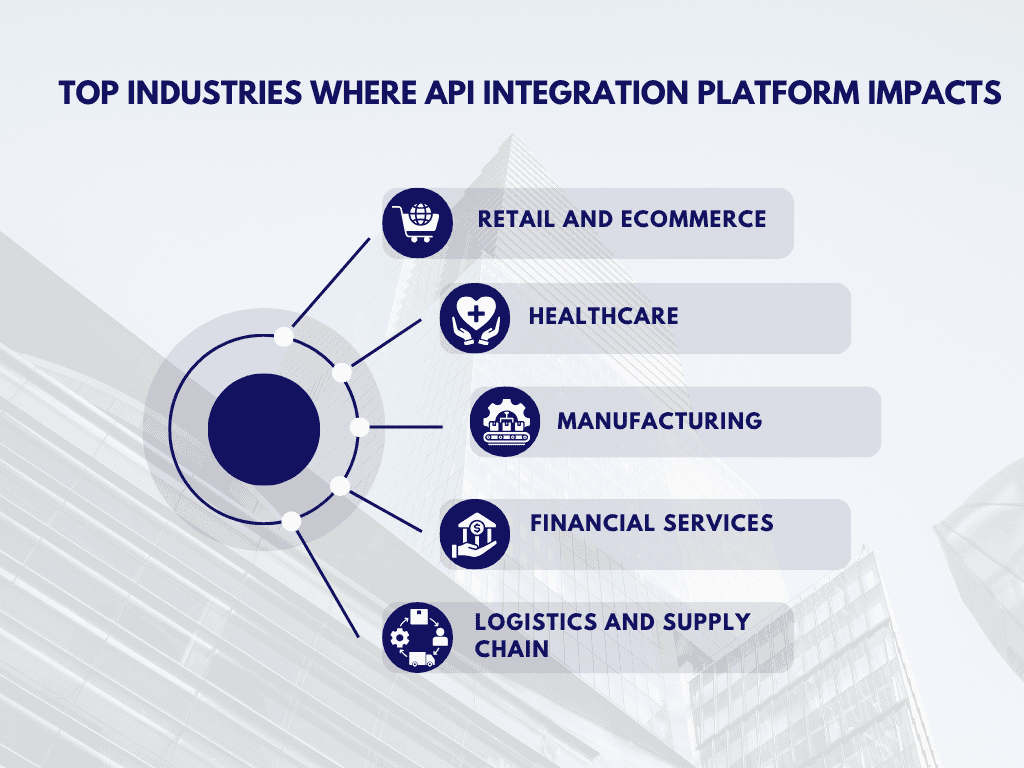
Retail and E-Commerce
Retailers run on more disconnected systems than almost any other industry: e-commerce platforms, point-of-sale terminals, inventory management, and fulfillment, often from different vendors that were never designed to share data. An API integration platform connects these systems so that a sale on your website updates inventory in your warehouse and appears correctly at the register, without a nightly batch job introducing a day of lag.
The practical outcome is real omnichannel commerce: customers can buy online and return in-store, check accurate stock levels before visiting, and get consistent pricing and promotions everywhere they shop. As post-pandemic consumer expectations pushed retailers to connect e-commerce platforms with backend systems faster, this became less of a competitive advantage and more of a baseline requirement.
Healthcare
Healthcare has a regulatory driver that most industries don’t: the 21st Century Cures Act requires providers to give patients API-based access to their own health information. That mandate alone has pushed API adoption from “nice to have” to “compliance requirement” across the sector.
Beyond compliance, integration platforms connect electronic health record systems, scheduling software, billing, and lab systems so that patient data flows accurately between departments and partner organizations. The stakes here are higher than most industries — a failed integration doesn’t just mean a delayed report, it can mean a delayed diagnosis or a billing error that takes weeks to unwind.
Manufacturing
Manufacturers use API integration platforms to bridge the gap between shop-floor systems and business systems: connecting equipment sensors and production data with ERP for real-time monitoring, tying supply chain data to procurement, and giving partners visibility into order status without manual updates. This connectivity supports modernization efforts broadly, from empowering employees with better data to enabling faster responses to supply chain disruptions.
The common thread is reducing the lag between “something happened on the shop floor” and “the right system and the right person knows about it.” That lag is where costly downtime and missed delivery windows usually originate.
Financial Services
Financial services organizations treat APIs as core infrastructure rather than a technical detail: 67.1% rank APIs as a top strategic priority according to industry survey data. Use cases range from connecting core banking systems to fraud detection tools, to powering the open banking integrations that let customers share their financial data securely with third-party apps.
Security and auditability matter more here than almost anywhere else, which is why evaluation criteria like auth handling and observability — covered in our 10-point evaluation framework — carry extra weight for financial services buyers.
Logistics and Supply Chain
Logistics operations depend on timely data from carriers, warehouses, customs systems, and customer-facing tracking tools — all of which historically moved through EDI files, spreadsheets, or manual status updates. An API integration platform replaces those manual handoffs with live connections, so a shipment status update from a carrier’s system reaches your customer notification system within minutes instead of showing up in a batch file the next morning.
The compounding benefit shows up during disruptions. When a shipment is delayed, teams with real-time integration can reroute, notify affected customers, and adjust downstream planning immediately. Teams still relying on manual updates or overnight batch jobs find out hours or days later, by which point the options for fixing it have narrowed considerably.
Industry Use Case Snapshot
| Industry | Primary Use Case | Typical Outcome |
|---|---|---|
| Retail | Omnichannel inventory and order sync | Consistent stock and pricing across channels |
| Healthcare | Patient data interoperability | Compliance with API access mandates |
| Manufacturing | Shop-floor to ERP connectivity | Real-time production visibility |
| Financial Services | Core banking to fraud detection integration | Faster, more secure transaction processing |
| Logistics & Supply Chain | Real-time shipment and carrier data sync | Faster disruption response, fewer manual status updates |
Finding the Right Use Case to Start With
The industries above share a pattern: the highest-value use cases connect a system of record with a system of action, so that data doesn’t just get stored somewhere — it triggers the next step automatically. Explore the full range of AI orchestration use cases across supply chain and enterprise to see which pattern matches your own operations most closely.
Once you’ve identified a use case worth pursuing, the next step is making sure the platform you choose can actually support it at scale. Explore our blog on API integration platforms vs. middleware and ESBs to understand what your business actually needs.
It’s also worth thinking beyond individual integrations to how these use cases evolve once AI agents start acting on the data these systems exchange. Our piece on how API integration platforms change in the agentic AI era covers what shifts when a system that’s currently triggering a workflow starts triggering it autonomously.
Aekyam is built as an AI orchestration platform to handle exactly this pattern across industries, rather than requiring a different toolchain for each one. It connects systems of record with systems of action, applies the governance and auditability that regulated industries like healthcare and financial services need, and lays the groundwork for these same integrations to support AI agents as use cases mature from simple sync tasks to autonomous, state-changing actions.
If you’re trying to identify which use case to tackle first, our solutions by use case page breaks down common starting points by industry, and our team of experts can help you map your specific systems to a rollout plan.
Frequently Asked Questions
What’s the Fastest Use Case to Implement First?
Start with a use case that’s high-friction today but structurally simple: syncing two systems that already have clean, well-documented APIs, rather than the most ambitious cross-department workflow on your wish list. A quick win — often inventory sync in retail or scheduling sync in healthcare — builds internal confidence and budget for the harder integrations later.
Do Use Cases Differ for B2B vs. B2C Companies?
Yes. B2C companies tend to prioritize integrations that improve the direct customer experience — order tracking, personalization, real-time inventory. B2B companies more often prioritize integrations that streamline partner and supply chain relationships — EDI-to-API bridges, partner portals, and procurement workflows. Both benefit from the same underlying platform capabilities, just applied to different systems.
What Metrics Prove a Use Case Was Worth Automating?
Tie the use case to a number the business already tracks, rather than a new metric invented for the project. For retail, that’s usually order-to-fulfillment time or stock accuracy rate. For healthcare, it’s often time-to-access for patient records. For manufacturing, it’s typically unplanned downtime or time-to-detect a production issue. When the improvement shows up in a metric leadership already watches, the case for the next integration makes itself.
How Much of the Integration Backlog Should You Automate at Once?
Resist the urge to automate everything in the first project. IDC has estimated that API-centric digital transformation spending ran into the billions of dollars over just a few years, and most of that value came from organizations that sequenced their rollout rather than attempting a full replacement of manual processes at once. Pick two or three high-friction integrations, prove the value, and use that momentum to justify the next wave.
How Long Does a Typical First Integration Take to Go Live?
For a well-scoped, single use case with clean APIs on both ends — like syncing inventory between an e-commerce platform and a warehouse system — teams commonly see a working integration in weeks rather than months. Timelines stretch significantly when legacy systems are involved, since those often need custom connectors or middleware to expose data the platform can actually use.
Should IT or the Business Team Own a New Integration Use Case?
Ownership works best as a partnership rather than a handoff. The business team should define the outcome and the metric it's tied to, since they understand the operational pain point. IT (or an integration platform team) should own the technical implementation, security review, and ongoing monitoring. Use cases that are purely IT-driven often solve the wrong problem; use cases that are purely business-driven often underestimate the governance work needed, especially in regulated industries.
Do Smaller Companies Get the Same Value From These Use Cases as Large Enterprises?
The relative value is often higher for smaller companies, even though the absolute scale is smaller. A mid-sized retailer or clinic usually has fewer engineering resources to maintain custom point-to-point integrations, so a platform that handles connectivity, monitoring, and compliance out of the box removes more of the burden per team member than it does for an enterprise with a dedicated integration team already in place.
Share
Read Similar Blogs

AI Agents and API Integration Platforms: What Changes in the Agentic AI Era
September 15, 2026

AI Orchestration Platform Buyer’s Guide
September 3, 2026