


Why Businesses Choose Aekyam
Aekyam is an enterprise AI orchestration platform that combines iPaaS with real-time workflow orchestration. Aekyam stands out and has an edge over its competitors for three outcomes that can be measured as well: zero message loss, 70% less integration effort, and inventory managed across 37 countries on one integration layer.
In this blog you will see three customer cases, learn how the platform works, and find out how to get started.
What Is Aekyam and How does it Help Businesses?
Aekyam is an AI Orchestration platform that connects your applications, data and AI in one place. It helps businesses automate workflows, move data between systems in real time and give teams clear visibility, without heavy custom coding.
Key features:
- Pre-built adapters in the Aekyam Marketplace
- An API-first approach for everything else.
- Real-time monitoring,
- Payload traceability
- A failed-entry dashboard.
- Automated error reprocessing and replay.
- Cloud-native, auto-scaling architecture that runs on cloud, on-premises or hybrid setups.
Benefits. Faster integration, fewer lost messages, quicker fixes when something fails, and lower effort to run and maintain.
AI highlights. Aekyam uses AI to match and organize data automatically, detect unusual patterns, explain results in simple language, generate APIs and resolve issues proactively. These AI capabilities sit on top of the integration layer, so they work with live business data.
Learn more on the Platform, Marketplace and Gen AI pages.
How Has Aekyam Impacted Its Clients?
Aekyam is industry agnostic. Any business that runs several systems that must stay in sync can use it. Today it supports retail, fashion, telecom, supply chain and healthcare use cases. The three case studies below come from fashion and retail, where the pressure on data is especially high.
To see what Aekyam can do, look at these results.
Case study 1: Keeping inventory in sync across 37 countries
Why they chose Aekyam: reliability across geographies.
The client. A Singapore-based luxury fashion brand with about 5,000 employees and a presence in many regions.
The challenge. Expansion outgrew their systems. Integrating different systems across regions was complex, data exchange was slow and unreliable, and the team could not process data in bulk. Inventory updates, order processing and catalogue management suffered.
What Aekyam did. It set up a centralized integration using Aekyam Cloud and Aekyam Edge components, which connected on-premises applications across geographies. It added geographic load balancing, processed data locally to meet regional compliance and latency needs, and used configurable mapping to keep data consistent. Monitoring and error handling made failures easy to find and fix.
The results.
- Inventory managed across 37 countries.
- 9+ warehouse management systems connected across continents.
- 70% fewer integration issues.
- Zero message loss.
Case study 2: Zero order drops across global marketplaces
Why they chose Aekyam: speed and visibility.
The client. An Indian accessories manufacturer from Bengaluru with 5,000+ employees and a global footprint.
The challenge. The brand wanted to become a premium seller on global marketplaces. But integrations were complex and slow, reach across marketplaces was limited, and the team had little visibility or control over high-volume data. Messages were getting lost.
What Aekyam did. It used an API-first approach with pre-built adapters, so new marketplaces could be connected quickly. Secure integration prevented message loss, and a simple interface gave teams visibility and control over data flows.
The results.
- Zero order drops.
- 70% less integration effort.
- Faster onboarding onto more marketplaces.
- Higher seller ratings across marketplaces.
Case study 3: Surviving peak season without losing a message
Why they chose Aekyam: resilience and recoverability.
The client. A premier Indian fashion retailer from Mumbai with 10,000+ employees, building a marketplace of sellers.
The challenge. Onboarding sellers was slow and error-prone. At peak, the system could not keep up with message volume, which led to delays, crashes and lost messages, with no way to retrieve or retrace the data.
What Aekyam did. It configured a scalable architecture for the client’s peak volumes and added error handling and recovery. A dashboard showed every failed entry and let teams reprocess it, and a replay function let sellers resend messages. A modular framework left room to add new partners and features.
The results.
- 70% faster seller onboarding.
- 2x auto-scaling tested against peak-hour volume.
- Shorter time to value and lower cost of ownership.
- Failed messages can be traced and replayed instead of being lost.
The Pattern: Six Reasons Businesses Choose Aekyam
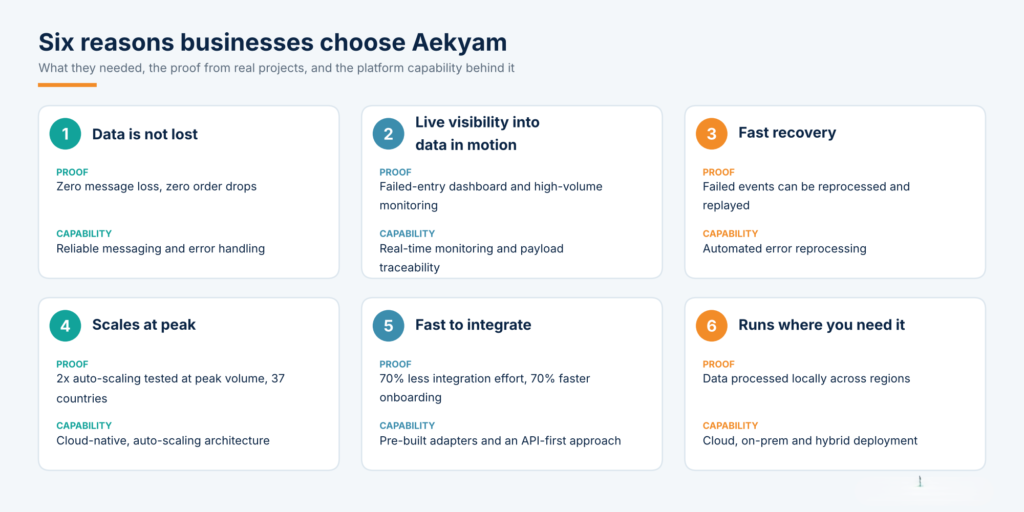
Look across the three case studies and the same six reasons show up. Each one links a business need to proof and to a platform capability.
| Why they choose Aekyam | Proof from the cases | Platform capability |
|---|---|---|
| Data isn’t lost | Zero message loss, zero order drops | Reliable messaging, error handling |
| Live visibility into data in motion | Failed-entry dashboard, high-volume monitoring | Real-time monitoring, payload traceability |
| Fast recovery | Reprocess and replay of failed events | Automated error reprocessing |
| Scales at peak | 2x auto-scaling, 37 countries | Cloud-native, auto-scaling architecture |
| Fast to integrate | 70% less effort, 70% faster onboarding | Pre-built adapters, API-first approach |
| Runs where you need it | Local processing across regions | Cloud, on-prem and hybrid deployment |
The takeaway: the first two reasons, no lost data and clear visibility, come up in every case. Speed and scale matter, but trust in your data comes first.
Is Aekyam the Right Fit for You?
Aekyam is a strong fit if you:
- Run several systems, such as OMS, WMS, ERP and marketplaces, that must stay in sync.
- Operate across regions or channels.
- See peak-load spikes, such as festive sales or seasonal rushes.
- Are replacing legacy middleware that is hard to monitor or scale.
A quick self-check. Answer yes or no to each question. Three or more yeses mean a real-time integration platform is worth a closer look.
- Have you ever sold stock you did not have because systems were out of sync?
- Do your teams spend hours finding out why a message or order failed?
- Do new marketplace or partner connections take weeks?
- Does your system slow down or fail at peak?
- Do you run in more than one country or region?
When it may be too much. If you only need to connect two apps with a simple one-way sync, a lightweight tool may be enough. Aekyam pays off when complexity, volume or reliability is the real problem.
How to Get Started With Aekyam
Getting started is simple:
- Step 1: Explore the platform and the Marketplace to see which adapters match your systems.
- Step 2: Request a demo and bring your toughest integration problem.
- Step 3: Talk to our experts to plan a pilot, check pricing and map out your rollout.
Businesses choose Aekyam because it protects their data, shows them what is happening in real time, recovers fast when something fails and scales when it matters. If those are the things keeping your team up at night, Aekyam was built for you.
Frequently Asked Questions
1. How is Aekyam different from a traditional integration platform?
Traditional integration tools often need heavy coding and long project timelines. Aekyam is a modern iPaaS that offers low-code and no-code configuration, AI-powered data mapping and real-time data traceability, so teams can build and monitor integrations with less effort.
2. Do we need a large development team to use Aekyam?
No. Pre-built adapters, reusable templates and an API-first approach mean many integrations can be set up without complex custom code. Your developers can still extend the platform where you need something specific.
3. How is Aekyam different from building integrations in-house or using AI coding assistants?
AI coding assistants can speed up writing code, but you still own the code afterwards. Aekyam gives you a governed, production-grade integration layer with monitoring, security and scalability built in, so your team spends its time on business value instead of maintaining custom integration code.
4. What is the difference between API integration and workflow automation?
API integration connects systems so they can exchange data. Workflow automation goes a step further: it orchestrates the whole process and business logic across those systems. Aekyam does both, which is why it is described as an orchestration platform and not only an integration tool.
5. How many applications can Aekyam connect to?
Aekyam states that it connects 3,000+ integrations and AI tools. The Aekyam Marketplace lists the pre-built adapters, and anything not listed can be connected through the API-first approach. If you have a specific system in mind, ask our team.
6. How long does it take to get started?
Aekyam positions itself as moving integration projects from months to days, and its customers report faster onboarding and shorter time to value. Your actual timeline depends on how many systems you connect and how complex your workflows are. Request a demo to get a realistic estimate for your setup.
Share