


Introduction
Retail and e-commerce teams need a current view of inventory, orders, pricing, and fulfillment across storefronts, warehouses, ERPs, OMS platforms, and POS systems. When that data arrives late, the result is overselling, stockouts, delayed fulfillment, inaccurate reporting, and poor customer experiences.
This blog compares 10 real-time data integration tools specifically for retailers. The focus is not overall platform breadth; it is each tool’s ability to deliver fresh data reliably—through CDC, streaming, event-driven integration, APIs, or fast micro-batches.
To understand why retailers, need real-time data integration, read our blog titled, Why Real-time Data Integration Is the Key to Success for Retailers.
Top Real-Time Data Integration Tools To Choose From
Aekyam is an AI orchestration platform that enables real-time data visibility and integration across enterprise systems. It connects applications, normalizes data, and orchestrates information flows across retail operations, making it accessible for analytics, AI agents, and automated workflows.
Here’s how Aekyam measures up across key aspects of real-time data integration:
Real-time approach: Event-driven order and inventory flows across OMS, WMS, e-commerce, POS, ERP, and EDI systems, with real-time visibility into transactions and exceptions. Aekyam connects and normalizes data across these retail systems and contextualizes it for analytics, AI agents, and automation.
Typical latency: Not publicly benchmarked. Ask Aekyam for an end-to-end latency figure for your specific order, inventory, and fulfillment flows.
Retail real-time use cases:
- Order orchestration and status updates
- Omnichannel inventory synchronization
- Warehouse and fulfillment exception handling
- Real-time visibility across OMS, WMS, e-commerce, POS, and EDI
- Retail analytics and AI-driven automation.
Real-time-relevant connectors: Shopify, SAP, Salesforce, Oracle, Manhattan, Snowflake, and Amazon; Aekyam Edge supports synchronization for non-cloud systems.
Reliability under load: Aekyam provides retries, exception handling, anomaly detection, and AI-assisted mapping recommendations. Its retail positioning emphasizes unified inventory, order, and fulfillment data across hybrid and on-premise environments.
Real-time limitations: Aekyam does not publish detailed latency benchmarks, a public documentation portal, or release notes. Request these directly during evaluation.
Best for: Retail and fashion enterprises that need real-time order and inventory flows across OMS, WMS, and e-commerce systems without heavy custom coding.
Pros
- Retail-specific focus across OMS, WMS, e-commerce, POS, and EDI
- Strong operational focus on inventory accuracy and exception handling
- Prebuilt adapters and hybrid/on-premise support through Aekyam Edge
- Published customer proof point of 99% inventory accuracy
Cons
- No public latency benchmark or detailed technical documentation
- Pricing transparency is limited
- Less suited to teams seeking a general-purpose streaming platform
Below mentioned are a few other tools and platforms offering real-time data integration capabilities similar to Aekyam, which readers can explore to evaluate additional options based on their business requirements.
Disclaimer: The information in this comparison is based on publicly available information. Features, integrations, capabilities, and pricing may change over time. Readers are encouraged to verify the latest details directly with the respective providers and assess each solution based on their specific business requirements.
- Celigo.io
Real-time approach: Event-driven and scheduled flows through prebuilt integration applications.
Typical latency: Confirm latency for each real-time flow; it varies by trigger, endpoint, and flow design.
Retail real-time use cases: Order, inventory, pricing, and catalog synchronization between Shopify, Magento, SAP, Dynamics, and NetSuite.
Real-time-relevant connectors: Commerce and ERP endpoints that support real-time triggers.
Reliability under load: Includes error management and retry capabilities for operational integrations.
Real-time limitations: Not a CDC or streaming tool. Debugging complex flows can be difficult, and its strength is particularly concentrated around NetSuite.
Best for: Mid-market retailers needing real-time order and inventory synchronization around NetSuite.
Pros
- Strong commerce and ERP integration templates
- Good fit for NetSuite-centric retailers
- Business-user-friendly workflow design
Cons
- Not a streaming or CDC platform
- Complex flows can be harder to debug
- Pricing transparency is limited
- Boomi
Real-time approach: Event-driven and API-led integration flows; verify CDC and streaming claims for your specific use case.
Typical latency: Verify directly with Boomi; latency depends on the connector, runtime, and process design.
Retail real-time use cases: Order flows, supplier and EDI exchanges, and multichannel inventory and fulfillment synchronization.
Real-time-relevant connectors: Hybrid runtime support across cloud and on-premise systems.
Reliability under load: Verify retry behavior, delivery guarantees, monitoring, and scaling limits for high-volume retail events.
Real-time limitations: Not a streaming platform. It can become complex and costly at enterprise scale.
Best for: Mid-to-large enterprises needing real-time flows across cloud and on-premise systems.
Pros
- Strong hybrid integration support
- Broad enterprise connector coverage
- Suitable for EDI and supplier workflows
Cons
- Not a native streaming platform
- Can be complex to operate
- Costs may escalate with message volume and connectors
- MuleSoft Anypoint Platform
Real-time approach: API-led integration using request/response and event-driven patterns; verify streaming and CDC capabilities for your use case.
Typical latency: Verify; latency depends heavily on API design, network path, and system performance.
Retail real-time use cases: Unified commerce, real-time ERP and CRM synchronization, and Salesforce Commerce and Service workflows.
Real-time-relevant connectors: Verify connector-level real-time support before committing.
Reliability under load: Verify retry, delivery, monitoring, and scaling behavior under peak retail traffic.
Real-time limitations: Not a CDC or stream-processing platform. It is expensive and developer-heavy for many retail teams.
Best for: Large, Salesforce-centric enterprises with API-driven real-time integration needs.
Pros
- Strong API management and enterprise governance
- Deep Salesforce ecosystem fit
- Suitable for complex enterprise architectures
Cons
- Developer-heavy
- High cost for many mid-market retailers
- Not purpose-built for CDC or streaming
- Workato
Real-time approach: Event-driven “recipes” triggered by webhooks and system events.
Typical latency: Verify per recipe and connector; event-driven does not automatically mean streaming-grade latency.
Retail real-time use cases: Order-to-cash workflows, returns handling, customer notifications, and cross-system automation triggered by business events.
Real-time-relevant connectors: Verify which connectors support real-time triggers rather than polling.
Reliability under load: Includes governance controls; validate retry behavior, idempotency, and delivery guarantees for critical order and inventory workflows.
Real-time limitations: Event-driven automation, not stream processing. Costs can grow with recipe complexity and usage.
Best for: Business and IT teams automating real-time cross-system workflows.
Pros
- Low-code automation experience
- Strong workflow and app-ecosystem coverage
- Good for business-led automation
Cons
- Not a streaming or CDC platform
- Usage-based costs can rise quickly
- Less suitable for high-volume data replication
- Informatica Intelligent Data Management Cloud
Real-time approach: CDC and streaming ingestion capabilities; this review excludes its broader MDM, data quality, and governance modules.
Typical latency: Verify for your selected CDC source, transformation, and target.
Retail real-time use cases: Large-scale real-time loading into cloud warehouses and lakehouses for analytics and AI.
Real-time-relevant connectors: CDC-supported enterprise databases and cloud targets; verify the exact source list.
Reliability under load: Verify checkpointing, recovery, ordering, schema-drift handling, and monitoring at your expected event volume.
Real-time limitations: Heavy, complex, and costly for smaller retail teams or focused use cases.
Best for: Large retailers needing enterprise-scale CDC and streaming ingestion.
Pros
- Enterprise-grade CDC and ingestion capabilities
- Strong fit for large-scale data programs
- Broad enterprise data-management ecosystem
Cons
- Complex implementation
- High cost for smaller teams
- Real-time capability must be separated from the wider platform evaluation
Quick Comparison Table
| Tool | Real-time method | Typical latency | Best for | Retail use cases | Delivery guarantees | Real-time pricing factor | Rating |
|---|---|---|---|---|---|---|---|
| Aekyam | Event-driven order/inventory flows | Not publicly benchmarked | Retail order and inventory orchestration | Inventory sync, order status, exception handling | Retries, exception handling, anomaly detection | Usage-based; quote required | 4.6/5 |
| Celigo | Event-driven + scheduled flows | Flow-dependent; verify | NetSuite-centric retail operations | Order, inventory, pricing, catalog sync | Error management and retries | Endpoints and flows | 4.1/5 |
| Boomi | Event-driven and API-led | Verify | Hybrid cloud/on-prem integration | Orders, EDI, supplier flows | Verify per use case | Messages, connectors, tiers | 4.0/5 |
| MuleSoft | API-led and event-driven | Verify | Salesforce-centric enterprises | Unified commerce, ERP/CRM sync | Verify per use case | Capacity and API usage | 3.9/5 |
| Workato | Event-driven recipes | Recipe-dependent; verify | Business-led automation | Order-to-cash, returns, notifications | Verify retry and delivery behavior | Recipes and usage | 4.1/5 |
| Informatica IDMC | CDC and streaming ingestion | Verify | Enterprise-scale CDC programs | Warehouse and lakehouse ingestion | Verify at scale | Consumption-based | 4.2/5 |
How We Evaluated These Tools
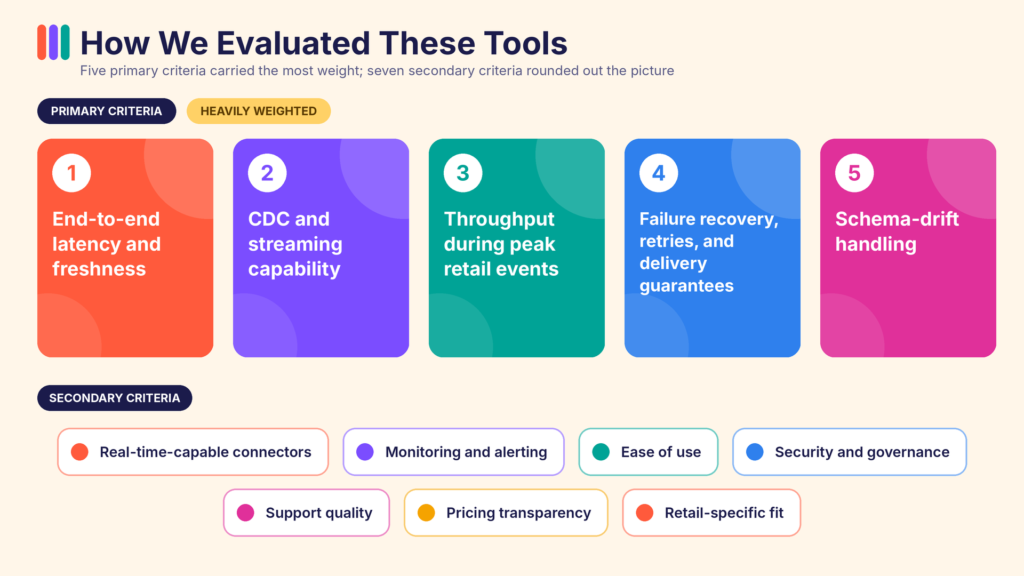
Primary criteria, heavily weighted:
- End-to-end latency and freshness
- CDC and streaming capability
- Throughput during peak retail events
- Failure recovery, retries, and delivery guarantees
- Schema-drift handling
Secondary criteria:
- Real-time-capable connectors
- Monitoring and alerting
- Ease of use
- Security and governance
- Support quality
- Pricing transparency
- Retail-specific fit
Which Tool Is Best for Your Situation?
By real-time need
- Near-real-time analytics: Aekyam
- Operational order and inventory synchronization: Aekyam or Celigo
- Enterprise API-led integration: MuleSoft or Boomi
- Large-scale CDC ingestion: Informatica
By organization
- Enterprise retailers: Aekyam, Boomi, MuleSoft or Informatica
- Mid-market retailers: Aekyam, Celigo, Workato
- Business-led teams: Celigo or Workato,
By team skills
- Low-code preference: Aekyam, Celigo or Workato
- Developer-led preference: MuleSoft or Boomi
By constraints
- Budget-limited: Celigo or Aekyam—depending on data volume and required freshness
- Legacy or on-premise-heavy: Aekyam, Boomi, or MuleSoft
How Aekyam qualifies
| Criterion | Aekyam assessment |
|---|---|
| Real-time order and inventory sync | Strong fit; event-driven flows across OMS, WMS, e-commerce, POS, and EDI |
| Retail-specific connectors | Strong; includes Shopify, SAP, Salesforce, Oracle, Manhattan, Snowflake, and Amazon |
| Hybrid and legacy support | Strong; Aekyam Edge supports non-cloud systems |
| Reliability | Retries, exception handling, anomaly detection, and AI-assisted mapping |
| Low-code usability | Strong; prebuilt adapters reduce integration time and ownership cost |
| Latency transparency | Gap; request a benchmark during evaluation |
| Pricing transparency | Gap; usage-based, but plan details require a quote |
How to Run a Real-Time Proof of Concept Before You Buy
Do not rely only on vendor demonstrations. Run a scoped proof of concept using your own systems, data volumes, and peak-event conditions.
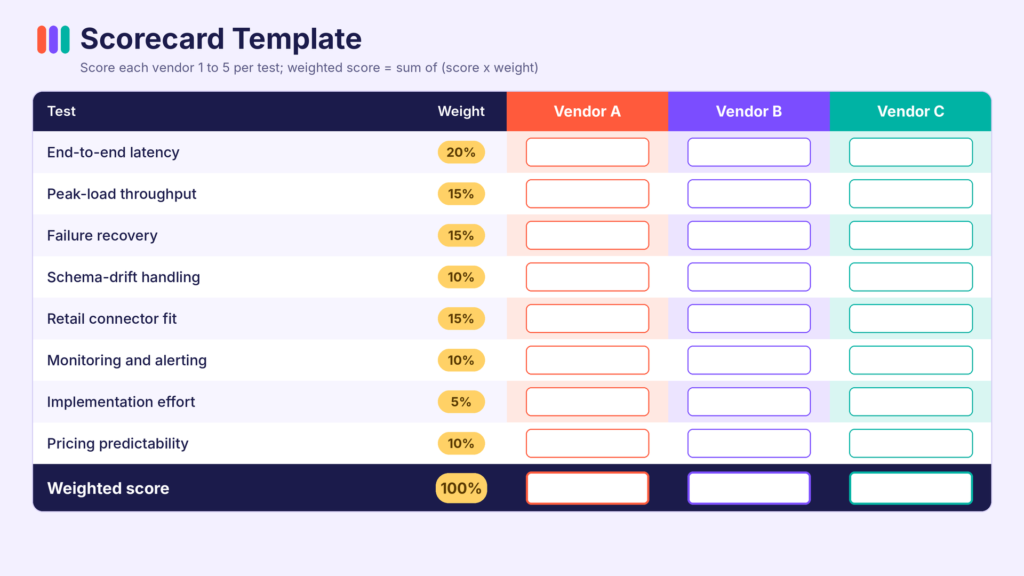
Test Criteria
- End-to-end latency: Measure the time from source change to destination availability.
- Peak-event behavior: Simulate high-volume scenarios such as Black Friday, flash sales, or seasonal inventory updates.
- Failure recovery: Interrupt the network, target system, or pipeline and measure recovery time and data loss.
- Schema changes: Add, rename, or change field types and observe how the pipeline responds.
- Monitoring: Confirm whether your team receives alerts before business users notice a problem.
Sample Retail Scenarios
| Scenario | What to measure |
|---|---|
| Inventory update | Time from stock change in WMS/ERP to storefront or OMS update |
| Order status change | Time from order event to fulfillment, CRM, and analytics update |
| Price change | Time from pricing-system update to channel-wide price availability |
| Fulfillment exception | Detection, alerting, retry, and resolution time |
| Peak traffic | Throughput, lag, error rate, and recovery behavior |
Scorecard Template
Choosing the Right Real-Time Integration Tool for Your Retail Business
There is no single “best” real-time integration tool for every retailer. Streaming platforms excel at high-volume event processing, managed ELT tools excel at warehouse freshness, iPaaS platforms excel at business workflow automation, and retail-focused platforms excel at connecting the operational systems that run commerce.
For retailers whose biggest pain is keeping orders, inventory, fulfillment, and channel data aligned, Aekyam is a strong option. Its retail-focused approach connects OMS, WMS, e-commerce, POS, ERP, and EDI systems, with operational features such as exception handling, retries, anomaly detection, and hybrid connectivity.
Book a demo or explore Aekyam for retail to evaluate Aekyam against your current integration stack?
Frequently Asked Questions
What is the best real-time data integration tool for retailers?
There is no universal best tool. Aekyam is a strong choice for retail order, inventory, and fulfillment orchestration; Celigo, Workato, Boomi, and MuleSoft are strong for event-driven business workflows.
What counts as real-time data integration?
Real-time data integration continuously captures and delivers data changes with minimal delay. It can use CDC, event streams, webhooks, APIs, or fast micro-batches, but true real-time capability should be validated through measured end-to-end latency.
Are there free or open-source options?
Yes. Airbyte offers a free self-managed Core edition, Confluent offers free basic usage until data flows, and several vendors offer free trials or developer tiers. However, infrastructure, engineering, and maintenance costs can be significant.
What is the difference between iPaaS, ETL, and streaming platforms for real-time use?
iPaaS platforms automate business workflows between applications; ETL tools move data into warehouses for analytics; streaming platforms process continuous event flows at low latency. Some tools overlap, but their core strengths differ.
How do I compare real-time pricing across vendors?
Compare the cost of achieving your required freshness, not just license fees. Include connector fees, data volume, compute, message or event charges, support, implementation effort, and the cost of maintaining the pipeline.
Can these tools sync Shopify, Magento, SAP, or Oracle in real time?
Some can, but real-time support varies by connector, object, trigger type, and plan. Aekyam, for example, lists Shopify, SAP, Salesforce, Oracle, Manhattan, Snowflake, and Amazon among its relevant connectors.
How important are prebuilt real-time connectors?
Very important. Prebuilt connectors reduce implementation time, but depth matters more than quantity. Confirm support for the exact objects, custom fields, webhooks, APIs, and error-handling behavior your retail workflows require.
How do I migrate from my current tool?
Start with one high-value flow, such as inventory synchronization or order-status updates. Run both systems in parallel, validate data accuracy and latency, define rollback procedures, then migrate additional flows gradually.
Share