
Not long ago, real-time data was a nice-to-have. A daily report was fine. A nightly file transfer was fine. A shopper today expects live inventory, a patient expects live updates, and a trader expects a decision in milliseconds. Real-time data integration has evolved from “advanced” to mandatory.
The change is simple to explain. Businesses now run on many systems: cloud apps, older platforms, partner portals, sensors and AI tools. If those systems only talk once a day, every team works with old information. Real-time data integration fixes that by passing data between systems the moment something happens. For the full definition, see What Is Real-Time Data Integration?
This blog shows what real-time integration looks like in six industries, what they all share, and how Aekyam helps each one get there.
Why Real-time Integration Needs Look Different in Every Industry
The shared problem
In every sector, delayed or lost data costs three things: revenue, trust and time. A missed order, a late alert or a wrong balance all trace back to the same cause. One system knew something. Another did not find out in time.
The differences
What each industry worries about most is different. That decides which data must move fastest.
| Industry | What worries them most | What late data costs |
|---|---|---|
| Retail and e-commerce | Inventory and orders | Oversold stock, cancelled orders, lost customers |
| Fast fashion | Speed to trend | Missed demand and unsold stock |
| Supply chain and logistics | End-to-end visibility | Delays, idle labour, stock-outs |
| Healthcare and life sciences | Accuracy and traceability | Delayed care and spoiled products |
| Transport and mobility | Uptime and punctuality | Breakdowns and missed schedules |
| Finance and banking | Speed and risk | Fraud losses and lost deals |
How Aekyam Supports Real-time Integration Across Industries
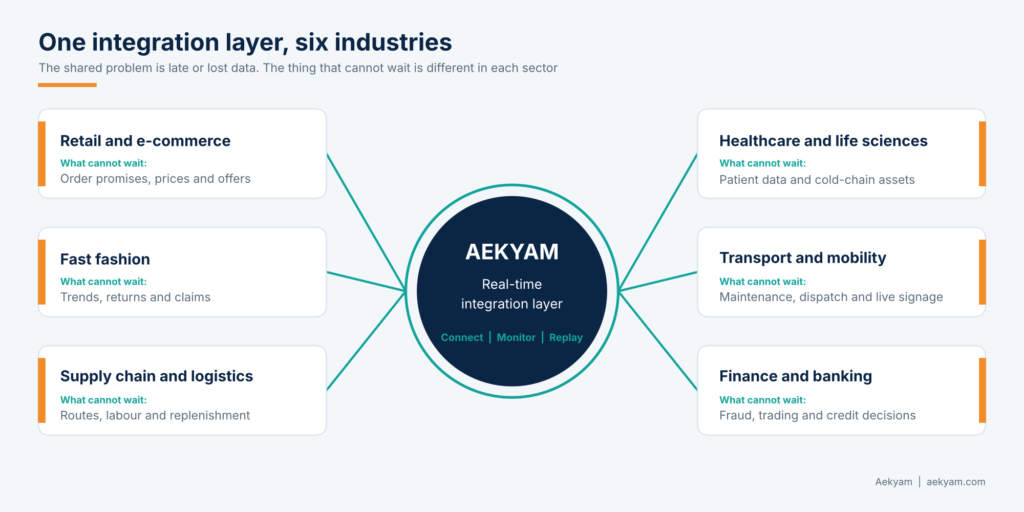
Aekyam is an enterprise AI orchestration platform, built initially as an iPaaS platform, Aekyam has now advanced as a real-time workflow orchestration platform. It gives each industry the same foundation: pre-built adapters, event-driven data flows, live monitoring and replay of failed events. On top of that foundation, each industry builds its own use cases. Here are six.
3.1 Retail and e-commerce
- Omnichannel order promising. Show shoppers an accurate delivery date by checking live stock across stores, warehouses and marketplaces before they pay. Fewer broken promises mean fewer cancellations.
- Dynamic pricing engines. Feed live sales, stock and competitor signals into pricing rules, so prices adjust while demand is still there, not a day later.
- Hyper-personalized marketing. Connect your CRM, e-commerce and email tools so a customer’s latest click or purchase shapes the very next offer.
How Aekyam helps: pre-built adapters for tools such as Shopify, SAP, Salesforce and Amazon, plus event-driven order and inventory flows across OMS, WMS and e-commerce.
3.2 Fast fashion
- Micro-trend capitalization. Spot a fast-selling style from live sales and social signals, then trigger replenishment or production while the trend is still hot.
- Visual search and recommendation engines. Keep product, stock and customer data updated so a “shop the look” result never points to an item that’s no longer available.
- Returns and claims processing. Automatically move return requests, quality checks and refunds between systems and get returned stock back on sale faster.
- How Aekyam helps: reliable data flow between stores, warehouses and marketplaces. Fashion brands already use it to keep inventory in sync across 37 countries and sell on global marketplaces without any order drops.
3.3 Supply chain and logistics management• Dynamic route reallocation. Live traffic and order data allow for immediate re-planning of routes in the event of a delay or road closure, rather than waiting for the next planning cycle.
• Optimize the warehouse manpower. Staff incoming orders by the hour using live order and dock data to minimize idle time and overtime.
• Forecast inventory replenishment. Integrate shipment, supplier and sales data so you reorder before you run out, not after.
How Aekyam helps: It connects WMS, OMS, ERP and partner systems; it allows teams to replay failed events; and it provides live monitoring to show data in motion, so that lost messages don’t become lost shipments.
3.4 Life sciences and health care
• Continued monitoring of the patient. Stream device readings into clinical systems so care teams can track changes in real-time and act accordingly.
• Telehealth data synchronization. Ensure that prescription, record and appointment data are consistent across hospital systems and telehealth tools.
• Cold-chain asset tracking. Keep an eye on the temperature and location of vaccines and medications in transit and alert before they spoil.
Aekyam enables you to integrate legacy and modern systems and operate in the cloud, on-premises, or in a hybrid configuration, keeping sensitive data where you want it, according to your policies. Aekyam lists its industries and one of the use cases is healthcare.
3.5 Mobility and Transport
• Predictive maintenance. Use live sensor data to find a component likely to fail and schedule its replacement before a failure happens.
• Fleet dynamic dispatch. Use real-time location, demand and availability to match the best possible vehicle.
• Operations signage for transit. Push accurate arrival and delay information to station and stop displays and applications in seconds.
Aekyam’s event driven flows and auto-scaling architecture manage the constant flow of small messages coming from vehicles and sensors, and monitoring capabilities that can indicate that a feed has stopped.
3.6 Banking and Finance
- Fraud prevention. Each transaction is checked against live signals before it clears. This means that instead of suspicious activity being reported later, it is completely stopped.
- Algorithmic asset trading. Order and market data between systems are delivered with low delay and without any lost messages.
- Immediate credit decisioning. Identity, income and bureau data are brought together in seconds to approve or decline while the customer is still on the page.
Aekyam offers reliable messaging with error handling, payload traceability for audit trails, and replay of failed events. The same capabilities that protect an order, also protect a payment.
What Stays the Same in Every Industry
Under the different use cases, every industry asks for the same few things. This is why you do not need a separate tool for each sector.
| Common requirement | Why it matters | How Aekyam fulfils it |
|---|---|---|
| No lost data | One lost message can mean a lost order, payment or alert | Reliable messaging and error handling, with zero message loss in customer cases |
| Live visibility | You cannot fix what you cannot see | Real-time monitoring, payload traceability and a failed-entry dashboard |
| Fast recovery | Failures will happen; downtime should not | Reprocess and replay of failed events |
| Scale at peak | Volume spikes are unpredictable | Cloud-native, auto-scaling architecture |
| Connect old and new | Few businesses start from a clean slate | Pre-built adapters, API-first approach and support for legacy systems |
| Run where data must stay | Rules and latency differ by region | Cloud, on-prem and hybrid deployment, with local processing |
| Quick to set up | Long projects delay value | Pre-built adapters and reusable templates cut integration effort |
| Smarter over time | Data volumes outgrow manual checks | AI that matches data, flags unusual patterns and explains results in plain language |
Why this matters: A platform that gets these eight things right can serve a retailer, a hospital and a bank. Only the use cases on top change.
Ensuring Business Success With Aekyam’s Real-time Data Integration Capabilities
Real-time data integration is no longer a project for a few advanced teams. It is how modern businesses stay accurate, fast and trusted, whether they sell shoes, ship medicines or approve loans.
Aekyam gives you one orchestration layer to connect your systems, watch your data in motion, recover quickly from failures and scale when it counts. You can start with one use case, such as order flow or inventory sync, and grow from there.
Want to see what real-time integration can do for your industry? Bring one use case and we will show you how it would run on Aekyam. Talk to our team of experts or request a demo, to get started.
Frequently Asked Questions
Which industries does Aekyam support?
Aekyam lists retail, fashion, telecom, supply chain and healthcare among its use cases, and its customer cases come mainly from fashion and retail. Because the platform is industry agnostic, it suits any business that runs several systems that must stay in sync, including transport and finance. Ask the team about your sector.
Can Aekyam integrate with my existing systems?
In most cases, yes. The Aekyam Marketplace offers pre-built adapters for tools such as SAP, Oracle, Shopify, Salesforce, Manhattan, Snowflake and Amazon, and the platform is API-first, so other systems can be connected too. It also works with on-premises and legacy systems.
Do I need different tools for different industries?
No. The core needs are the same: reliable delivery, visibility, recovery, scale and flexible deployment. One platform can cover them, and each industry adds its own workflows on top.
How do I know whether Aekyam fits my industry?
Start with three questions. Do you run several systems that must stay in sync? Does late or lost data cost you money or trust? Do you face peaks, multiple regions or a mix of old and new systems? If yes, request a demo or contact Aekyam’s team of experts and they will map your use case.
Share