


Introduction
Decisions, customer experiences, and operations can all suffer when data arrives hours, or even days after the event that created it. A support team sees an outdated order status, marketing targets customers with stale inventory, and finance spends hours reconciling systems manually instead of acting on fresh signals.
In this blog, we cover what real-time data integration is, how it works, a 10-point checklist to assess whether your business needs it, and the criteria to use when evaluating a real-time integration tool.
What Is Real-Time Data Integration?
Real-time data integration is the continuous process of capturing data changes in source systems and delivering them to downstream systems with minimal delay. Instead of copying entire datasets on a nightly schedule, it moves only new or changed data as it becomes available.
For example, when a customer places an order, the order can update inventory, trigger fulfillment workflows, refresh a dashboard, and feed a personalization model without waiting for the next batch run.
How It Works
A typical real-time integration pipeline follows this flow:
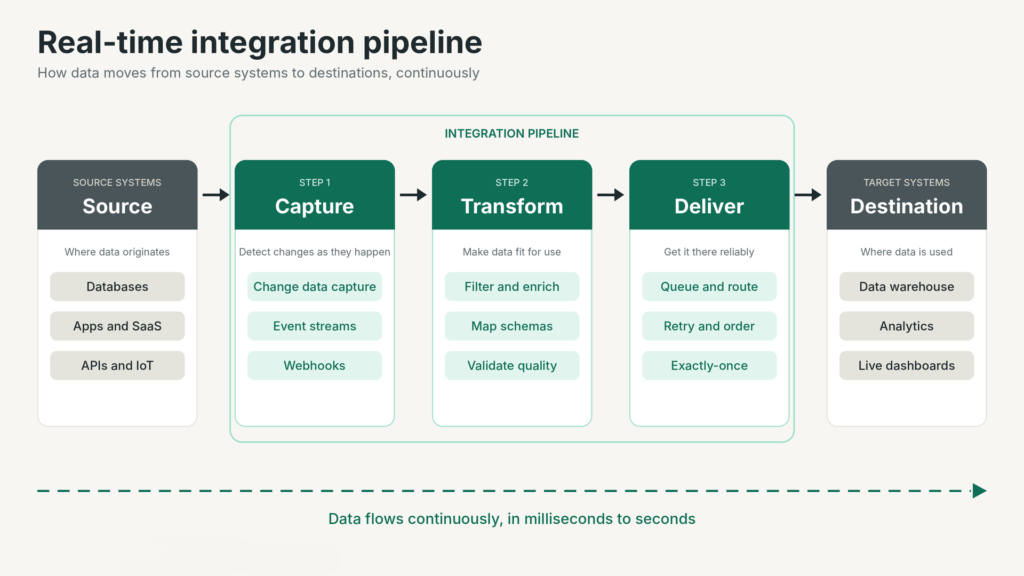
- Source systems generate data: databases, business applications, point-of-sale systems, CRMs, ERPs, IoT devices, and event-producing applications.
- Capture detects changes using methods such as change data capture (CDC), event streams, webhooks, or APIs.
- Transformation standardizes, enriches, filters, or reshapes the data in flight.
- Delivery sends the processed data to a data warehouse, lakehouse, operational application, search index, dashboard, or AI/ML system.
CDC is one of the most common capture methods. It identifies inserts, updates, and deletes in a source database and forwards those changes downstream, often by reading the database transaction log. This reduces the load on source systems because it transfers only changes rather than repeatedly extracting full tables.
To learn more about what real-time data integration is and why retailers need it, read our comprehensive guide.
Does Your Business Need Real-Time Data Integration? Checklist
Not every business needs real-time integration everywhere. Batch processing can be perfectly appropriate for payroll, historical reporting, and many back-office workflows. But if several of the issues below occur frequently, real-time data integration is likely worth prioritizing.
The 10-Point Checklist
- Decisions are made on data that is hours or days old.
Why it matters: Late data turns operational decisions into guesses, especially in pricing, inventory, marketing, and customer support.
- Customers see outdated information, such as stock, pricing, or order status.
Why it matters: Stale customer-facing data creates failed orders, support tickets, lost sales, and reduced trust.
- Teams export or reconcile data between systems manually.
Why it matters: Manual exports are slow, error-prone, and difficult to scale as systems and data volumes grow.
- Fraud, security, or anomaly detection needs an instant response.
Why it matters: Detecting suspicious activity after a nightly batch may be too late to prevent financial or security impact.
- Batch jobs are failing, overrunning their windows, or slowing production systems.
Why it matters: Large full-table extracts can strain source databases and create fragile, hard-to-maintain pipelines.
- Different teams report conflicting numbers.
Why it matters: When systems sync at different times, sales, finance, operations, and marketing may each see a different version of the truth.
- You are launching personalization, AI/ML, or automation that requires fresh data.
Why it matters: Models, recommendations, and automated workflows are only as useful as the freshness of the data feeding them.
- Data volume or the number of sources is growing quickly.
Why it matters: More sources and higher event volumes make scheduled, manual, or point-to-point integration harder to sustain.
- SLAs or compliance requirements demand timely, auditable data movement.
Why it matters: Regulated or service-level commitments may require proof of when data moved, what changed, and whether delivery succeeded.
- Competitors respond to market changes faster than you.
Why it matters: Faster access to operational signals can enable quicker pricing, inventory, fulfillment, and customer-experience decisions.
How to Score Yourself
Count the number of statements above that apply to your business:
| Score | What it usually means |
|---|---|
| 0–3 | Batch integration is likely sufficient for most workflows. Focus on improving reliability, data quality, and scheduling before adding real-time complexity. |
| 4–6 | A hybrid approach is often best: keep batch for historical analytics and use real-time pipelines for customer-facing, operational, or time-sensitive use cases. |
| 7+ | Real-time data integration should be a priority. Start with one high-value workflow, prove its business impact, then expand gradually. |
What to Look for in a Real-Time Data Integration Tool
The right tool is not the one with the longest feature list. It is the one that reliably meets your latency, scale, governance, and operating-cost requirements for the systems you actually use.
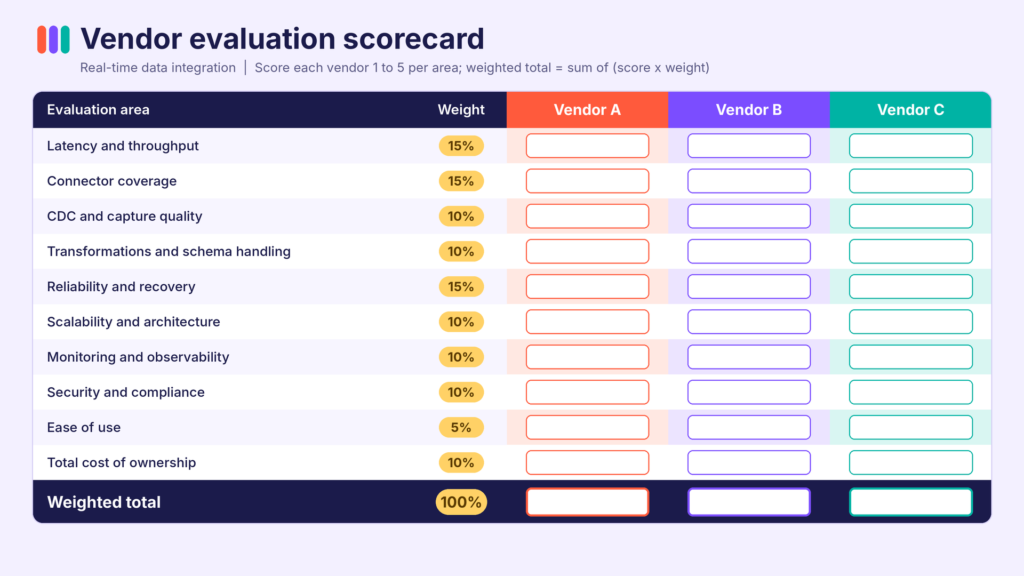
| Criterion | What good looks like | Question to ask vendors |
|---|---|---|
| Latency and throughput | Sustained end-to-end latency that matches your use case, not just a demo-speed benchmark | “What is typical end-to-end latency for a workload like ours at our expected event volume?” |
| Connector coverage | Native support for your databases, business applications, cloud warehouses, and streaming platforms | “Do your connectors support the custom objects, fields, and APIs we rely on?” |
| CDC support | Log-based CDC that captures inserts, updates, and deletes with low impact on source systems | “Do you use log-based CDC, and how do you minimize load on production databases?” |
| Transformation capabilities | In-flight transformations, schema evolution handling, filtering, enrichment, and routing | “How do you handle schema drift and transformations without breaking pipelines?” |
| Reliability and delivery guarantees | Clear delivery semantics, automatic recovery, checkpointing, replay, and backfill support | “What delivery guarantee do you provide, and how do you recover from outages or failed writes?” |
| Scalability and architecture | Cloud-native, elastic architecture that supports hybrid or multi-cloud deployment where needed | “How does the platform scale during traffic spikes, and can it run in our required environments?” |
| Monitoring and observability | Pipeline health dashboards, alerts, lag metrics, lineage, audit logs, and data-quality checks | “Can operations teams detect lag, failures, and data-quality issues before business users do?” |
| Security and compliance | Encryption in transit and at rest, role-based access control, single sign-on, audit trails, and relevant certifications such as SOC 2, GDPR, or HIPAA | “Which compliance certifications, access controls, and audit capabilities are included?” |
| Ease of use | Low-code or no-code configuration for common flows, with APIs and advanced controls for engineers | “Can data analysts operate routine pipelines without engineering support?” |
| Total cost of ownership | Transparent pricing that accounts for connectors, data volume, infrastructure, support, and maintenance | “What costs are included, and what additional infrastructure or engineering effort will we need?” |
CDC, streaming, and delivery guarantees matter because real-time integration is ultimately an operational system: it must continue working through schema changes, network interruptions, source outages, and growing data volumes.
Evaluation Scorecard
Use this scorecard to compare two or three vendors. Rate each area from 1 to 5, where 1 means poor fit and 5 means excellent fit.
What are Some Red Flags to Watch For
Be cautious if a vendor:
- Claims “real-time” without publishing or demonstrating latency benchmarks for a workload similar to yours.
- Offers broad connector counts but shallow support for the custom objects, APIs, or data models in your critical systems.
- Hides pricing behind vague usage terms or makes data growth economically punishing.
- Cannot clearly explain delivery guarantees, replay, backfill, failure recovery, or how it avoids data loss.
- Provides weak monitoring, limited audit logs, or no alerting for pipeline lag and failures.
- Requires extensive custom engineering for use cases that should be standard.
From Delayed Data to Real-Time Decisions
Real-time data integration keeps your business systems updated by continuously capturing, transforming, and delivering data changes as they happen. It becomes essential when delayed information affects customer experience, decision-making, fraud detection, reporting accuracy, or operational efficiency.
The 10-point checklist in the blog, will help you assess whether your business needs real-time integration, and help you evaluate potential tools based on latency, connector coverage, CDC support, reliability, scalability, observability, security, ease of use, and total cost of ownership.
One such tool is, Aekyam. Aekyam is an AI Orchestration platform built with real-time capabilities. It helps you connect different data sources, build dependable real-time and hybrid pipelines, and deliver fresh, trusted data to the teams and applications that need it, so you can make faster decisions and deliver better customer experiences. Talk to our team of experts, or request for a demo to experience real-time transformation.
Frequently Asked Questions
What is the difference between real-time data integration and ETL?
Traditional ETL typically extracts data on a schedule, transforms it, and loads it into a destination in batches. Real-time data integration continuously captures and delivers changes as they occur, often using CDC or event streams.
Is real-time data integration the same as streaming?
No. Streaming is a common mechanism for real-time integration, but they are not identical. Real-time integration is the broader outcome—keeping systems synchronized with minimal delay—while streaming refers to continuously processing data as a flow of events.
How much does real-time data integration cost?
Costs vary widely based on data volume, number of connectors, transformation complexity, infrastructure choices, support needs, and vendor pricing. Look beyond license fees and include engineering time, monitoring, maintenance, and the cost of infrastructure required to meet your latency and reliability targets.
Can I run real-time and batch pipelines together?
Yes. A hybrid architecture is often the most practical approach: use batch for historical reporting and large backfills, and real-time pipelines for operational dashboards, customer-facing systems, fraud detection, personalization, and automation.
How long does implementation take?
Simple, well-scoped implementations—such as syncing one database to a warehouse—can take days to weeks. More complex programs involving many sources, custom transformations, governance requirements, and operational integrations can take several months. Start with one high-impact use case rather than trying to make every system real-time at once.
Share