


Introduction
A single AI agent is impressive right up until you need two of them to work together. Then the cracks show — one agent loses the thread of what another did, work gets duplicated, and decisions compound on outdated information.
This is the coordination problem at the heart of agentic AI, and it’s why AI agent orchestration has become essential. As soon as agents start collaborating on real work — one extracting data, another validating it, a third routing exceptions, a fourth updating systems — you need something coordinating the handoffs. Without it, you’re back to custom development and brittle glue code.
This blog explores what agent orchestration is, how it differs from the agents themselves, and the mechanisms that let multiple agents operate reliably at scale. For the bigger picture of where this fits, read our comprehensive on what an AI orchestration platform is.
Agents vs. Orchestration: The Distinction That Trips Everyone Up
This confuses a lot of buyers, so let’s settle it plainly. An AI agent is a model that can plan and execute tasks on its own — answering questions, calling tools, and adapting based on results. Agent orchestration is the layer that coordinates multiple agents, models, and tools into coherent workflows. To explore more about what AI agent orchestration, and it’s importance in the present business landscape, read our blog on how AI agent orchestration is the backbone of modern day enterprises.
Agents execute tasks autonomously, while orchestration coordinates them. The orchestra analogy holds, the agents are the musicians, and orchestration is the conductor making sure they play together. You typically want both: specialized agents doing the work, and a coordination layer directing their combined effort.
Why can't a single powerful agent just do everything?
Because capability isn’t the bottleneck — coordination is. A single agent can be remarkably capable, but its value depends less on raw ability and more on how work gets divided and how context is shared across steps. Complex processes naturally split into specialized roles: one agent good at extraction, another at validation, another at routing. Trying to cram all of that into one agent makes it fragile and hard to maintain. Coordinating specialists beats one generalist doing everything.
What Breaks Without Orchestration
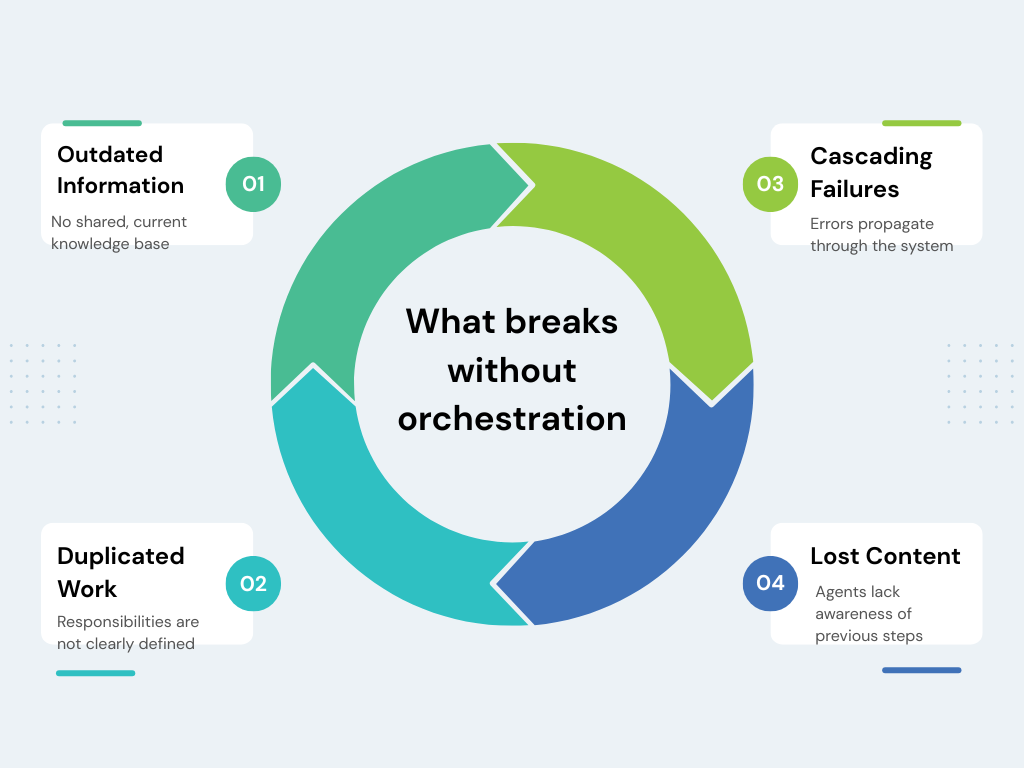
Run multiple agents without a coordination layer, and the same failure patterns appear every time.
- Lost context. An agent completes a step, but the next agent doesn’t know what happened, so it works from incomplete information.
- Duplicated work. Two agents tackle the same task because nothing is dividing responsibilities.
- Outdated information. An agent acts on stale data because there’s no shared, current knowledge base.
- Cascading failures. One agent produces a flawed output, another builds on it, and the error only surfaces after it’s caused business impact.
In non-orchestrated systems, failures often stay hidden until they become expensive. Orchestration exists to catch these before they compound.
How AI Agent Orchestration Coordinates the Work
Orchestration solves those problems with a few core mechanisms.
Shared context and a common knowledge base
The orchestrator keeps agents updated with real-time context and maintains a shared knowledge base, so agents exchange information continuously instead of working blind. The orchestrator dynamically identifies the best-suited agent for each task based on real-time data and workload, then keeps everyone in sync.
Defined handoffs
Instead of informal, hope-it-works handoffs, orchestration makes them explicit workflow steps. Each agent knows what it receives, what it produces, and where its output goes next — like a well-rehearsed relay team passing the baton cleanly.
Fault isolation
When one agent fails, orchestration contains it. The failed agent retries or routes around the issue while others keep working, so a single failure doesn’t take down the whole system. Orchestration defines exactly where errors get intercepted and when a retry or escalation kicks in.
Human-in-the-loop checkpoints
Not every decision should be autonomous. Orchestration embeds approval steps for high-impact or high-risk actions, keeping people in control where judgment matters. This governance is central to running agents in regulated, enterprise-grade workflows.
Single Agent vs. Orchestrated Multi-Agent System
| Challenge | Single Agent / No Orchestration | Orchestrated Multi-Agent System |
|---|---|---|
| Context across steps | Lost between agents | Shared, real-time knowledge base |
| Task assignment | Ad hoc, often duplicated | Dynamically assigned to best agent |
| Handoffs | Informal, brittle | Defined workflow steps |
| Failures | Cascade silently | Isolated, retried, or escalated |
| Oversight | Hard to enforce | Human-in-the-loop checkpoints built in |
Why This Matters Now
Agent orchestration isn’t a future concern — the demand is here. Around 40% of enterprise apps are integrating AI agents in 2026, and the shift toward multi-agent systems is what’s driving the need for robust coordination. Modern use cases increasingly require several agents working together, and that’s precisely where informal approaches fall apart.
The payoff for getting it right is real. Centrally orchestrated multi-agent systems improved performance by up to 80.9% on parallelizable tasks compared to a single agent, proving that coordination—not just more agents—is what drives results. To see where multi-agent coordination delivers the most value, explore the AI orchestration use cases across supply chain and enterprise operations.
From Agents to Orchestration: What Actually Determines Success at Scale
Three things to hold onto. Agents and orchestration are distinct, agents do the work, orchestration coordinates them. Single agents are fine until you need several working together, at which point lost context and cascading failures become the norm. And orchestration solves this through shared context, clean handoffs, fault isolation, and human checkpoints.
As agentic AI moves from pilots to production, the coordination layer becomes the thing that determines whether it works. That’s the layer Aekyam provides, orchestrating agents, apps, and data into workflows that hold together at scale.
Ready to move agents from experiment to production? Book a demo or contact with our team of experts to bring a multi-step process worth automating.
Frequently Asked Questions
What is AI agent orchestration in simple terms?
AI agent orchestration is the coordination layer that lets multiple AI agents work together as one reliable system. It manages how agents share information, hand off tasks, and recover from errors, so they contribute to a shared goal instead of operating in isolation. In short, it's the conductor that turns a group of individual agents into a coordinated team.
How is an AI agent different from AI orchestration?
An AI agent is a single system that plans and executes a task on its own — it answers, decides, and acts. AI orchestration is the layer above that coordinates many agents, models, and tools into a coherent workflow. The agent does the work; orchestration makes sure all the agents' work fits together, in the right order, toward the right outcome.
Why do multi-agent systems fail without orchestration?
They fail because of coordination breakdowns, not because the agents are weak. Without a coordination layer, agents lose context between steps, duplicate each other's work, act on outdated information, and let failures cascade silently until they cause real damage. Orchestration prevents this by maintaining shared context, defining clean handoffs, and isolating failures before they spread.
Can multiple AI agents share information with each other?
Yes — that's one of the main jobs of orchestration. The orchestrator maintains a shared, real-time knowledge base and keeps agents updated as work progresses, so each agent acts on current information rather than a stale snapshot. This continuous exchange is what prevents duplicated effort and keeps a multi-agent workflow consistent from start to finish.
Do humans stay involved in orchestrated AI agent workflows?
Yes, and by design. Most enterprise deployments include human-in-the-loop checkpoints for approvals, exception handling, and high-impact decisions where judgment matters. Orchestration embeds these checkpoints directly into the workflow, so automation handles the routine work while people retain control over the decisions that carry real risk.
What happens when one AI agent fails in a multi-agent system?
n an orchestrated system, a single agent's failure is contained rather than catastrophic. The orchestration layer isolates the fault — the failed agent retries or the workflow routes around it — while the other agents keep working. This fault isolation is a key reason orchestrated multi-agent systems are more resilient than loosely connected agents, where one failure can quietly corrupt everything downstream.
Is AI agent orchestration only for large enterprises?
No. While large enterprises use it to manage complexity at scale, smaller teams benefit just as much because they can't afford to babysit agents or maintain custom coordination code. Any organization running more than one or two agents that need to work together will hit the same coordination problems, and orchestration platforms that scale across business sizes make the capability accessible without a large IT team.
Share
Read Similar Blogs