


Every major integration vendor now claims to offer “AI orchestration.” Almost none of them mean exactly the same thing by it. Some are describing AI-assisted developer tools that speed up how humans build integrations. Others are describing full agentic platforms where AI systems reason, act, and coordinate work autonomously across your enterprise. That gap matters enormously when you’re evaluating vendors, because it’s the difference between a platform that helps your team build faster and one that can actually run production workflows with AI agents in the loop.
This guide breaks down what AI orchestration actually is, why enterprises are adopting it, the capabilities that separate a real platform from a feature list, and the questions you should be asking every vendor on your shortlist.
What Is AI Orchestration?
AI orchestration is the coordination layer that sits above your applications, data, and AI agents, managing how they work together to complete business processes. Where traditional integration platforms moved data from Point A to Point B on a schedule or a trigger, an orchestration platform does three additional things:
- Connects AI agents to enterprise systems, turning existing APIs, databases, and applications into tools that agents can discover and safely call — increasingly through the Model Context Protocol (MCP), an emerging open standard for exposing enterprise systems to AI models.
- Coordinates multi-step, multi-agent workflows, routing tasks between agents, applications, and humans, with checkpoints where deterministic business rules need to override probabilistic AI reasoning.
- Governs and monitors agent behavior at scale, enforcing identity, permissions, budgets, and audit trails so autonomous agents don’t become a compliance or security liability as adoption grows.
The distinction worth remembering: integration connects systems. Orchestration connects systems, data, and AI agents, and gives all three a coordinated, governed way to get work done together.
Why Enterprises Need Orchestration
Three converging pressures are driving enterprises toward AI orchestration platforms, rather than continuing to stretch legacy integration tools.
Agent sprawl is already happening. Teams across the enterprise are building agents on different frameworks — some in-house, some embedded in vendor tools, some on hyperscaler platforms like Bedrock or Vertex AI. Without a coordination layer, organizations end up with dozens of disconnected agents and no single place to monitor, govern, or control them.
Read our blog to understand the true cost of AI sprawl, its impact on enterprise operations, and how orchestration helps.
Static integrations weren’t built for autonomous decision-makers. An AI agent that can “see” a customer or order record isn’t useful unless it can also act on it — with the right permissions, audit logging, and guardrails in place. Point-to-point integrations designed for scheduled data syncs weren’t built with autonomous software in mind.
The gap between piloting AI and running it in production is where most initiatives stall. Industry research increasingly finds that a large share of enterprise AI agent projects never reach production, with governance and not capability, cited as the primary reason. Orchestration is the layer that turns experimental agents into governed, auditable, production-grade systems.
To get a comprehensive idea of what AI Orchestration is, and why your enterprise might need it, read our blog titled, What Is an AI Orchestration Platform and Why Does Your Business Need One?.
Top Capabilities to Evaluate
Not every “AI orchestration platform” delivers on all of these. Use this list to separate genuine platforms from rebranded automation tools.
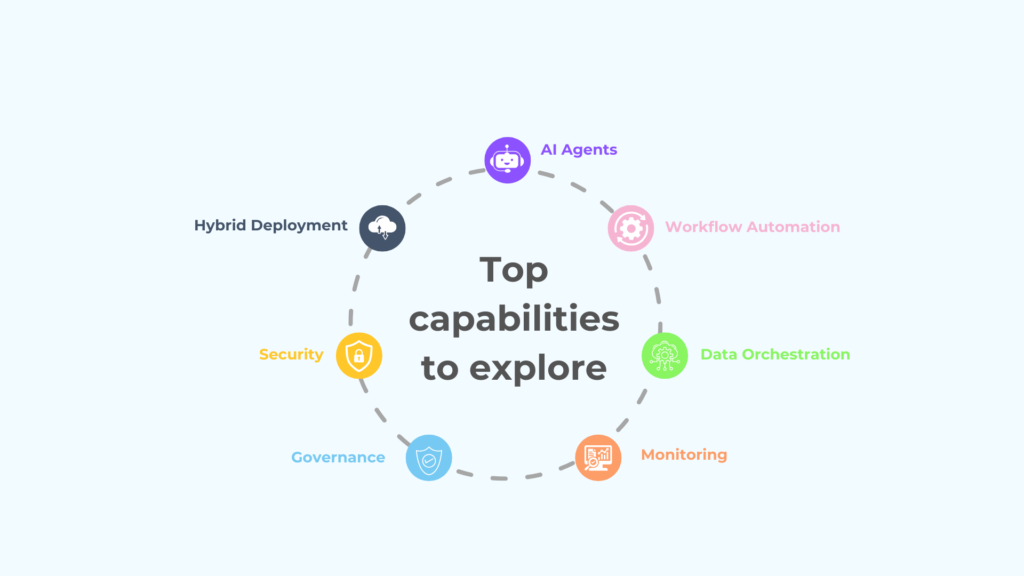
AI Agents
Can the platform actually build, deploy, and coordinate AI agents — not just connect to ones built elsewhere? Look for native agent-building tools, support for multi-agent collaboration, and the ability to blend deterministic business logic with LLM reasoning so critical workflows stay predictable rather than fully probabilistic.
Workflow Automation
Beyond AI agents, does the platform still handle traditional, rules-based workflow automation well? Most real-world processes are a mix of deterministic steps and AI-driven decisions — a platform needs to handle both without forcing every workflow through an LLM unnecessarily.
Data Orchestration
Can the platform move, transform, and unify data across ERPs, CRMs, warehouses, and applications in real time — and can it prepare that data in a form AI agents can reliably reason over? AI orchestration is only as good as the data foundation underneath it.
Monitoring
Look for full observability into every transaction, workflow, and AI agent action — not just system uptime. If an agent takes an unexpected action, can you trace exactly what data it accessed, what reasoning it followed, and what it did as a result?
Governance
This is the capability most vendors talk about and fewest fully deliver. Real governance means centralized policy enforcement, permission and identity management for agents (not just humans), budget and cost controls, and audit trails that satisfy compliance and security teams — regardless of which framework an agent was built on.
Security
Evaluate how the platform secures agent-to-system communication, whether it supports your existing identity and access management infrastructure, and what certifications (SOC 2, ISO 27001, industry-specific standards) it holds. AI agents introduce new attack surfaces; the platform should treat that as a first-class concern, not an afterthought.
Hybrid Deployment
Can the platform run in the cloud, on-premises, or in a hybrid configuration — and can it keep sensitive data within specific regions or environments for compliance reasons? For regulated industries or organizations with data-sovereignty requirements, this isn’t optional.
Questions Buyers Should Ask
Before signing with any vendor, get direct, specific answers to these five questions:
- Can the platform orchestrate AI agents?Ask for a concrete example — not a roadmap slide. Can the vendor show a production deployment where AI agents are actively reasoning and taking action within a governed workflow, versus a platform that merely offers AI-assisted development tools for humans building integrations?
- Does it support hybrid environments?If your organization has any regulatory, data-sovereignty, or legacy-system requirements, confirm the platform can run on-premises or in a hybrid model — not just as a pure SaaS offering — and ask what specifically stays under your control in that configuration.
- How does it handle governance?Push past the marketing language. Ask how the platform enforces permissions for AI agents specifically, what audit logs look like in practice, and how it handles an agent from a different framework (say, one your team built independently) that needs to be brought under the same governance umbrella.
- What is the time to deployment?Ask for realistic, reference-checkable timelines from comparable customers — not best-case estimates. A platform with deep prebuilt accelerators for your industry will typically get you to production dramatically faster than a general-purpose platform that needs custom configuration for your specific systems.
- Does it offer industry accelerators?Generic connectors get you partway there. Ask whether the vendor has prebuilt templates, workflows, and connectors specific to your industry — retail, supply chain, manufacturing, financial services, healthcare — and ask to see them, not just hear that they exist. Industry accelerators are often the single biggest factor separating a months-long implementation from a weeks-long one.
To learn more about how to go on about evaluating the right orchestration platform for your enterprise, read our AI Orchestration evaluation framework.
Making the Decision
The right AI orchestration platform depends less on which vendor has the longest feature list and more on how well its architecture matches your organization’s actual constraints — your regulatory environment, your existing systems, your industry’s specific workflows, and how quickly you need to move from pilot to production. Use the capabilities and questions above to cut through vendor positioning and evaluate what each platform can actually deliver, not just what it claims to orchestrate.
Evaluating AI orchestration platforms for retail and supply chain specifically? Explore this list of 7 orchestration platforms, including Aekyam, built for retail and supply chain, what each of these are good for and to explore which one best suits your requirement.
Got a query or a doubt? Talk to our team of experts or request for a demo to understand how Aekyam can help your business.
The information presented is based on publicly available sources as of the publication date. Features and capabilities may change over time. Readers are encouraged to verify details directly with each vendor.
Frequently Asked Questions
How is an AI orchestration platform different from an iPaaS or RPA tool?
iPaaS platforms move data between systems, and RPA tools automate repetitive tasks by mimicking human clicks. An AI orchestration platform sits above both. It lets AI agents reason, make decisions, and take action across systems, while still governing and auditing that activity.
Do we need an AI orchestration platform if we already have an integration platform?
Not necessarily right away. If your current use case is mainly data movement and scheduled syncs, an integration platform may be enough. Orchestration becomes necessary once you introduce AI agents that need to act autonomously across systems with governance in place.
How long does it typically take to see ROI from an AI orchestration platform?
This varies widely by vendor, industry, and how many pre-built accelerators are available for your use case. Ask vendors for reference-checkable timelines from similar customers rather than relying on generic ROI claims.
Does adopting AI orchestration require hiring new technical talent?
It depends on the platform's design. Some platforms are built for business and integration teams with low-code tooling, while others require dedicated AI or data engineering skills. Clarify this during evaluation, since it directly affects implementation cost and speed.
Can an AI orchestration platform work alongside our existing agents built on other frameworks?
A genuine orchestration platform should be able to bring agents built elsewhere, in-house, on hyperscaler platforms, or embedded in other vendor tools under a single governance layer, rather than requiring you to rebuild them.
What happens if an AI agent makes an incorrect decision inside a workflow?
This depends on how the platform blends deterministic rules with AI reasoning. Platforms with strong governance allow checkpoints where business rules can override or halt agent actions, and full observability lets teams trace exactly what happened and why.
Is AI orchestration only relevant for large enterprises?
No. While large enterprises face agent sprawl earlier due to scale, mid-sized organizations adopting multiple AI tools across teams face the same coordination and governance challenges, just at a smaller scale.
How much does an AI orchestration platform typically cost?
Pricing varies significantly based on deployment model (cloud vs. hybrid), number of agents and workflows, and industry-specific accelerators. Most vendors don't publish flat pricing, so it's worth requesting a detailed quote tied to your specific use case rather than comparing list prices alone.
Share
Read Similar Blogs