


Introduction
Every AI orchestration vendor sounds impressive in a demo. That’s the problem. The polished walkthrough shows the happy path, and the differences that actually matter, the ones you’ll feel six months in, and the live in areas a demo rarely stresses.
So how do you choose an AI orchestration platform without getting burned? You need a framework: a consistent set of criteria to score every platform against, so you’re comparing substance instead of sales polish. Get this right and you avoid two costly outcomes: buying a tool you outgrow in a quarter, or overspending on power you’ll never use.
This blog gives you that framework: the six evaluation areas that matter, the red flags in each, and a checklist to run your shortlist through. If you’re still forming the basics, start with what an AI orchestration platform is. If you’re ready to evaluate, read on.
The Six Areas That Actually Matter
Score every platform on these six. A tool can look great on one or two and quietly fail on the rest.
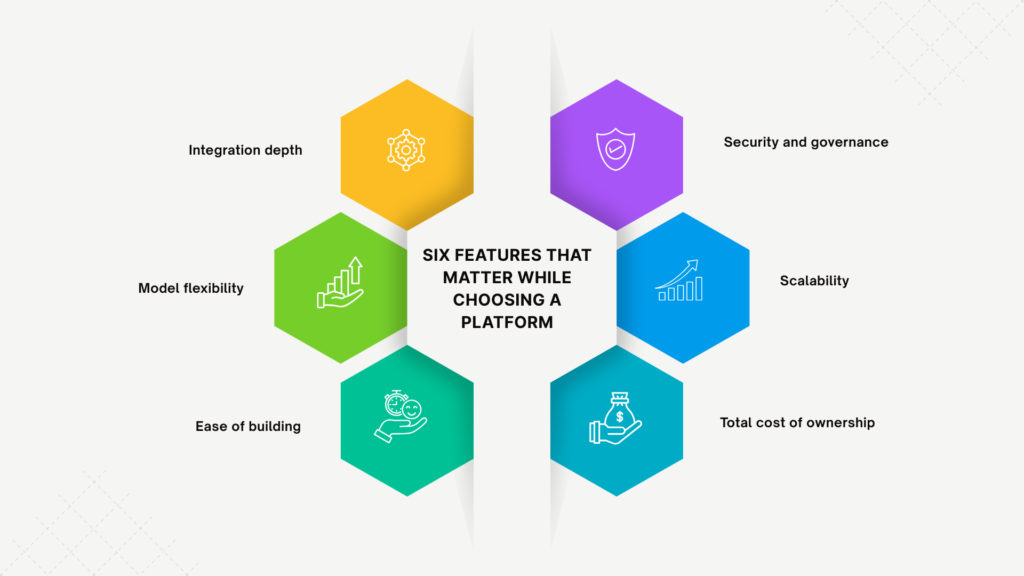
- Integration depth
An orchestration platform is only as useful as what it can connect to. Look for a broad library of pre-built connectors plus solid API support, so your AI can reach the systems it needs without custom pipeline work for each one. This is often the single biggest factor in how fast you get to production. A thin connector library means engineering time you didn’t budget for.
- Model flexibility
Most enterprises aren’t loyal to one AI provider, they use different models for different jobs based on performance, cost, or compliance. A model-agnostic platform lets you route requests to any model and swap providers without rewriting workflows. That flexibility protects you from lock-in and means you can always use the best model for the task.
- Ease of building
Not every workflow should require a developer. The strongest platforms pair drag-and-drop and natural-language building for business users with code options for complex customization. This balance speeds up time-to-value, teams prototype quickly, and developers extend when needed. Watch for tools that force everything through code, or that cap you at no-code with no path to customize.
- Security and governance
This is non-negotiable for enterprise AI, and it’s where you should be strict. Zero-trust access is the baseline, not a premium feature. Look for role-based access controls, encryption, audit logs, human-in-the-loop approvals for high-impact actions, and certifications like SOC 2 and GDPR readiness — plus sector-specific ones where relevant. With analysts flagging AI agent misuse as a growing risk, governance over agent behavior is essential, not optional.
- Scalability
A tool that flies in a pilot can crawl under real load. Ask how the platform handles concurrent workflows, many simultaneous agents, and resource allocation. Cloud-native architectures that scale elastically with demand are what separate a prototype from a system that runs hundreds of workflows at once without falling over.
- Total cost of ownership
Sticker price is only part of it. Common models include usage-based, seat-based, and enterprise contracts, and the real number includes implementation, compute, and API usage. Map your expected volume against the pricing model so you don’t get surprised as you scale, and factor in the maintenance you’ll avoid with a deeper platform. Compare options against your growth plans on the pricing side before committing.
Evaluation Checklist
| Criterion | What to look for | Red flag |
|---|---|---|
| Integration depth | Broad connector library, strong APIs | Few connectors, custom work for everything |
| Model flexibility | Model-agnostic, easy provider swap | Locked to one model provider |
| Ease of building | Low-code plus code options | Code-only, or no-code with no extensibility |
| Security & governance | Zero-trust, RBAC, audit logs, SOC 2/GDPR | Governance treated as an upsell |
| Scalability | Cloud-native, handles concurrency | Struggles past pilot volumes |
| Total cost | Predictable model matched to your volume | Opaque pricing, surprise usage fees |
The Mistake That Costs the Most
The single biggest buying error is choosing on the demo instead of the depth.
A great demo shows a clean workflow running end to end. It rarely shows what happens under load, how governance holds up in an audit, or how much custom work a real integration takes. Teams that skip a structured evaluation tend to discover the gaps in production — and by then, switching is expensive.
The fix is discipline: score every platform across all six areas, weight them for your context, and prioritize the tools that check every box. Platforms that deliver depth across all six are the ones that reduce long-term integration debt and grow with you. And match the platform to your size and stage, a tool built to scale from startup to enterprise means you won’t have to rip and replace as you grow.
Evaluating for Today and Scaling for Tomorrow
Three things to carry into your evaluation. Score every platform on the same six areas: integration, model flexibility, ease of building, security, scalability, and cost, instead of reacting to demos. Treat security and governance as baseline requirements, not premium features. It is also important to weight the criteria for your own context, because the right platform depends on your stack, your compliance needs, and your growth plans.
A platform that’s strong across all six is one you won’t outgrow in a quarter. That’s the standard Aekyam is built to meet — depth across integration, orchestration, governance, and scale in one place.
Ready to put a platform through the framework? Book a demo or connect with our team of experts to bring your toughest evaluation questions.
Frequently Asked Questions
How do I choose the right AI orchestration platform for my business?
Score every option against six areas: integration depth, model flexibility, ease of building, security and governance, scalability, and total cost of ownership. Weight those criteria for your own context — your existing stack, compliance needs, and growth plans — and prioritize platforms that show depth across all six rather than excelling at one or two. The goal is to compare substance consistently instead of reacting to whichever demo looks slickest.
What features are most important in an AI orchestration platform?
The features that matter most are a broad pre-built connector library, model-agnostic flexibility, both low-code and code-based building options, enterprise-grade security and governance, elastic scalability, and predictable pricing. Integration depth and model flexibility usually determine how fast you reach production and how future-proof you are, while security and scalability determine whether the platform survives real enterprise use.
Why does model-agnostic matter when choosing a platform?
Model-agnostic support lets you route requests to any AI model and switch providers without rewriting your workflows. It matters because most enterprises use different models for different tasks based on cost, performance, or compliance, and being locked to one provider limits your options and raises your risk. A model-agnostic platform protects you from lock-in and lets you always use the best model for each job.
How important is security and governance in an orchestration platform?
They're essential and should be treated as baseline requirements, not optional extras. Look for zero-trust access, role-based controls, encryption, audit logs, human-in-the-loop approvals, and compliance certifications like SOC 2 and GDPR readiness. As AI agents take on more autonomous actions, strong governance is what makes the difference between a platform you can scale safely and one that becomes a liability at enterprise volume.
What's the biggest mistake to avoid when selecting a platform?
The most common and costly mistake is choosing based on a polished demo instead of depth across all six evaluation areas. Demos show the happy path and rarely stress governance, scalability, or the real effort of integration. Teams that skip a structured evaluation usually discover the gaps in production, when switching platforms is far more expensive. A disciplined scorecard prevents that.
Do I need a technical team to evaluate and run an orchestration platform?
You don't need a large engineering team, especially with platforms that offer low-code and visual building for business users. However, having someone who understands your integration needs and security requirements helps you evaluate depth rather than surface features. The best platforms let non-technical users build workflows while still giving developers the ability to customize, so you can start without heavy technical resources and extend as needed.
How do I compare pricing across AI orchestration platforms?
Look past the headline price to total cost of ownership, including implementation, compute, and API usage fees. Pricing models vary — usage-based, seat-based, and enterprise contracts each behave differently as you scale — so map your expected volume against each model to avoid surprises. Also factor in the maintenance costs you'll avoid with a deeper platform, since a cheaper tool that needs constant custom work can cost more over time. Comparing options against your growth plans and pricing upfront prevents expensive surprises later.
Share
Read Similar Blogs