


The Integration Bottleneck Slowing Your Business Down
Your enterprise team manages an average of 300 SaaS applications. Each one holds critical data. But they don’t talk to each other.
Traditional integration takes months of developer time. You need specialized skills. You wait in long IT queues. Meanwhile, your competitors move faster.
iPaaS platforms with low-code no-code features change this. They let you connect systems in days, not months. Your business teams can build integrations without writing code. You get faster results with fewer resources.
What Are iPaaS Platforms with Low-Code No-Code Features?
iPaaS stands for Integration Platform as a Service. It’s a cloud-based solution that connects your applications, data, and systems. The platform handles all the technical complexity behind the scenes.
Low-code and no-code features make this accessible to everyone. Instead of writing complex code, you use visual tools. You drag and drop components. You configure settings through simple interfaces.
How Low-Code No-Code iPaaS Works
These platforms use three core components to simplify integration:
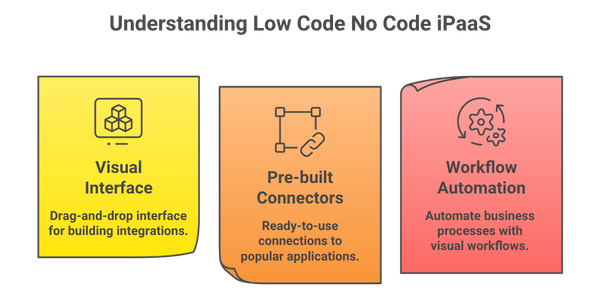
Visual Interface
You build integrations using drag-and-drop canvases. Flow-chart style workflows show you exactly what’s happening. No coding knowledge required.
Pre-Built Connectors
Ready-made connections to popular business applications save you time. Connect to your CRM, ERP, e-commerce platform, or database in minutes. The platform handles authentication and data mapping automatically.
Workflow Automation
Set up multi-step processes with branching logic. Schedule automated tasks. Handle errors and retries without manual intervention.
The platform translates your visual designs into executable code. It manages the runtime execution. You focus on the business logic, not the technical details.
What's the Difference Between Low-Code and No-Code iPaaS?
Low-code platforms give you visual tools plus the option to write custom code. They’re flexible. Developers can add JavaScript or TypeScript when needed. This works well for complex integrations.
No-code platforms require zero coding. Everything happens through visual interfaces. Business users can build and maintain integrations independently. This speeds up simple to moderate integrations.
Many modern AI workflow orchestration platforms offer both capabilities. You choose the approach that fits your team’s skills and requirements.
Why iPaaS Platforms with Low-Code No-Code Features Matter in 2026
The integration landscape has changed dramatically. Understanding why these platforms matter helps you stay competitive.
The Integration Challenge Businesses Face Today
Enterprise IT environments have grown more complex. Applications and data are scattered across hybrid and multi-cloud setups. SaaS sprawl is real—the unchecked growth of software subscriptions within organizations.
Manual integration processes can’t keep up. Data silos form. Information gets stuck in individual systems. Teams waste time on repetitive data entry.
The cost of poor integration is high. Delayed decisions. Lost revenue opportunities. Customer experience suffers when systems don’t share data in real time.
How These Platforms Solve the Developer Shortage
The global software developer shortfall is expected to reach 4 million unfilled roles by 2025. Your IT team is already stretched thin. Traditional integration methods require specialized skills that are hard to find and expensive to hire.
iPaaS platforms with low-code no-code features democratize integration. Non-technical users can build what they need. Your marketing team can connect their automation tools. Your sales team can sync CRM data. Your operations team can automate workflows.
This frees up your developers for high-value work. They focus on innovation, not routine integration tasks.
Can Non-Technical Users Really Build Integrations?
Yes. The statistics prove it works.
Nearly 60% of custom applications are now built by employees outside IT departments. Business technologists—people with domain expertise but not formal programming training—are leading this shift.
Organizations report that business users can configure workflows with minimal training. The visual interfaces are intuitive. Pre-built templates provide starting points. Users learn by doing.
Of course, IT still plays a role. They set governance standards. They manage security policies. They handle complex edge cases. But day-to-day integration work shifts to the teams who understand the business processes best.
Key Features of Low-Code No-Code iPaaS Platforms
Modern iPaaS platforms with low-code no-code capabilities share several essential features. Here’s what to look for.
Visual Interface and Drag-and-Drop Builders
The visual designer is your main workspace. You see your integration flows as diagrams. Each step is a block or node representing an operation.
Building an integration feels like creating a flowchart. You drag components onto the canvas. You connect them with lines showing data flow. You configure each step through simple forms and dropdown menus.
The platform validates your work in real time. It catches errors before you deploy. You can test integrations with sample data before going live.
Pre-Built Connectors and Templates
A robust integration marketplace accelerates your work. Pre-built connectors handle the technical details of connecting to specific applications.
Common connectors include:
- CRM systems like Salesforce and HubSpot
- ERP platforms like SAP and Oracle
- E-commerce tools like Shopify and WooCommerce
- Databases like MySQL, PostgreSQL, and MongoDB
- Cloud storage like Google Drive and Dropbox
- Communication tools like Slack and Microsoft Teams
Templates provide pre-configured integration patterns. Use a template for common scenarios like syncing contacts, processing orders, or onboarding employees. Customize it for your specific needs.
API Management Capabilities
Many low-code iPaaS platforms let you build, publish, and manage APIs directly. This is powerful for organizations with custom applications.
You can create APIs that expose your internal systems to external partners. The platform handles authentication, rate limiting, and monitoring. You enforce security policies without writing code.
This makes it easier to participate in API-led architectures. Your integrations become reusable services.
Workflow Automation and Orchestration
iPaaS platforms excel at orchestrating complex multi-step processes. You define the sequence of operations. The platform executes them reliably.
Features include:
- Event triggers that start workflows automatically
- Conditional logic for branching paths
- Error handling with automatic retries
- Scheduling for batch processes
- Parallel processing for performance
The platform monitors execution. You get alerts when something fails. You can view logs and troubleshoot issues through the visual interface.
Benefits of Using iPaaS Platforms with Low-Code No-Code Features
The business impact of these platforms is significant. Here’s what you can expect.
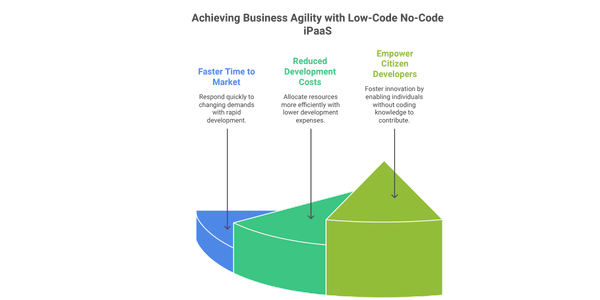
Faster Time to Market
Speed is the most obvious benefit. Organizations report development time reductions of 60% to 90%.
What used to take months now takes weeks or days. You respond to market changes faster. You launch new products quicker. You beat competitors to market.
Product launches increasingly focus on low-code integration development. IT teams reduce deployment time by up to 35% using these approaches.
Reduced Development Costs
Lower costs come from multiple sources. You need fewer specialized developers. You reduce dependency on expensive consulting services. You minimize custom code that requires ongoing maintenance.
Average annual savings reach $187,000 per organization. Payback periods range from 6 to 12 months. The ROI is compelling.
You also avoid the hidden costs of delayed projects. Integration bottlenecks no longer block business initiatives.
Empowering Citizen Developers
Citizen developers are non-professional programmers who create applications and integrations. They have domain knowledge but not formal coding training.
41% of companies now have active citizen development programs. These initiatives work because low-code no-code tools are accessible.
Your marketing team can connect their martech stack. Your HR team can automate onboarding. Your finance team can sync reporting tools. They don’t wait for IT approval for every small change.
This creates a culture of innovation. People solve their own problems. They iterate quickly based on feedback.
How Much Can Businesses Save with Low-Code iPaaS?
The financial impact varies by organization size and complexity. But the patterns are consistent.
Small to medium businesses save on hiring costs. They avoid bringing in expensive integration specialists. They can compete with larger companies without massive IT budgets.
Large enterprises save on project timelines. Faster delivery means faster revenue realization. Reduced IT workload lets developers focus on strategic projects.
One study found that companies achieve a 253% ROI with low-code adoption. Full payback happens in under 7 months. Over three years, businesses save an estimated $4.4 million by avoiding additional developer hires.
Common Use Cases Across Industries
iPaaS platforms with low-code no-code features work across sectors. Here are real-world applications.
E-Commerce and Retail Integration
Retail businesses use these platforms to connect their entire ecosystem. The e-commerce platform talks to the inventory system. The inventory system updates the ERP. The ERP triggers reorder workflows.
Customer orders flow automatically from the website to fulfillment. Payment gateways connect to accounting systems. Marketing automation syncs with customer data.
This creates seamless customer experiences. Inventory is always accurate. Orders process without manual intervention. The retail market is projected to reach $40.74 billion by 2030, growing at 23.9% CAGR, driven partly by these integration capabilities.
Healthcare System Connectivity
Healthcare organizations face unique challenges. Systems must be highly secure. Compliance with HIPAA and other regulations is mandatory. Integration needs are complex.
iPaaS platforms help connect electronic health records (EHR) with other systems. Patient data flows to billing systems. Lab results integrate with physician dashboards. Appointment systems sync with CRM tools.
One healthcare provider integrated their EHR system with Salesforce using an iPaaS platform. This increased efficiency and reduced administrative workload. They delivered 292,000 dialysis treatments more efficiently.
Finance and Banking Automation
Financial services rely heavily on data integration. Transactions must be processed in real time. Risk assessment requires data from multiple sources. Regulatory reporting needs accurate, complete data.
iPaaS platforms with low-code capabilities help banks automate workflows. Customer onboarding connects identity verification, account creation, and compliance checks. Loan processing integrates credit scoring, document management, and approval workflows.
Security and compliance features are critical. Platforms provide encryption, access controls, and audit trails. They help organizations meet GDPR, SOC 2, and industry-specific requirements.
Manufacturing and Supply Chain
Manufacturing companies use iPaaS to orchestrate their supply chains. Production systems connect to inventory management. Supplier portals integrate with procurement systems. Quality control data flows to analytics platforms.
IoT devices in factories generate massive amounts of data. An iPaaS platform can connect diverse sensors, machines, and monitoring tools. This enables predictive maintenance and real-time optimization.
Supply chain visibility improves when all systems share data. You track shipments across multiple carriers. You monitor inventory levels across warehouses. You respond quickly to disruptions.
Challenges and How to Address Them
No technology is perfect. Understanding potential challenges helps you plan effectively.
Security and Compliance Considerations
Moving data between systems creates security risks. You need to protect sensitive information. You must comply with regulations like GDPR and CCPA.
Choose platforms with robust security features:
- End-to-end encryption for data in transit and at rest
- Role-based access controls to limit who can build and modify integrations
- Comprehensive audit logs for compliance reporting
- Compliance certifications (SOC 2, ISO 27001, HIPAA)
Implement governance policies. Define who can create integrations. Require security reviews for integrations handling sensitive data. Monitor integration activity regularly.
Technical Limitations and Workarounds
Low-code no-code platforms can’t handle every scenario. Very complex logic may require custom coding. Performance-intensive operations might need optimization.
The good news: most platforms offer flexibility. You can add custom code when needed. Developers can write JavaScript, Python, or other languages for specific components. This hybrid approach gives you the best of both worlds.
For performance issues, consider:
- Batch processing for large data volumes
- Caching frequently accessed data
- Optimizing data transformation logic
- Using the platform’s performance monitoring tools
How Do You Avoid Vendor Lock-In?
Vendor lock-in is a legitimate concern. You don’t want to become dependent on a single platform that limits your future options.
Look for platforms that support open standards. API-first architectures make it easier to switch solutions. Export capabilities let you extract your integration logic.
Consider hybrid approaches. Use the low-code platform for standard integrations. Build critical, complex integrations with custom code that you fully control. This balances speed with strategic flexibility.
Evaluate the platform’s integration capabilities with other tools. Can it connect to multiple clouds? Does it support hybrid cloud and on-premises deployments? Application orchestration should work across your entire technology landscape.
Choosing the Right Platform for Your Needs
Not all iPaaS platforms are equal. Evaluate based on your specific requirements:
For SMBs:
- Easy to use with minimal training
- Affordable pricing that scales with usage
- Good library of pre-built connectors for common apps
- Strong support and documentation
For Enterprises:
- Advanced security and compliance features
- Scalability to handle high transaction volumes
- Hybrid cloud and on-premises deployment options
- Enterprise-grade SLAs and support
For Developers:
- Ability to write custom code when needed
- API management capabilities
- Version control and testing tools
- Integration with existing development workflows
Research multiple options. Run proofs of concept. Test with real integration scenarios before committing.
Low-Code iPaaS Market Statistics 2026
Here’s what the data shows about market growth and adoption:
| Metric | Value | Source |
|---|---|---|
| Global low-code iPaaS market size (2026) | $28.75 billion | IDC |
| Projected market size (2032) | $264.40 billion | Market Research |
| Compound annual growth rate (CAGR) | 32.2% | Industry Analysis |
| Integration development time reduction | 60-90% | Gartner |
| New apps using low-code/no-code by 2026 | 70% | Gartner |
| Average annual cost savings | $187,000 | Forrester |
| Developer shortfall by 2025 | 4 million roles | Industry Reports |
| Product launches focusing on low-code | 51% | Market Analysis |
| IT workload reduction post-iPaaS adoption | 49% | Enterprise Surveys |
These numbers show explosive growth. The technology has moved from emerging to mainstream. Organizations that adopt early gain competitive advantages.
Future of iPaaS with Low-Code No-Code Capabilities
The evolution continues. Here’s what’s coming next.
AI and Machine Learning Integration
Artificial intelligence is transforming iPaaS platforms. 54% of vendors have added AI capabilities in recent years. This trend accelerates.
AI-powered integration development helps in several ways:
Intelligent Recommendations
AI suggests which systems to connect based on your usage patterns. It recommends optimal integration approaches. It predicts potential issues before they occur.
Automated Data Mapping
AI can automatically map fields between systems. It recognizes similar data structures. It learns from your mappings to improve over time.
Natural Language Integration
Describe what you want in plain English. The AI generates the integration workflow. You review and adjust as needed.
Predictive Monitoring
Machine learning identifies patterns that signal future failures. You fix issues proactively. Uptime improves.
65% of businesses now use AI in business functions. This percentage will grow as AI capabilities mature.
Small and medium-sized businesses are accelerating adoption. These organizations benefit the most from democratized integration.
SMBs traditionally couldn’t afford enterprise integration tools. The upfront costs were too high. The required expertise wasn’t available. Low-code no-code iPaaS changes this equation.
Cloud-based pricing makes these tools accessible. You pay for what you use. You scale as you grow. No massive upfront investment required.
Asia-Pacific shows the fastest growth rates—projected at 31% annually through 2029. Over 55% of organizations in the region consider low-code no-code essential for enterprise automation.
This global expansion drives innovation. More use cases emerge. Platforms become more capable. The flywheel effect accelerates adoption further.
Transform Your Integration Strategy Today
iPaaS platforms with low-code no-code features represent a fundamental shift in how organizations approach integration. The technology has matured. The business case is proven. The market growth is explosive.
Three key takeaways:
Speed wins: Organizations that can integrate systems faster respond to market changes better. Low-code no-code platforms deliver speed without sacrificing capability.
Democratization drives innovation: When business users can build their own integrations, innovation accelerates. IT becomes an enabler, not a bottleneck.
The technology will keep evolving: AI integration, improved automation, and expanding connector libraries make these platforms more powerful every year.
Aekyam’s AI-powered orchestration platform combines the ease of low-code tools with the power of intelligent automation. You can bring your own code when needed. You customize workflows to fit your exact requirements. The platform scales with your business.
Ready to streamline your integration strategy? Explore how iPaaS with low-code no-code features can transform your workflow automation and accelerate your digital transformation. The tools exist. The time is now.
Talk to our team to see how Aekyam can help you build a more connected, automated enterprise.
Share
Read Similar Blogs