

How are enterprises using AI workflow automation?
AI workflow automation has moved past pilot projects. Companies now use it for real work: processing documents, routing decisions, and managing exceptions without human help. It handles tasks that are too varied for simple rule-based systems and too high-volume for people to manage at scale. Here’s where it’s being used, what it replaces, and what companies gain.
For a deeper look at the technology, implementation approaches, and real-world use cases behind AI workflow automation, explore our comprehensive guide.
What are the industries where AI workflow automation is predominantly used?
AI Workflow automation is being rapidly adopted across multiple industries, to ensure faster processes, lesser manual work and efficient processes.
Read our blog on the benefits of AI workflow automation to learn how enterprises and industries alike are leveraging it.
Some industries which are using AI workflow now are:
- Retail and Supply Chain
- Finance and Banking
- HR and Operations
- Healthcare
- Manufacturing
- Customer support
To understand how these industries are utilizing AI workflow automation, let’s look at the real-world use cases below:
Retail and Supply Chain
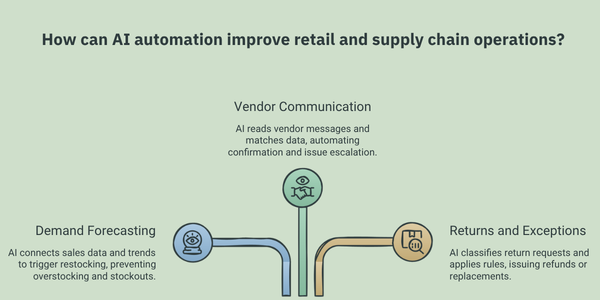
AI automation is changing retail by acting on demand signals in real time, easing vendor management, and handling exceptions that once clogged human queues. The result: a supply chain that responds faster and needs less manual work.
Demand Forecasting and Restocking
Manual reorder processes often lead to overstocking or stockouts. AI connects sales data, seasonal trends, and supplier lead times into one workflow. It triggers restocking the moment thresholds are hit, based on current demand rather than last quarter’s numbers.
Vendor Communication and Purchase Orders
AI reads vendor messages in any format, pulls out key data, and matches it against open orders. It confirms, flags, or escalates issues automatically. Purchase orders that once needed manual drafting and follow-up are now generated and tracked by the system.
Returns and Exceptions
Every return has a different reason and resolution path. AI classifies each request, applies policy rules, and issues refunds or replacements when criteria are met. Complex cases go to a human reviewer with full context attached. The same logic handles damaged shipments and delivery delays.
Finance and Banking
Banks use AI automation for three demanding tasks: invoice processing, fraud detection, and compliance documentation. Each involves high volume, strict accuracy needs, and costly errors.
Invoice Processing and Approvals
AI reads invoices in any format, extracts key fields, and matches them to purchase orders. Discrepancies go to a reviewer; clean invoices process automatically. Approval routing now runs by invoice value and vendor category, cutting cycle times from days to hours.
Real-Time Fraud Detection
AI monitors transactions as they happen, using models trained on past fraud patterns. It flags or blocks suspicious activity before it completes and improves over time as it learns from flagged cases, cutting false positives that frustrate real customers.
Compliance and Audit Trails
AI logs every action, timestamp, and trigger as part of the workflow itself. This creates a searchable compliance record with no manual assembly. When regulators ask for documentation, it’s ready immediately.
HR and Operations
AI automation cuts the administrative load that eats up HR teams’ time, freeing them for work that truly needs a human touch.
Screening Candidates
AI reads applications in any format, checks qualifications and experience, and ranks candidates by fit. Recruiters get a prioritized shortlist with reasoning attached, instead of a raw stack of resumes.
Onboarding and Offboarding
AI coordinates system access requests, sends documents to new hires, and schedules orientation, removing the delays of manual handoffs across HR, IT, and hiring managers. Offboarding runs the same way in reverse: access revoked, equipment recovered, final pay processed.
Leave and Policy Management
AI checks leave balances, applies policy rules, and approves straightforward requests automatically. It answers policy questions using current documentation and escalates sensitive cases to HR staff.
Other Industries
Healthcare
Prior authorizations require reading payer guidelines and compiling patient records, work that varies by payer and changes often. AI reads clinical documents, matches them to payer criteria, prepares the request, and tracks its status. Scheduling and billing follow the same pattern, freeing clinical staff to focus on patients.
Manufacturing
AI monitors sensor data and production metrics in real time. It spots patterns that predict equipment failure and triggers maintenance alerts before breakdowns happen. It also flags batches outside quality tolerances and starts the review process automatically.
Customer support
AI reads incoming queries, classifies them by type and urgency, and routes them to the right team. For complex cases, it drafts a suggested response for agent review. Agents spend less time sorting tickets and more time solving real problems.
The Bigger Picture
These use cases share one trait: the work is too varied for basic automation and too high-volume for people alone. AI workflow automation fills that gap.
Companies using it aren’t running experiments anymore. They are processing real invoices, claims, support tickets, and HR requests through AI-driven workflows every day. The gap between early adopters and everyone else keeps growing. AI workflow automation now delivers real, measurable value across every major industry. It’s not a future promise, it’s already at work.
Aekyam is an enterprise AI orchestration platform that helps companies put these use cases into practice. It connects your existing systems, deploys AI models suited to your workflows, and builds the orchestration layer for end-to-end automation, without rebuilding your infrastructure.
Connect with our team of experts or request a demo to see how Aekyam can help your industry.
Frequently Asked Questions
1. How can I use AI workflow automation to put in place fraud detection and alerts for my banking operations?
AI workflow automation can put fraud detection and alerts in place by monitoring every transaction in real time and applying machine learning models trained on historical fraud patterns. Each transaction is evaluated against behavioral patterns, transaction history, and risk rules simultaneously, flagging anomalies before they complete, not after. Alerts are routed automatically to the right team with supporting context attached, so investigators can act immediately instead of gathering information manually.
2. How can I ensure that my IT support tickets are resolved on time with AI workflow automation?
AI workflow automation can ensure your IT support tickets are resolved on time by cutting out manual triage and routing. It reads incoming tickets, classifies them by issue type and urgency, and routes each one to the correct team or technician automatically with relevant system context already attached. Common issues with known resolution paths get handled without human involvement, while specialist-level tickets are escalated with priority flags before SLA deadlines are at risk.
3. How can AI workflow automation help me simplify the tax filing process?
AI workflow automation can simplify your tax filing process by removing the bulk of manual document handling. It extracts financial data from invoices, receipts, bank statements, and payroll records automatically, classifies each transaction by tax category, and compiles the consolidated figures needed for filing. Discrepancies are flagged for review rather than passed through unchecked, cutting preparation time significantly compared to manual processing.
4. How should I optimize routes for delivery operations with AI workflow automation?
AI workflow automation can optimize routes for your delivery operations by making the process dynamic instead of static. It ingests real-time data on order volumes, delivery locations, traffic, vehicle capacity, and driver availability, generating optimized routes continuously rather than once per shift. When conditions change mid-route, a failed delivery, a new urgent order, routes are recalculated and updated automatically, reducing fuel costs, improving on-time delivery, and cutting manual dispatch coordination.
5. How can AI workflow automation help me simplify system access grant processes?
AI workflow automation can simplify your system access grant process by handling the full request-approval-provisioning sequence. When an employee submits a request, the system maps it against role-based access policies, routes it to the right approver, and provisions access automatically once approved, no manual coordination needed between IT, HR, and managers. Access reviews and revocations follow the same logic, keeping permissions aligned with current roles without relying on manual audits.
6. Which industries can get benefitted from Aekyam's AI workflow automation?
Aekyam's AI workflow automation platform is designed to work across industries rather than being built for a single sector. Current deployments span banking and financial services, insurance, healthcare, retail and e-commerce, manufacturing, logistics, and enterprise IT operations. The platform handles the workflow types most common across these industries, including document processing, decision routing, compliance documentation, exception management, and system integration, while remaining configurable for the specific process logic and data types that each industry requires
Share
Read Similar Blogs