
Where to Start with for Implementing AI Workflow Automation?
Start with one high-volume, well-defined workflow that causes clear friction today. Starting with the wrong process is the most common reason early implementations lose momentum before they show results.
Read our blog why enterprises are moving towards AI workflow automation to understand why enterprises have started implementing it in the first place.
How to Identify the Right Processes to Automate First
Look for workflows that are repetitive, involve large volumes, and currently require manual effort to complete. Processes with high error rates or long cycle times are strong candidates. Avoid starting with anything that is highly variable or depends heavily on human judgment. Pick something where success is achievable and visible quickly.
What Makes a Good Pilot Workflow
A good pilot is narrow in scope, has clear inputs and outputs, and produces results that are easy to measure. Invoice processing, employee onboarding, and IT ticket routing work well as pilots because they follow consistent logic and generate enough volume to produce meaningful data fast.
Who Needs to Be Involved from Day One
Implementation needs input from operations, IT, and the business owner of the process being automated. Leaving any of these out creates gaps. Including a change management lead from the start also matters, because the people currently doing the manual work need to understand how their roles will shift before the system goes live.
How Do You Set the Right Foundation?
A strong foundation means clean data, connected systems, and a clear decision on how you will build the technology. Skipping any of these creates problems that are expensive to fix later.
Getting Your Data in Order First
AI models learn from data, so the quality of your data determines the quality of your automation. Before deployment, check your data for completeness, consistency, and accuracy. Cleaning and consolidating data before training begins produces a more reliable model from the start.
Planning Integrations with Existing Systems
AI workflow automation needs to read from and write to your existing systems. Map out the integrations required before development begins. Identify which systems have APIs and where data transformation will be needed. Resolving integration questions early prevents delays that commonly surface mid-implementation.
Build, Buy, or Partner: How to Decide
Building from scratch gives maximum control but requires significant time and engineering resources. Buying off the shelf is faster but may not fit your specific workflows. Partnering with a configurable platform works best for most enterprises. Base the decision on your internal capacity, workflow complexity, and how quickly you need to move.
What Does a Phased Rollout Look Like?
A phased rollout moves from a focused pilot to validated workflow to broader scale, with deliberate evaluation at each stage. Rushing to scale before the pilot is fully refined is where most implementations go wrong.
Piloting with a Focused Scope and Clear KPIs
Run the pilot on a single workflow with defined success metrics set before go-live. Relevant KPIs include processing time, error rate, and volume handled without human intervention. Give the pilot six to twelve weeks before making any decisions about expansion.
Evaluating Before Scaling
After the pilot, review results against your KPIs. Identify where the automation performed well and where it fell short. Make adjustments before expanding. Scaling a system with known gaps simply multiplies those gaps across a larger operational surface.
Expanding with the Right Infrastructure
Each new workflow added to the platform benefits from the foundation already in place, making each successive deployment faster. Prioritize next workflows using the same criteria as the pilot: high volume, clear logic, and measurable outcomes.
How to Know AI Workflow Automation Is Working?
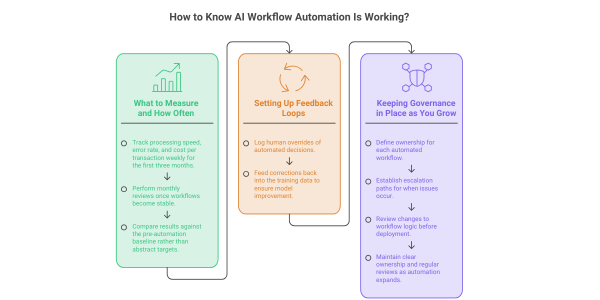
Knowing whether automation is working requires tracking the right metrics, creating feedback loops, and maintaining governance as the system grows.
Read our blog What are the benefits of AI workflow automation to know what sort of outcomes enterprises can expect post implementation.
What to Measure and How Often
Track processing speed, error rate, and cost per transaction weekly for the first three months. After that, monthly reviews are sufficient for stable workflows. Always compare against the pre-automation baseline, not an abstract target.
Setting Up Feedback Loops
When a human reviewer overrides an automated decision, that correction should be logged and fed back into the training data. Without structured feedback loops, the model stays at its launch-day accuracy level rather than improving over time.
Keeping Governance in Place as You Grow
Governance means knowing who owns each automated workflow, what the escalation path is when something goes wrong, and how changes to workflow logic are reviewed before deployment. As automation expands, clear ownership and regular reviews become more important, not less.
Implementation Is Where Strategy Meets Reality
The enterprises that get the most from AI workflow automation are not the ones that moved fastest. They are the ones that started with the right workflow, built a clean foundation, evaluated honestly before scaling, and maintained governance as they grew. Each of those steps builds on the last, and skipping any of them reduces the returns the system can deliver.
Implementing AI workflow automation well is about disciplined execution at each stage. Choose the right starting point, prepare your data and systems, roll out in phases, and measure consistently. Each step sets up the next one.
Aekyam is an enterprise AI Orchestration platform that supports organizations through every stage of this process, from identifying the right workflows and connecting existing systems to deploying AI models and building the infrastructure needed to scale.
Connect with our team of experts or request a demo to start your AI workflow automation implementation journey.
Frequently Asked Questions
1. How can I implement AI-powered customer support with AI workflow Automation?
Deploy a natural language processing layer that reads incoming queries, classifies them by type and urgency, and either resolves them automatically or routes them to the right agent with context attached. Start with the highest-volume query types where resolution paths are consistent, then expand as the model improves.
2. Who are the trusted implementation partners for AI workflow automation?
Look for partners who have implemented similar workflows in your sector, offer pre-built connectors for your existing systems, and provide ongoing support after go-live rather than a static handoff. Aekyam works with enterprises across the full implementation lifecycle, from workflow assessment through to deployment and scale.
3. Is implementing AI workflow automation a time-consuming and costly process?
A well-scoped pilot on a single workflow with clean data can go live within six to ten weeks. The cost of a phased implementation is typically lower than the annual cost of the manual processing it replaces, meaning most enterprises recover their investment within the first year.
4. Is implementing AI workflow automation safe for my organization?
It is safe when implemented with proper governance. Set confidence thresholds so low-confidence decisions go to human review, maintain a complete audit trail of every action, and embed your compliance requirements into the workflow logic from the start. A well-implemented system is more auditable than the manual processes it replaces.
5. How do I know if the automation is actually working after implementation?
Compare your post-go-live metrics against the pre-automation baseline: processing time, error rate, and cost per transaction. If these are improving, the system is working. Monthly performance reviews combined with regular audits of human-reviewed cases give a complete picture of how the automation is performing.
6. How can Aekyam help me implement AI workflow automation?
Aekyam starts with an assessment of your workflows to identify where automation delivers the most immediate value. It then connects to your existing systems, deploys AI models configured for your process logic, and builds the orchestration layer that ties everything together. After go-live, Aekyam provides the monitoring and feedback infrastructure to keep improving performance over time.
Share
Read Similar Blogs