


What Is Legacy Automation, and Why Is It Reaching Its Limits?
Legacy automation is software built to follow fixed rules. It runs the same steps every time, no matter what changes around it. This worked well for years. It is reaching its limits now because business conditions change faster than a fixed rule can keep up with.
A legacy system can only do what it was told to do. An order might come in with a twist. It might have an unusual shipping address. It might involve a rare product mix. It might arrive during a sudden spike in volume. Either way, the system breaks, or it hands the problem to a person. Every new situation needs a developer to write a new rule. Over time, this makes legacy automation slow to adapt and expensive to maintain.
What Makes AI Automation Different From Legacy Automation?
AI automation is different because it can make decisions, not just follow instructions. It does not rely on a fixed set of rules. Instead, it learns patterns from real data. It applies that learning to new situations it has not seen before. For a better understanding of what AI automation is all about, read our comprehensive guide on AI workflow automation.
This changes what automation can actually handle. A legacy system needs a rule for every scenario a developer can imagine ahead of time. An AI system can respond to situations nobody planned for. It reasons from patterns, not from a script. This is the core shift pushing so many businesses away from legacy tools.
Why Does AI Automation Replace Legacy Automation Instead of Just Improving It?
AI automation replaces legacy automation because the two are built on different foundations. A legacy system cannot become smart by adding more rules. More rules just make the system harder to maintain, not more flexible.
AI automation is built around learning from the start. It does not need a developer to plan for every possible situation. It can generalize from examples instead. This is why businesses are not just patching old systems. They are replacing the whole approach.
Read our blog on why enterprises are moving towards AI workflow automation, for a detailed perspective on why AI automation is replacing legacy automation.
Where Does AI Automation Outperform Legacy Automation?
AI automation outperforms legacy automation in three clear areas. These are decision-making, adaptability, and handling messy data. Each area exposes a real weakness in older, rules-based systems.
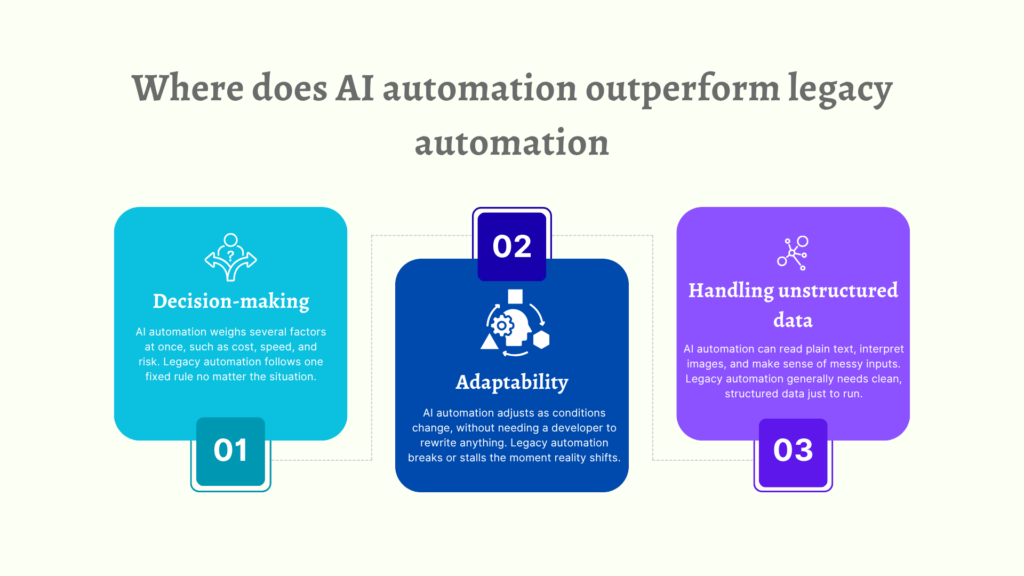
- Decision-making: AI automation weighs several factors at once, such as cost, speed, and risk. Legacy automation follows one fixed rule no matter the situation.
- Adaptability: AI automation adjusts as conditions change, without needing a developer to rewrite anything. Legacy automation breaks or stalls the moment reality shifts.
- Handling unstructured data: AI automation can read plain text, interpret images, and make sense of messy inputs. Legacy automation generally needs clean, structured data just to run.
Together, these differences explain why AI automation increasingly takes over tasks that once needed a fixed workflow and a person watching closely.
What Are the Risks of Sticking With Legacy Automation?
The biggest risk of sticking with legacy automation is falling behind competitors who adapt faster and serve customers better. Legacy systems tend to pile up more manual exceptions over time, not fewer. Every new situation adds another workaround instead of a real fix.
This slowly raises the cost of running the business. Staff spend more time handling exceptions by hand. Errors creep in wherever the rules do not quite fit reality. Meanwhile, competitors using AI automation can respond to changes within days. They do not need a developer to update a rulebook every time something new comes up.
How Should a Business Move From Legacy Automation to AI Automation?
A business should move from legacy automation to AI automation gradually. It should start with areas where decisions are already slow or inconsistent. A full, all at once replacement is rarely necessary. It is often risky too.
- Identify the tasks where legacy rules already break down often, since these are the clearest early wins
- Clean up the data feeding into these tasks, since AI automation depends heavily on data quality
- Run the AI system alongside the legacy system for a period, comparing results before switching over fully
- Expand into other areas once the first rollout proves reliable and the team trusts the results
This phased approach limits risk. It still lets a business capture the benefits of AI automation early on. Learn how to seamlessly implement AI workflow automation, in our blog titled, How to Seamlessly Implement AI Workflow Automation in Your Enterprise.
AI Automation Is Not Just an Upgrade, It Is a Different Way of Working
Legacy automation was built for a world where conditions stayed fairly predictable. Today’s business world does not work that way anymore. AI automation gives a business the flexibility to keep up with constant change. It does this instead of constantly rewriting rules to chase it.
Replacing legacy automation is not simply a matter of installing new software. It needs clean data, a clear view of where AI can help most, and a rollout plan that avoids disrupting daily work.
Aekyam, is an AI Orchestration Platform and helps businesses move from legacy, rules-based systems to AI powered automation without unnecessary risk. Its team finds where legacy processes are already breaking down. It prepares the data these systems depend on. It guides a phased rollout, so a business sees real results before committing further. Aekyam focuses on automation that genuinely improves decision-making, not automation added just to chase a trend.
Connect with Aekyam’s team of experts or request for a demo, to explore your options.
Frequently Asked Questions
Does AI automation completely eliminate the need for human oversight?
AI automation does not eliminate the need for human oversight completely, especially for high stakes decisions. Most businesses keep a person reviewing key outcomes, while letting AI automation handle the repetitive work that used to slow legacy systems down.
How long does it take to see results from AI automation?
Most businesses start seeing measurable results from AI automation within a few weeks of a focused rollout, especially in areas where legacy automation was already causing frequent errors or delays. Impact across the wider business usually builds over several months as adoption expands.
Is switching from legacy automation to AI automation expensive?
Switching from legacy automation to AI automation does need investment, but a phased rollout keeps the cost manageable. Many businesses find that the ongoing cost of legacy automation, in manual exceptions and lost speed, ends up higher over time.
Is AI automation reliable enough for critical business operations?
AI automation can be reliable enough for critical business operations when it is built on clean, well tested data and monitored closely during the early rollout. Businesses that start with lower risk tasks and expand gradually tend to build this reliability with the least disruption.
Does AI automation require clean data to work well?
AI automation does need clean, well organized data to work well, since its decisions are only as good as the data it learns from. This is one of the first things a business should prepare before adopting AI automation.
How can Aekyam help my business move from legacy automation to AI automation?
Aekyam can assess where legacy automation is breaking down, prepare the data AI automation depends on, and manage a phased rollout. This helps a business adopt AI automation with confidence rather than disruption.
Share
Read Similar Blogs

AI Agents and API Integration Platforms: What Changes in the Agentic AI Era
September 15, 2026

AI Orchestration Platform Buyer’s Guide
September 3, 2026