


Introduction
Here’s a pattern playing out in most companies right now. Marketing bought an AI tool to write content. Support deployed a different one for chat. Finance runs its own model for forecasting. Each works fine on its own and none of them talk to each other.
That’s the coordination problem. You don’t have an AI strategy; you have a dozen AI islands. Data doesn’t move between them, governance is inconsistent, and every new use case means stitching together yet another brittle integration by hand.
An AI orchestration platform solves this by sitting above your individual AI tools and coordinating how they work together. This guide breaks down what an AI orchestration platform actually is, why the need became urgent in the last two years, what it does under the hood, and how to tell whether your business is ready for one. By the end, you’ll know where orchestration fits, and where it doesn’t.
What Is an AI Orchestration Platform?
An AI orchestration platform is software that coordinates multiple AI models, agents, data pipelines, and applications so they operate as a single, governed system rather than isolated parts. It routes tasks, manages state, handles errors, and keeps data flowing across every step toward a shared business outcome.
The clearest way to picture it: AI Orchestration is the layer that streamlines the end-to-end AI lifecycle, automating workflows, tracking progress, managing resources, and handling failures. If your AI tools are musicians, the orchestration platform is the conductor. It doesn’t play an instrument. It makes sure every instrument comes in at the right moment.
This is exactly the role Aekyam’s AI workflow orchestration platform is built to play: connecting applications, data, and AI agents into one coordinated flow. For a closer look at the machinery inside, see how the core components fit together in the architecture breakdown later in this series.
How is orchestration different from a single AI tool?
A single AI tool does one job well, it drafts text, classifies an image, or answers a question. It has no awareness of what the rest of your stack is doing.
Orchestration adds awareness. It connects that tool to your data, to other models, and to downstream systems, then coordinates the handoffs. One model extracts data, another validates it, a third routes exceptions to a human, and the platform manages the sequence, the retries, and the audit trail. That coordination is the part a standalone tool can’t give you.
Why AI Orchestration Matters Now
The need for an AI orchestration platform became urgent because AI stopped being a single experiment and became a sprawl. Two years ago, there wasn’t much to orchestrate, a chatbot here, a summarizer there. Today, agents are being deployed across departments at speed, on different platforms, using different models and different data.
The second driver is the shift from single tools to multi-agent systems. Modern workflows increasingly need several AI agents working together one extracting, one validating, one routing, one updating downstream systems. Without a coordination layer, wiring that up means custom development and integrations that break the moment something changes.
What an AI Orchestration Platform Actually Does
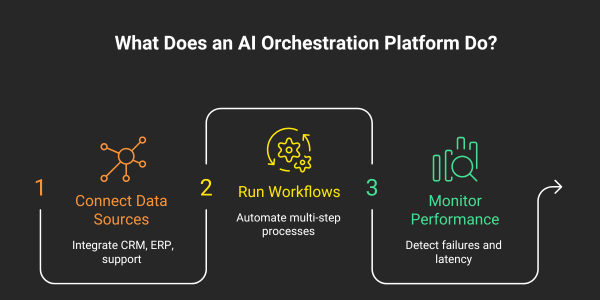
At a high level, an orchestration platform guarantees three things: data moves reliably through your organization, AI tasks execute consistently, and security and oversight are built into every step.
In practice, that breaks into a few jobs. It connects data sources: CRMs, ERPs, support systems so AI always works from current information instead of stale copies. It runs multi-step workflows in the background without constant human babysitting. And it monitors everything. So, when a model fails or latency spikes, the workflow reroutes instead of grinding to a halt. The mechanics of each layer are worth their own deep dive, but that’s the shape of it. To get a detailed idea of how AI orchestration works, read our blog titled, How an AI Orchestration Platform Works: Core Components and Architecture.
The Business Benefits of AI Orchestration
The benefit that matters most is that your AI finally produces predictable results. When models pull from connected, governed data, their output gets more accurate, no more guessing from stale spreadsheets.
The other gains stack from there:
- Adaptive automation. Unlike rigid rule-based automation, an orchestrated workflow adjusts in real time, rerouting when a step fails, flagging issues before they cascade.
- Built-in governance. Access controls, audit logs, and human-in-the-loop checkpoints live inside the workflow instead of being bolted on afterward which matters most in regulated sectors like healthcare, banking, and insurance.
- Scale without sprawl. You manage many models and agents from one place, so growth doesn’t mean a proportional jump in headcount or maintenance.
Different reports suggest that teams that get this right have seen meaningful operational gains. According to one of the reports by Fortune Business Insights also suggest that the global AI orchestration market is projected to grow from USD 13.99 billion in 2026 to USD 60.34 billion by 2034, at a 20.05% CAGR .
To see real AI orchestration impact across supply chain, finance, and service, explore the real-world AI workflow orchestration use cases.
Do small businesses need AI orchestration, or just enterprises?
Both, though for different reasons. Enterprises need orchestration to tame complexity, hundreds of workflows, dozens of systems, strict compliance. The risk they’re managing is chaos.
Smaller businesses need it to punch above their weight. With a lean team, you can’t afford to hand-maintain integrations or babysit every AI task. Orchestration lets a small team run enterprise-grade workflows without an enterprise-grade IT department. The problem being solved differs by size, but the value a structured way to coordinate AI, data, and apps applies at every scale.
How AI Orchestration Differs from Automation and iPaaS
Short version: automation runs a task, integration moves data, and orchestration coordinates the whole thing adapting as conditions change. Traditional automation follows fixed rules and breaks when a field shifts unexpectedly. Orchestration sequences tasks based on real-time conditions and keeps the workflow moving. For a deeper understanding of how AI Orchestration, Workflow Automation, and iPaaS differ, and where each fit in your technology stack, read our blog, AI Orchestration vs. Workflow Automation vs. iPaaS: What’s the Difference?
That distinction deserves its own full treatment, because the categories get blurred constantly in vendor marketing. The detailed comparison of orchestration versus workflow automation versus integration platforms is the next post in this series.
Orchestrate Business Success With AI Orchestration
Three things to take with you. First, an AI orchestration platform is the coordination layer that turns scattered AI tools into one governed system. Second, the need is now; AI sprawl and multi-agent workflows have outgrown manual integration. Third, the payoff is practical: accurate output, adaptive automation, and scale without spiralling complexity.
If your AI feels like a set of islands, the fix isn’t another tool, it’s a way to connect the ones you have. That’s the problem Aekyam was built to solve, orchestrating apps, data, and AI agents into workflows that actually run end to end.
Ready to see it work on your stack? Request a demo or connect with our team of experts to solve your messiest workflow.
Frequently Asked Questions
What is an AI orchestration platform in simple terms?
An AI orchestration platform is software that coordinates multiple AI models, agents, and business systems so they work together as one governed workflow. In plain terms, it's the conductor that makes your separate AI tools operate in sync instead of in isolation. It handles the sequencing, data handoffs, error recovery, and oversight that individual tools can't manage on their own.
Is AI orchestration the same as AI automation?
No. AI automation executes a specific task or decision without human input — it handles one piece of the puzzle. AI orchestration coordinates many of those automated pieces across tools, teams, and systems so they add up to a complete process. Put simply: automation does the work, orchestration makes sure all the work fits together and adapts when conditions change.
Do I need an AI orchestration platform if I only use one or two AI tools?
Probably not yet — but the tipping point arrives faster than most teams expect. If your AI tools don't need to share data or hand off tasks, a standalone tool is fine. The moment you add a second use case that depends on the first, or you need consistent governance across tools, orchestration stops being optional. A good rule of thumb: when you start manually copying data between AI tools, you've outgrown running them separately.
How does AI orchestration improve data governance and security?
It builds governance into the workflow instead of applying it after the fact. Role-based access controls, audit logs, and human-in-the-loop approvals sit inside each orchestrated process, so every AI action is traceable and every sensitive step is controlled. This is why regulated industries like banking, healthcare, and insurance treat orchestration as the foundation for deploying AI safely rather than a nice-to-have.
What business problems does an AI orchestration platform solve?
It solves fragmentation — disconnected AI tools, siloed data, brittle integrations, and inconsistent oversight. Instead of each department running its own AI island, orchestration connects them into coordinated workflows with reliable data flow and centralized control. The practical results are more accurate AI output, automation that adapts instead of breaking, and the ability to scale new workflows without a proportional jump in maintenance work.
How long does it take to see ROI from AI orchestration?
It depends on scope, but well-defined workflows tend to pay back quickly. Narrow, high-volume processes with clean data — invoice handling, ticket routing, document processing — often show returns within a few months. More complex, multi-system workflows like supply chain coordination typically reach full ROI over 12 to 18 months as monitoring and exception-handling mature. The strongest predictor of a fast return is scope discipline: start with one clear process, deploy it to production, then expand.
Can an AI orchestration platform work with the AI models and tools I already use?
Yes — that's the point of a good one. A capable orchestration platform is model-agnostic and integration-first, connecting to the models, apps, and data sources you already run through pre-built connectors and APIs. You shouldn't have to rip out your existing stack to orchestrate it; the platform layers on top and coordinates what's already there, which also protects you from being locked into a single model provider.
Share
Read Similar Blogs

AI Agents and API Integration Platforms: What Changes in the Agentic AI Era
September 15, 2026
AI Orchestration Platform Buyer’s Guide
September 3, 2026