


About This Guide
Purpose: To provide a structured, repeatable method for taking AI-driven workflow automation from isolated pilots to a governed, organization-wide capability.
Audience: Operations leaders, automation/COE (Center of Excellence) owners, IT and platform teams, and business unit leaders sponsoring automation initiatives.
Scope: This guide covers strategy, architecture, governance, and execution. It does not cover the mechanics of prompting or selecting a single vendor tool. It covers how to make automation work reliably at scale, across teams and systems. If you’re still getting oriented on the topic itself, our blog titled, AI Workflow Automation: A Guide for Enterprises, is a good starting point before diving into the scaling mechanics below.
How to use this guide: Read Sections 1–2 in full first. Sections 3–7 are designed to be used as working references during implementation, return to them at each phase of your rollout. Section 8 provides a ready-to-adapt roadmap. The appendix contains checklists and a glossary for quick lookup.
Table of Contents
Why 2026 Is a Turning Point
For most of 2023–2025, organizations treated AI workflow automation as a series of experiments: a chatbot here, a document extractor there, an isolated RPA-plus-LLM pilot in one department. That phase is ending.
Three shifts define 2026 specifically:
Adoption is accelerating past the pilot stage. Gartner projects that the share of enterprises running task-specific AI agents in production to rise from under 5% in 2025 to roughly 40% by the end of 2026. Gartner also states that by 2026, 80% of enterprises will rely on AI APIs and workflow automation platforms to manage core business processes.
- The bottleneck has moved. Model access is no longer the primary constraint. McKinsey’s own research finds that nearly two-thirds of organizations have not yet scaled AI beyond a handful of pilots, and that what separates the leaders from the rest isn’t better data, models, or tools alone. It’s how well the organization helps people adopt, adapt, and create value with AI day to day (McKinsey — “Are your people ready for AI at scale?”). OpenAI’s own enterprise data points to the same conclusion: with new model capabilities shipping roughly every three days, the primary constraint for organizations is no longer model performance or tooling, but organizational readiness and implementation
- The gap between “using AI” and “scaling AI” is now the defining competitive line. Only a minority of enterprises using generative AI have actually scaled it past a single business function. According to McKinsey only 7% of organizations have fully scaled AI across the enterprise, despite AI and LLM tasks appearing throughout modern automation pipelines.
- The practical implication: if your organization already has one or two working AI-assisted workflows, you are not behind you are exactly where most of the market is. The work now is the harder, less glamorous part: turning isolated wins into an operating capability that other teams can reuse without reinventing it each time.
We unpack exactly what’s driving this shift, and why it’s happening now rather than two years ago, in our blog: Why Are Enterprises Suddenly Shifting Towards AI Workflow Automation?
Defining "Scale": What It Actually Means
Before building a plan, align your stakeholders on what “scaling” actually requires. Scaling is not simply “doing more automations.” It is the transition across four dimensions simultaneously:
| Dimension | Pilot Stage | Scaled Stage |
|---|---|---|
| Breadth | One team, one process | Multiple departments, multiple process families |
| Ownership | A single champion or vendor | A defined operating model (COE, platform team, business owners) |
| Infrastructure | Point-to-point integrations, manual glue | Reusable orchestration layer, shared connectors |
| Oversight | Ad hoc review | Formal governance, audit trail, human-in-the-loop policy |
| Measurement | Anecdotal ("it saves time") | Tracked KPIs tied to cost, cycle time, and error rate |
A useful industry framing distinguishes two very different scaling problems depending on company size: enterprises are mostly focused on scaling automation across departments without losing control, while smaller companies are focused on affordable AI agents, faster setup, and winning one clear workflow at a time. This guide is written primarily for the enterprise scaling problem, but the phased framework in Section 4 applies to both, only the pace and governance depth will differ. Because “AI workflow automation” is often used loosely alongside older RPA-style automation, and the two aren’t the same thing. Our blog on the differences between workflow automation vs. AI-driven workflow automation breaks down both the concepts in detail, so your stakeholders are aligned on terminology from the outset.
It also helps to be precise about what “AI workflow automation” now includes, since the category has broadened considerably:
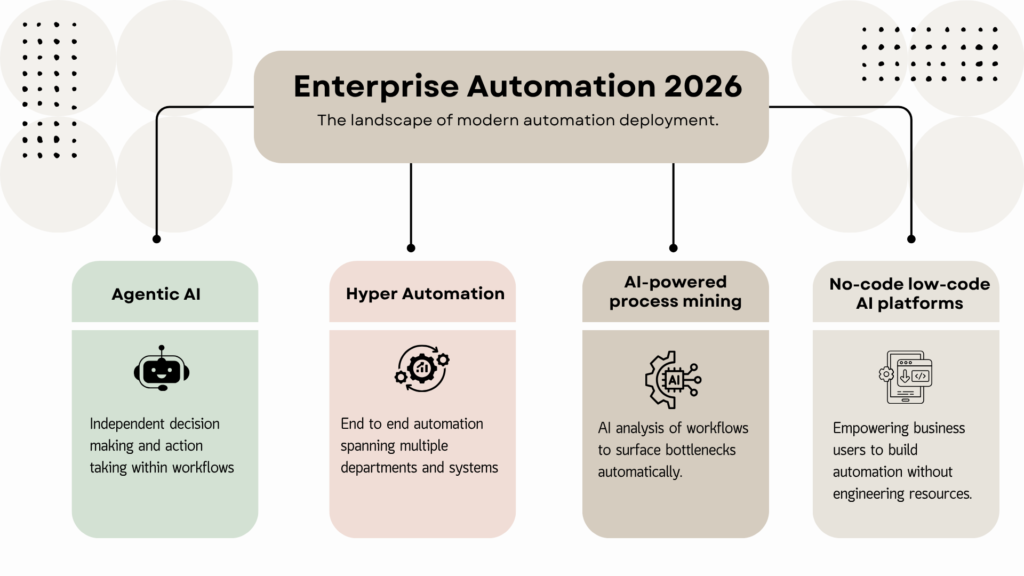
- Agentic AI — systems that independently make decisions and take actions within a workflow, such as approvals, routing, and exception handling, without constant human input.
- Hyper-automation — end-to-end automation that spans multiple systems and departments rather than a single task.
- AI-powered process mining — using AI to analyze how work actually flows through the organization, surfacing bottlenecks automatically rather than through manual process mapping.
- No-code / low-code AI platforms — putting automation-building capability directly in the hands of business users rather than requiring engineering resources for every workflow, which is one of the most significant trends reshaping how enterprises deploy automation tooling in 2026.
Readiness Assessment
Do not begin a scaling initiative without first answering these questions honestly. Each maps to a common failure point covered in Section 9.
3.1 Process Readiness
- Can the target processes be described as a discrete, repeatable sequence of steps, even if some steps require judgment?
- Have you distinguished the standard case (should be automated first) from the exception case (should route to a human)? Attempting to automate every exception upfront is a leading cause of stalled programs.
- Is there a known “system of record” for the data involved, or does the process rely on scattered spreadsheets and email threads?
3.2 Data Readiness
- Do the systems involved (ERP, CRM, HR, ticketing, document stores) expose the data via an API or connector, or does the workflow currently depend on manual export/import?
- Is there a data owner accountable for the accuracy of inputs the AI will consume?
- Can you trace a decision made by the system back to the data and model version that produced it? This traceability is a governance requirement, not a nice-to-have audits fail without it.
3.3 Organizational Readiness
- Is there a named owner for the automation program (a Center of Excellence, platform team, or equivalent), or is ownership currently informal?
- Do business units understand that scaling automation is a redesign of how work moves, not a bolt-on tool layered onto the existing process?
- Is there executive sponsorship with authority to resolve cross-departmental conflicts (e.g., which team owns a shared customer-onboarding workflow)?
3.4 Technical Readiness
- Do you have (or plan to have) an orchestration layer that can coordinate multiple agents, systems, and human approvers, rather than a collection of disconnected point automations?
- Is there a plan for observability – logging, monitoring, and alerting — before volume increases, not after?
- Have you evaluated whether workflows need real-time execution or can run on a scheduled/batch basis? Real-time synchronization is now standard in mature deployments but is not always necessary or worth the added complexity.
If more than two or three of these questions have an uncertain answer, treat that gap as the first item on your roadmap, not something to solve in parallel with scaling.
The Four-Phase Scaling Framework
Scaling AI workflow automation is best managed as four sequential phases. Each phase has an entry condition, a primary objective, and an exit criterion. Do not skip a phase to move faster. Most failed scaling attempts are the result of moving to Phase 3 or 4 without the foundation from Phase 1 and 2 in place.
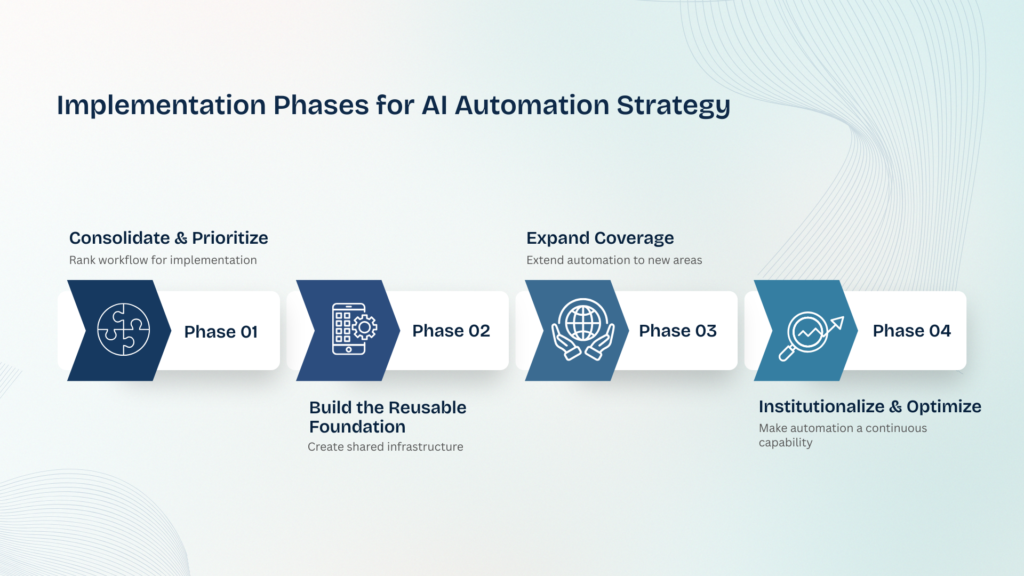
Phase 1 — Consolidate and Prioritize
Objective: Move from scattered pilots to a ranked, business-cased portfolio of workflows.
- Inventory every existing AI-assisted automation across the organization, including shadow-IT pilots run by individual teams.
- Score each candidate workflow (existing or proposed) by economic and operational impact: volume, cost per transaction, error/rework cost, and time sensitivity.
- Select a small number of workflows to industrialize first — three is a workable starting number for most mid-to-large organizations, based on how practitioners recommend prioritizing by economic and operational impact rather than attempting a broad rollout at once.
Exit criterion: A ranked backlog with clear owners and success metrics for the first 3–5 workflows.
Phase 2 — Build the Reusable Foundation
Objective: Replace one-off integrations with shared infrastructure before adding more workflows.
- Stand up (or consolidate onto) a single orchestration layer rather than building bespoke connectors per workflow, ad hoc, one-off integrations for each system create brittle “automation islands” that don’t scale and are expensive to maintain.
- Establish a shared connector library for the systems you touch most (ERP, CRM, ticketing, document storage, identity/HR systems).
- Define your human-in-the-loop model once, as a policy, so every future workflow inherits it rather than reinventing escalation rules from scratch.
- Put baseline observability and logging in place before volume increases.
Exit criterion: Two or more workflows are running on the same shared orchestration and connector layer, not on separate custom builds.
Phase 3 — Expand Coverage
Objective: Extend from the first proven workflows to adjacent processes and departments.
- Move to the next tier of the prioritized backlog, reusing the foundation from Phase 2 rather than rebuilding it.
- Introduce cross-system orchestration where processes naturally span departments. For example, an order-to-cash process that touches sales, finance, and fulfillment.
- Begin formalizing self-service: let trained business users build or configure their own workflows within guardrails, rather than routing every request through a central engineering team. This is one of the clearest patterns separating organizations that scale from those that stay bottlenecked on a small automation team.
- Expand governance to match the new volume and risk surface (see Section 6).
Exit criterion: Automation is running in at least two to three business functions with a shared operating model, and new workflow requests can be fulfilled without a full engineering build each time.
Phase 4 — Institutionalize and Optimize
Objective: Make continuous improvement and governance a standing operational capability, not a project.
- Use AI-powered process mining to continuously surface new automation candidates and detect where existing workflows are degrading or drifting.
- Formalize the Center of Excellence as a permanent function: platform ownership, governance review cadence, training, and a workflow intake process for new requests.
- Move from static workflows to adaptive ones, where the system analyzes bottlenecks and suggests better paths rather than executing a fixed sequence indefinitely.
- Review vendor and model choices periodically: this is an operating capability, not a one-time architecture decision.
Exit criterion: Automation scaling has its own budget line, governance cadence, and intake process independent of any single champion or executive sponsor.
Reference Architecture
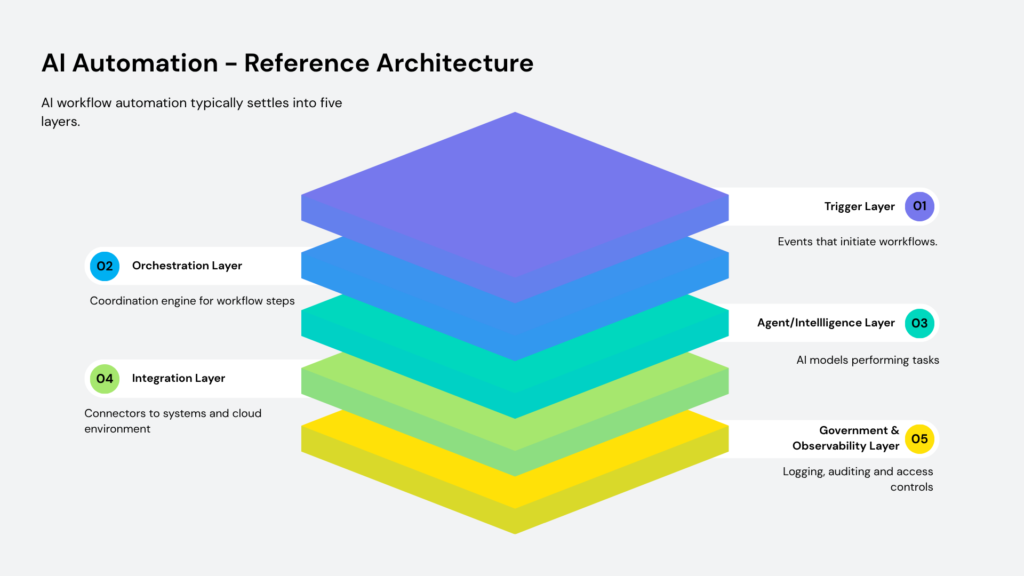
At scale, AI workflow automation typically settles into five layers. Treat this as a reference, not a mandate. The right depth for each layer depends on your organization’s size and risk profile.
- Trigger Layer Events that start a workflow: a new order, an uploaded invoice, a support ticket, a policy update, a scheduled interval. Mature deployments favor event-driven triggers over manual kickoffs wherever possible.
- Orchestration Layer The coordination engine that sequences steps, invokes agents and systems, manages state, and routes exceptions to humans. This is the layer most responsible for reliability at scale — an AI workflow orchestrates multiple agents, humans, and systems into a coordinated process, and this coordination layer is what makes individual agents valuable rather than isolated.
- Agent / Intelligence Layer The models and agents performing extraction, classification, drafting, decisioning, or recommendation. This layer should be modular: a document-classification agent, an approval-routing agent, and a customer-response agent are separate, independently testable components — not one monolithic prompt trying to do everything.
- Integration Layer Connectors into systems of record (ERP, CRM, HR, ticketing, document stores) and across cloud environments. Enterprises increasingly need this layer to work across AWS, Azure, Google Cloud, and on-premises systems simultaneously, to avoid vendor lock-in and preserve flexibility as tools evolve.
- Governance and Observability Layer Logging, audit trail, human-in-the-loop checkpoints, model/version tracking, and access controls. This layer is not optional at scale — it is what turns “an AI did something” into “we can explain, audit, and correct what the AI did.”
A practical rule for architecture decisions: build once, reuse across workflows. The organizations that scale successfully treat the orchestration, integration, and governance layers as shared infrastructure invested in upfront, while the agent layer is where most of the workflow-specific customization happens.
Governance and Risk Management
Governance is the single most common gap between organizations that scale successfully and those that stall after the first few wins. Build it in from Phase 2 onward, not retroactively.
6.1 Human-in-the-Loop Policy
Define, as a written policy, which decisions the AI can make autonomously and which require human sign-off. A workable default:
- Autonomous: low-risk, high-volume, easily reversible actions (e.g., routing a standard support ticket, flagging a low-value invoice discrepancy for standard reconciliation).
- Human-reviewed: medium-risk or ambiguous cases (e.g., an exception that doesn’t match known patterns).
- Human-approved: high-risk, high-value, or hard-to-reverse actions (e.g., large payment approvals, contract commitments, personnel decisions).
Most mature enterprises operate a hybrid model on this spectrum: AI handles routine decisions while critical approvals continue to involve human oversight for accuracy and compliance — this is the norm, not a transitional state you’re expected to grow out of.
6.2 Data Lineage and Traceability
When a model makes a recommendation or decision, you need to be able to trace it back to the data and process that produced it — lack of this lineage is what causes audits to fail. Practically, this means:
- Logging the model/agent version used for each decision.
- Retaining the inputs (or a reference to them) that informed a given output.
- Making this trace queryable by compliance and audit teams without engineering involvement.
6.3 Common Governance Failure Patterns to Design Against
- Treating AI as a bolt-on to an existing process instead of redesigning the workflow so AI complements human decision points by design.
- Over-automating exceptions in an attempt to reach “100% automation” too early — automate the standard case first, and route edge cases to human reviewers with clear escalation rules.
- Lax data governance, where recommendations can’t be traced back to their source.
6.4 Regulatory Awareness
Governance requirements vary significantly by industry and geography and continue to evolve. Treat compliance requirements (data residency, model explainability, sector-specific regulation such as financial services or healthcare rules) as an input to your architecture decisions in Section 5, not an afterthought layered on at the end. Involve legal and compliance stakeholders during Phase 1 prioritization, not after a workflow is already in production.
Measuring ROI and Performance
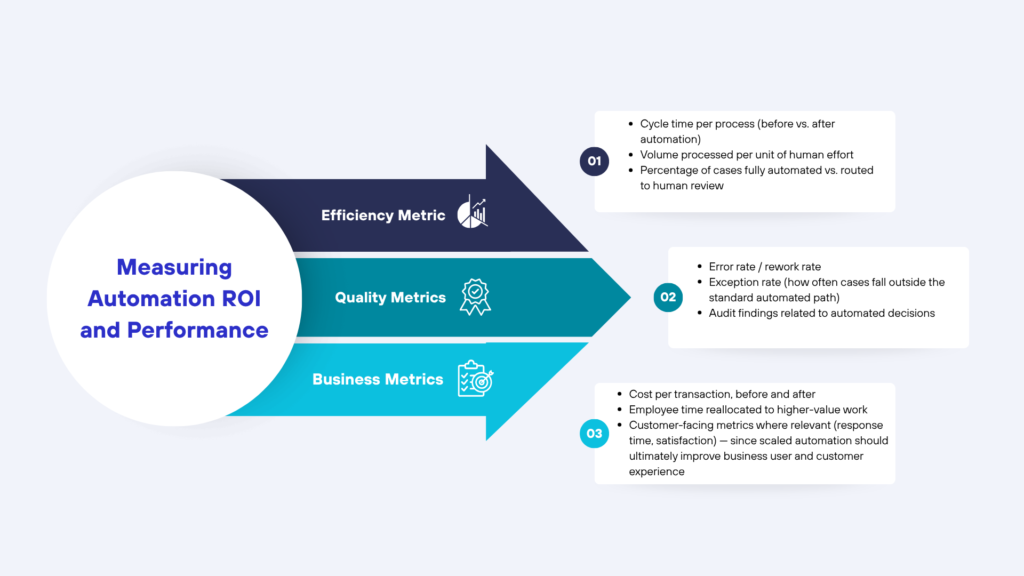
Scaled automation programs are judged on outcomes, not activity. Track metrics in three categories from day one so you have a baseline before volume increases.
7.1 Efficiency Metrics
- Cycle time per process (before vs. after automation)
- Volume processed per unit of human effort
- Percentage of cases fully automated vs. routed to human review
7.2 Quality Metrics
- Error rate / rework rate
- Exception rate (how often cases fall outside the standard automated path)
- Audit findings related to automated decisions
7.3 Business Metrics
- Cost per transaction, before and after
- Employee time reallocated to higher-value work
- Customer-facing metrics where relevant (response time, satisfaction) — since scaled automation should ultimately improve business user and customer experience, not just internal throughput
A note on ROI framing: avoid measuring success purely by “hours saved.” Enterprises with mature programs report reductions in process cycle times, error rates, and operational costs together, alongside improved user experience treat these as a connected set of outcomes rather than optimizing one in isolation, since over-optimizing for speed alone tends to increase the error rate you’re not tracking.
To know more about how AI workflow automation can benefit your business, read our blog titled, What are the benefits if AI workflow automation?
A 90-Day Rollout Roadmap
Use this as a starting template and adjust timelines to your organization’s size and existing maturity. This assumes you are starting Phase 1 with at least one working pilot already in place.
For a broader, more conceptual walkthrough of what a successful rollout involves beyond just this timeline, read our blog on how to seamlessly implement AI workflow automation.
Days 1–15: Assessment and Prioritization
- Complete the Readiness Assessment (Section 3) across process, data, organization, and technical dimensions.
- Inventory existing pilots, including shadow-IT automations.
- Score and rank candidate workflows by economic and operational impact.
- Secure executive sponsorship with cross-departmental authority.
Days 16–30: Foundation Design
- Select or consolidate the orchestration layer.
- Define the human-in-the-loop policy (Section 6.1) as a written, reusable standard.
- Design the connector library for your top 3–5 target systems.
- Involve legal/compliance stakeholders in reviewing the top-ranked workflows.
Days 31–60: First Scaled Deployment
- Deploy the top-ranked workflow(s) on the shared foundation, not as a custom build.
- Stand up baseline observability and logging.
- Run the workflow in parallel with the existing manual/legacy process for a defined validation window before full cutover.
- Begin tracking the three metric categories from Section 7.
Days 61–90: Validate and Expand
- Review metrics against baseline; adjust the human-in-the-loop thresholds based on observed exception rates.
- Formalize the Center of Excellence or platform-owner role if not already established.
- Begin Phase 3 expansion planning: identify the next tier of workflows and whether self-service capability can be extended to business users.
- Document lessons learned and update the governance policy based on real operating experience, not assumptions made in Phase 1.
Common Failure Modes and How to Avoid Them
| Failure Mode | Why It Happens | How to Avoid It |
|---|---|---|
| AI treated as a bolt-on | Existing process is left unchanged; AI is layered on top | Redesign the workflow itself so AI is part of the process architecture, not an add-on |
| Automation islands | Each workflow gets its own bespoke integration | Invest in a shared orchestration and connector layer before expanding coverage (Phase 2) |
| Over-automating exceptions | Pressure to hit a "100% automated" target | Automate the standard path first; route edge cases to humans with clear escalation rules |
| No data lineage | Traceability wasn't designed in from the start | Log model version, inputs, and decision rationale from Phase 1 onward |
| Stalling after the first win | No formal ownership beyond the original champion | Establish a Center of Excellence or platform owner before Phase 3 |
| Governance added too late | Governance seen as a blocker to speed rather than an enabler of scale | Build human-in-the-loop policy and audit trail in parallel with the first deployment, not after |
| Measuring only "hours saved" | Easiest metric to report, but incomplete | Track efficiency, quality, and business metrics together (Section 7) |
Appendix A: Scaling Readiness Checklist
Process
- Target processes are documented as repeatable sequences
- Standard cases and exception cases are clearly distinguished
- A system of record exists for the relevant data
Data
- Systems expose data via API/connector, not manual export
- A data owner is accountable for input accuracy
- Decisions can be traced back to the data and model version used
Organization
- A program owner (COE, platform team, or equivalent) is named
- Executive sponsorship with cross-departmental authority is in place
- Business units understand this is a workflow redesign, not a tool add-on
Technical
- A shared orchestration layer exists or is planned
- Observability (logging, monitoring, alerting) is planned before volume increases
- Real-time vs. batch execution needs have been evaluated per workflow
Governance
- A written human-in-the-loop policy exists
- Legal/compliance is involved in workflow prioritization, not just deployment
- An audit trail is queryable without engineering involvement
Appendix B: Glossary
Agentic AI — AI systems capable of autonomously making decisions and taking actions within a workflow (e.g., approvals, routing, exception handling) without constant human input.
Hyperautomation — The practice of automating end-to-end processes across multiple systems and departments, rather than automating individual, isolated tasks.
Orchestration Layer — The coordination engine that sequences workflow steps, invokes agents and systems, manages state, and routes exceptions to human reviewers.
Human-in-the-Loop (HITL) — A design pattern in which humans review or approve AI-driven decisions at defined checkpoints, based on risk or ambiguity.
Process Mining — The use of AI to analyze how work actually flows through an organization’s systems, surfacing bottlenecks and automation candidates automatically.
Center of Excellence (COE) — A dedicated cross-functional team responsible for owning automation platform standards, governance, training, and workflow intake at scale.
Automation Island — A workflow built on a bespoke, one-off integration that doesn’t share infrastructure with other automations, making it brittle and expensive to maintain.
Data Lineage — The ability to trace a system’s output or decision back to the specific data and model version that produced it.
This guide synthesizes current industry reporting and practitioner guidance on enterprise AI automation as of mid-2026. Governance and regulatory requirements vary by industry and jurisdiction validate specifics with your legal and compliance teams before finalizing policy.
Share
Read Similar Blogs