


Introduction
Two years ago, most conversations about an enterprise workflow automation platform were about forms, approvals and connectors. Today the questions have shifted. Can the platform reason about an exception? Can AI agents act inside a governed process? How do we keep control as automation spreads?
The change is real, but so is the noise. Every vendor now claims to be “AI-native,” and it’s hard to tell which trends will matter and which will fade. This blog separates the two. It covers the trends reshaping workflow automation in 2026, how AI is changing platforms, the best practices for scaling across departments, how to future-proof your strategy and what role automation will play in enterprise strategy going forward.
If you’re newer to the topic, start with our comprehensive guide on enterprise workflow automation platforms.
What Are the Emerging Trends in Enterprise Workflow Automation for 2026?
Rise of AI-driven automation
AI is moving into the applications you already use. Gartner predicts that 40% of enterprise applications will include task-specific AI agents by the end of 2026, up from under 5% in 2025. For workflow platforms, that means AI isn’t a separate project. It’s part of how processes run.
Growth of hyperautomation strategies
Hyperautomation is the practice of combining several methods, such as workflow orchestration, RPA, AI and process analysis, under a single strategy to automate as much as makes sense. The idea isn’t to automate everything. It’s to connect your automation efforts so they work together instead of in silos. In practice, that means choosing processes by value and feasibility, sharing connectors and data across teams, and measuring results in one place.
Emergence of agentic, autonomous workflows
Traditional automation follows fixed rules. Agentic workflows pursue a goal, choose tools and handle exceptions. There are three generations of automation: bots that mimic clicks, connector-based tools with fixed logic and AI-native agents that reason about the task. One 2026 trends review points to multi-agent orchestration becoming the enterprise control plane, where specialized agents coordinate under central management.
How Is AI Changing Workflow Automation Platforms?
Predictive workflow routing
Instead of fixed routing rules, AI can predict the best path for each request, based on content, history and workload. A support request can reach the right specialist faster, and an exception can be flagged before it causes a delay.
Picture a traffic app. Fixed rules are a printed map: the route never changes. Predictive routing is live navigation, adjusting as conditions shift. The destination is the same, but the journey is smoother.
Intelligent document processing
Invoices, contracts and emails used to need manual reading. AI can now extract data from unstructured documents and feed it into a workflow. That’s something older generations of automation can’t do without heavy pre-processing. It removes a big source of manual rekeying, and it opens up processes, like contract review, that rules alone couldn’t handle.
Autonomous agents handling multi-step tasks
Agents can plan and carry out a sequence of steps, such as gathering data, drafting a response and updating a record. Gartner expects infrastructure and operations teams to move toward prompt engineering, policy definition and workflow orchestration as the way they direct automation. Aekyam applies similar ideas through its generative AI capabilities.
What Best Practices Help Enterprises Scale Automation Across Departments?
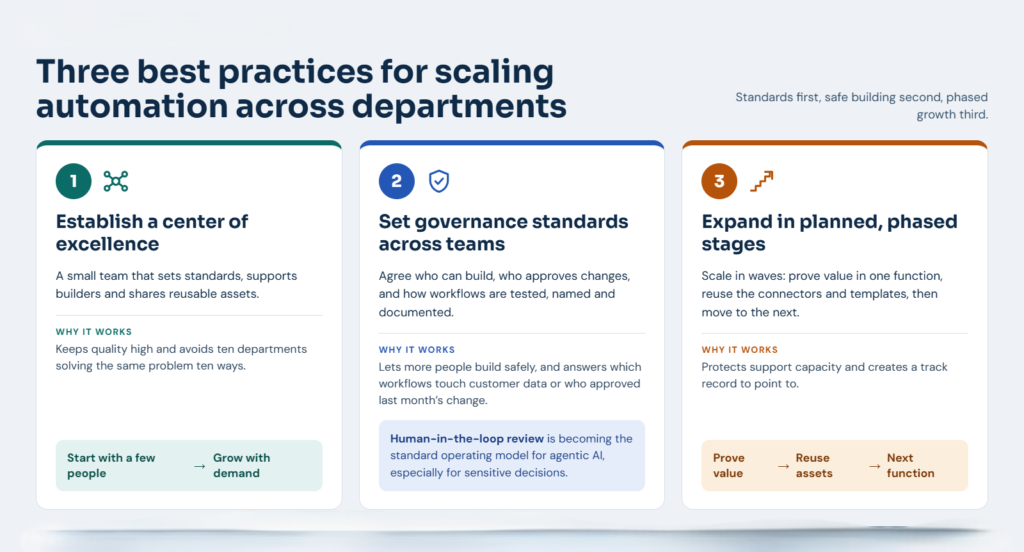
Establishing a center of excellence model
A center of excellence (CoE) is a small team that sets standards, supports builders and shares reusable assets. It keeps quality high and avoids ten departments solving the same problem ten ways. Start with a few people, and let the model grow with demand.
Setting governance standards across teams
Agree on who can build, who can approve changes and how workflows are tested, named and documented. Governance doesn’t have to slow teams down. Done well, it lets more people build safely, and it gives you answers when someone asks which workflows touch customer data or who approved a change last month. Human-in-the-loop review is also becoming the standard operating model for agentic AI, especially for sensitive decisions.
Expanding automation in planned, phased stages
Scale in waves. Prove value in one function, reuse the connectors and templates, then move to the next. This protects support capacity and creates a track record to point to.
To pick which areas to scale into, revisit our guide to top use cases and how to choose a platform and Aekyam’s use cases page.
How Do You Future-Proof Your Automation Strategy?
Choosing flexible, extensible platforms
Technology will keep changing. Pick a platform with open APIs, reusable connectors and the ability to add AI capabilities without rebuilding your workflows. Aekyam’s integration marketplace is one example of the reusable-component approach.
Avoiding heavy vendor lock-in
Check how portable your workflows and data are. Can you export them? Do they depend on proprietary formats? The easier it is to leave, the more freedom you keep to adapt as the market changes.
Building in regular strategy reviews
Set a recurring review, perhaps twice a year, to look at what’s working, what’s changed in the market and where to expand. Include business leaders, not just IT. Automation strategy goes stale quickly if no one revisits it.
How Do You Train Teams to Use a New Automation Platform Effectively?
Effective training formats
Mix formats. Live sessions work for kickoffs and complex workflows. Self-paced modules suit people who learn on their own schedule. In-app guidance helps at the moment of need. Match the format to the audience, since a casual approver needs far less than a workflow builder.
Building a power-user and champion program
Pick a few enthusiastic people in each team and give them early access, extra training and a direct line to the project team. Colleagues will ask a nearby champion before they’ll ask a help desk. Champions also bring back honest feedback.
Ongoing documentation and support resources
Keep short guides, FAQs and quick videos where people can find them. Update them as workflows change. Outdated documentation is worse than none.
What Role Will Automation Play in Enterprise Strategy Going Forward?
Automation as a driver of competitive advantage
Companies that move work faster, with fewer errors, can respond to customers and markets sooner. As more of the work becomes automated, the quality of your orchestration becomes part of how you compete.
Its growing role in overall digital strategy
Automation connects other digital efforts, such as AI, data and application modernization. Gartner expects 33% of enterprise software to include agentic AI by 2028, which makes orchestration central rather than peripheral.
Long-term impact on enterprise operating models
When routine coordination is automated, teams spend more time on exceptions, analysis and relationships. Roles, skills and org structures will shift accordingly. Forrester predicts 60% of Fortune 100 companies will appoint a head of AI governance in 2026, a sign of how seriously control is being taken.
Signals to watch
| Signal | What it suggests | Source |
|---|---|---|
| 40% of enterprise apps with task-specific AI agents by end of 2026 | AI is becoming part of core applications | Gartner |
| 33% of enterprise software with agentic AI by 2028 | Agentic design is heading to the mainstream | Firecrawl, citing Gartner |
| 60% of Fortune 100 naming a head of AI governance in 2026 | Governance is becoming a leadership role | Insentra, citing Forrester |
| Over 40% of agentic AI projects cancelled by end of 2027 | Costs, value and risk controls remain open questions | Forbes |
These are forecasts, and forecasts change. Use them as signals for planning, not as certainties.
Staying Ahead With Workflow Automation
The trends point in one direction: more intelligence in the workflow and more need for control around it. Build on a flexible platform, scale through a center of excellence, set clear governance and review your strategy regularly.
A useful test for any new capability is simple. Does it make a process faster or more accurate, and can you explain and audit what it did? If the answer to both is yes, it belongs in your roadmap. If not, it can wait.
Aekyam is an AI-powered orchestration platform that unifies applications, data and AI agents to automate enterprise workflows, with visibility across what’s running. Explore the platform, request a demo or contact us to talk through your automation roadmap.
Frequently Asked Questions
Will AI replace traditional workflow automation entirely?
Unlikely. Rule-based workflows are still the best fit for predictable, high-volume processes, where consistency and auditability matter. AI adds value where there’s ambiguity, such as reading documents or handling exceptions. Most enterprises will blend both under one orchestration layer.
How often should you reassess your automation strategy?
At least twice a year, and whenever your business or tools change significantly. Review adoption, results, new use cases and market developments. A short, regular check beats a big review every few years.
What skills will teams need as automation evolves?
Process thinking, data literacy and the ability to write clear instructions and rules. Teams will also need to supervise AI: reviewing outputs, setting boundaries and spotting errors. Forrester expects 30% of large enterprises to mandate AI fluency training by 2026.
How will regulation affect AI-driven automation platforms?
Expect more requirements around transparency, human oversight and records of automated decisions. The EU AI Act is already shaping procurement criteria for automated decision systems. Choose platforms with strong audit trails and controls, and involve legal and compliance teams early.
What’s the difference between hyperautomation and traditional automation?
Traditional automation tackles individual tasks or processes. Hyperautomation coordinates many methods, including orchestration, RPA, AI and analytics, under a single strategy so they work together and keep improving. The difference is the scope and the coordination.
Should enterprises build custom automation or buy a platform?
For most, buying a platform is faster and safer. It provides connectors, governance, monitoring and updates you’d otherwise build and maintain yourself. Custom code still has a place for unique needs, and a good platform lets you extend it with code where necessary.
Share