


Introduction
Picture a shopper in Pune. She opens a quick-commerce app, adds milk, a phone charger and a birthday candle, pays with UPI and expects the order in ten minutes. Behind that app is a store that is still running on yesterday’s inventory file. The candle is out of stock. The order is cancelled. She opens a different app.
That gap, between what customers expect and what systems can see, is the real story of Indian retail today. This blog will cover, how Indian retail moved from kirana stores to quick commerce, why customer expectations around data and delivery changed with it, which data problems are unique to Indian retailers, and where real-time data integration fits in, and how to choose a platform.
If you are new to the term our comprehensive guide on, What Is Real-Time Data Integration?, has the full picture. In one line: it moves data between your systems the moment something happens, instead of waiting for a scheduled batch.
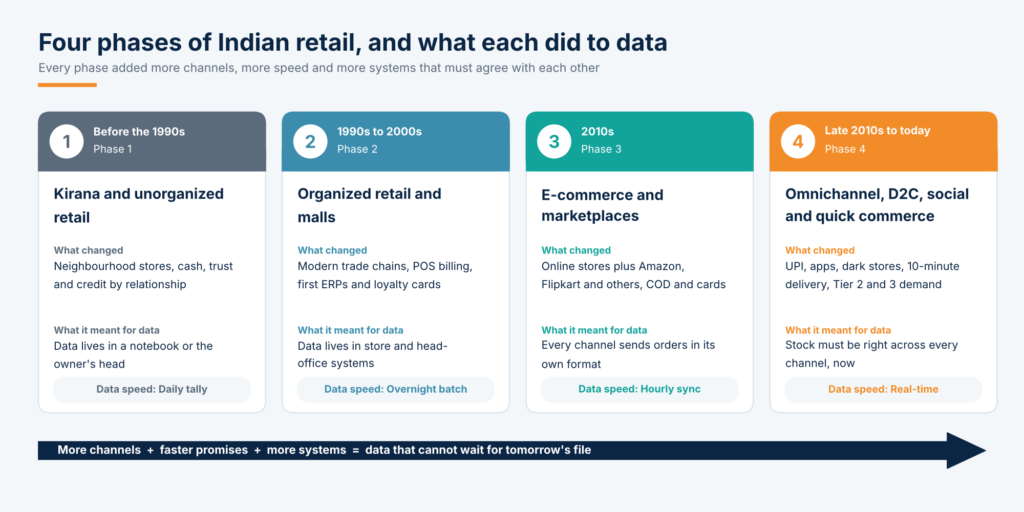
How Indian Retail Has Evolved: A Quick Timeline
Phase 1: Kirana stores and unorganized retail
For decades, Indian retail meant the neighbourhood kirana. Millions of these small stores still serve daily needs today. They run on trust, local knowledge and credit by relationship. The “system” was the owner’s memory and a notebook. That works at small scale, but it shares stock and sales data with nobody.
Phase 2: Organized retail and malls
From the 1990s, supermarkets, department stores and malls brought barcodes, POS billing and central buying. Retailers began using ERPs to manage stock and finance. Data finally lived in systems, but it moved slowly. Stores sent sales to head office in an overnight batch.
Phase 3: E-commerce and marketplaces
Online stores and marketplaces such as Amazon, Flipkart and Myntra opened a new sales channel. Retailers now had stock in stores, warehouses and marketplaces, often held in different systems. Each marketplace had its own order format and its own rules. Syncing every few hours started to hurt.
Phase 4: Omnichannel, D2C, social commerce and quick commerce
Today, one brand may sell through its own website, Instagram and WhatsApp, marketplaces, physical stores and dark stores. Shoppers expect to buy in one channel, return in another and see the right stock everywhere. Delivery is promised in minutes. Data has to keep up with it.
The pattern: Every phase added more channels, faster promises and more systems that must agree with each other. Data that was “good enough” in one phase became a problem in the next.
What Changed in Customer Expectations and Retail Operations
Four shifts changed what shoppers expect and what retail teams must deliver.
Digital payments (UPI) and mobile-first shopping
UPI processed a record 25.47 billion transactions in October 2026, according to NPCI data. Payment now confirms in seconds. That raises the bar for everything around it: order confirmation, stock reservation and delivery updates must be just as fast. On a phone, a stale stock number is a visible mistake. The shopper sees “in stock”, pays, and then gets a cancellation.
Tier 2 and Tier 3 city growth
Shoppers in smaller cities now order from apps and marketplaces as easily as metro shoppers. For retailers, that means more orders from more pin codes, more courier partners and more address formats. Each new region adds another set of systems and rules to keep in sync.
Delivery promises shrinking from days to hours to minutes
The delivery promise decides how fresh your data must be. If you promise three days, an overnight update is fine. If you promise ten minutes, every stock change must be visible in seconds.
| Delivery promise | Data freshness needed | What happens if data is late |
|---|---|---|
| Days | Overnight update | Occasional oversell, fixed next day |
| Hours | Hourly or near real-time | Missed cut-off times, late dispatch |
| Minutes | Real-time, every event | Cancelled orders and lost customers |
Multi-channel inventory: store, app, marketplace and dark store
One pair of sneakers may be listed in four places at once. If the last pair sells in the store at 6:02 pm and the app still shows it at 6:05 pm, you have an oversell. Multiply that by thousands of SKUs and several channels, and stock accuracy becomes the hardest daily problem in retail.
The Data Challenges Unique to Indian Retail
Many of these problems exist everywhere. In India they show up together, and at scale.
1. Fragmented tech stacks
A typical Indian retailer may run a legacy ERP at head office, regional POS software in stores and a modern cloud tool for e-commerce. Each one speaks a different data language. Without a layer in the middle, teams rely on spreadsheets and manual fixes.
2. Heavy marketplace dependence
Amazon, Flipkart and other marketplaces drive a large share of online sales. Each has its own API, order format and service-level rules. Late dispatch or cancellations can hurt your seller rating, which then hurts your visibility and sales.
3. Festive-season peaks
Diwali, Big Billion Days and the Great Indian Festival create sharp spikes in orders. October 2026 was a record month for UPI, driven by festive shopping. Batch jobs built for normal days struggle when volumes jump. A sync that takes two hours on a regular day can take longer than the sale itself.
4. Non-cloud and on-prem systems
Many store and warehouse systems still run on local servers. Some sites have patchy internet. A tool that only works with cloud apps cannot reach them, so those systems stay isolated.
5. Compliance: DPDP, GST and e-invoicing
Retail systems hold personal data such as names, phone numbers and addresses. India’s Digital Personal Data Protection (DPDP) Act is now being phased in. The DPDP Rules were notified in November 2025, and most obligations are scheduled to apply from 13 May 2027. The government has signalled it may shorten that window, so check the latest position.
GST and e-invoicing add another layer. Businesses above the notified turnover threshold must generate e-invoices, and that invoice data must match the orders behind it. Both rules push you to know exactly where data goes and to keep a clean record of it.
This is general information, not legal advice. Check specifics with your compliance team.
Why Real-time Data Integration Matters for Indian Retailers Now
Each challenge above has a direct answer in real-time integration. Here is the match-up.
| Challenge | What real-time integration does | Result |
|---|---|---|
| Fragmented stacks | Connects ERP, POS, OMS and WMS through one layer and translates data formats between them | One version of the truth across systems |
| Marketplace dependence | Brings every marketplace order into your OMS the moment it is placed, in one common format | Fewer missed or late orders, healthier seller ratings |
| Festive peaks | Moves data as events happen and scales with volume, instead of waiting for batch windows | No pile-ups at midnight |
| On-prem systems | Reaches local store and warehouse systems without a full replacement | Legacy systems join the real-time flow |
| Compliance | Tracks each message from source to destination | A clearer record of where personal and invoice data went |
What this looks like on a Diwali night
Without real-time integration: It is 11:40 pm. Orders pour in from the app and two marketplaces. Stock is updated every few hours, so the same 40 units are sold three times. By morning, 25 orders are cancelled, ratings dip and the support team is flooded.
With real-time integration: Each sale updates stock everywhere within seconds. The app stops selling at zero. The order goes to the warehouse or store that can ship it fastest. Cancellations stay low.
The three benefits that matter most:
- Inventory accuracy: every channel shows the same, current stock.
- Order orchestration: each order is routed to the best location automatically.
- Fewer cancellations: you stop selling what you do not have.
For the full list of benefits, see the our comprehensive guide on what real-time data integration is, and its benefits..
How Aekyam Fits In
Aekyam is an enterprise AI orchestration platform that combines iPaaS with real-time workflow orchestration. For Indian retailers, four things matter most.
- Event-driven order and inventory flows. When an order is placed, stock is reserved, picked and shipped, each event passes between your OMS, WMS and e-commerce systems instantly.
- Connectors that match your stack. The Aekyam Marketplace offers pre-built adapters, including Shopify, SAP, Salesforce, Oracle, Manhattan, Snowflake and Amazon.
- Runs where your systems run. Deploy on cloud, on-premises or hybrid, and process data locally in each region when needed.
- Built for peaks and recovery. Auto-scaling handles volume spikes. A failed-entry dashboard lets teams find a failed message and replay it.
Proof from retailers
A premier Indian fashion retailer (Mumbai, 10,000+ employees) faced delays, crashes and message loss at peak. With Aekyam, it achieved 70% faster seller onboarding and 2x auto-scaling tested against peak-hour volume. Read the case study.
An Indian accessories maker (Bengaluru, 5,000+ employees) wanted to sell on global marketplaces without integration headaches. It reached zero order drops and cut integration effort by 70%. Read the case study.
What Indian Retailers Should Look for When Choosing a Platform
Use this checklist when you compare tools. Ask each vendor to show it, not just say it.
| Look for | Why it matters in India | Question to ask |
|---|---|---|
| Local support | Rollouts and festive-season issues need help in your time zone | Who supports us during Diwali week, and how fast? |
| Marketplace connectors | Amazon, Flipkart and others each need their own format | Which marketplace adapters are pre-built, and which need custom work? |
| Peak-load handling | Festive spikes break batch-style tools | Can you show auto-scaling tested at peak volume? |
| DPDP readiness | Personal data moves through many systems | Can we trace each message end to end and control where data is processed? |
| Pricing in INR | Foreign-currency pricing makes budgets harder to plan | Is pricing available in INR, and what drives cost as volume grows? |
| Works with on-prem systems | Store and warehouse systems are often local | Do you support cloud, on-prem and hybrid? |
| Replay and error handling | A lost order is a lost customer | How do we find and replay a failed message? |
For a deeper evaluation framework, read our guide on tool evaluation criteria. To see how leading options compare, read Top 6 Real-Time Data Integration Tools for Retailers in 2026: Compared.
Stay Ahead for India’s Next Retail Wave With Real-time Data Integration
Indian retail has gone from notebooks to ten-minute delivery in a single generation. Customers now expect every channel to tell the truth about stock, price and delivery, all the time. Batch files cannot keep that promise. Real-time data integration can.
Aekyam helps retailers get there. It connects your OMS, WMS, ERP, marketplaces and e-commerce tools, moves data as events happen, scales for festive peaks and lets your team replay anything that fails. You do not need to replace your legacy systems to start.
Ready to see it with your own systems? Talk to our experts about your stack, your marketplaces and your next peak season, or request a demo to see Aekyam in action.
Frequently Asked Questions
How has Indian retail changed in the last decade?
It moved from mostly stores to many channels at once. Marketplaces, D2C websites, social selling and quick commerce grew fast. UPI made payments instant, smaller cities started shopping online, and delivery promises dropped from days to minutes.
Why do Indian retailers struggle with inventory accuracy?
Stock sits in many places: stores, warehouses, marketplaces and dark stores. Each place often has its own system, and they sync in batches. In between syncs, stock numbers drift, and the same item gets sold twice.
How does real-time integration help during festive-season sales?
It updates stock and orders as each event happens, so volume spikes do not pile up in a queue. With auto-scaling and replay for failed messages, teams can handle peak days without manual firefighting.
Can real-time integration work with legacy or on-prem systems?
Yes. A good platform uses adapters or local components to connect older ERPs and store systems, and can run on-premises or in a hybrid setup. You usually do not need to replace those systems first.
Does real-time integration help with DPDP Act compliance?
It helps, but it does not make you compliant on its own. Real-time integration gives you traceability, so you can see where personal data moves across systems and apply rules consistently. You still need consent, notices, retention policies and legal review.
Can Aekyam integrate with Indian marketplaces and ERPs?
Aekyam’s marketplace includes pre-built adapters for Amazon, SAP, Oracle, Shopify, Salesforce, Manhattan and Snowflake. For other marketplaces, regional POS systems or custom ERPs, talk to our team about your exact stack.
Share