


What Is Traditional Workflow Automation?
Traditional workflow automation is a rules-based system that executes predefined sequences of tasks without human intervention. At its core, it operates on a simple logic: if a specific condition is met, a specific action is triggered. These “if-then” rules are set up by developers or administrators in advance, and the system follows them exactly, every time.
How Does Traditional Workflow Automation Work at a Basic Level?
Every traditional automation workflow begins with a trigger, such as a form submission, a time of day, or a data change in a connected system. Once triggered, the system moves through a fixed sequence of steps: read data from one location, transform it according to preset rules, and write the result to another location or send a notification. There is no interpretation involved. The system does precisely what it is told, in the order it is told, using data that fits the expected format.
Where Traditional Workflow Automation Does Its Job Well?
Traditional automation performs reliably when the work is repetitive, the inputs are structured, and the process does not change. Invoice processing through a standard template, employee onboarding checklists, weekly sales reports generated from a database, and scheduled data backups are all tasks where rule-based automation thrives. The system is fast, consistent, and low-cost to run once it is configured correctly.
What Kind of Tasks Does Traditional Workflow Automation Handle Best?
The tasks best suited to traditional automation share a few common traits: they follow a predictable path, the data arrives in a consistent format, and there are no meaningful exceptions to handle. Think of bulk email campaigns triggered by a calendar date, data migration between two systems with matching schemas, or payroll calculations based on fixed variables. When the inputs are clean and the logic is linear, traditional automation delivers exactly what it promises.
Why Is Traditional Workflow Automation Not Suitable for the Present Time
Traditional workflow automation struggles because modern business data is rarely clean, consistent, or predictable. Today, enterprises deal with emails, PDFs, contracts, customer messages, and social media inputs that arrive in dozens of formats and carry meaning that cannot be captured by a fixed rule. When a rule-based system encounters data it does not recognize or a situation outside its programmed logic, it either fails, halts, or routes the task to a human.
The larger problem is rigidity. Changing business processes means rewriting the automation rules from scratch. Scaling to new use cases requires building new pipelines. Every exception requires a developer to write a new condition. In a business environment where speed, adaptability, and intelligence matter, rule-based automation creates a ceiling rather than a launchpad.
What Makes AI-Driven Workflow Automation Different?
AI-driven workflow automation is capable of understanding context, learning from experience, and handling situations it has never encountered before. It does not just follow instructions; it interprets them.
Read our guide on AI Workflow Automation for a comprehensive view of its role and significance in the present business landscape.
How AI Adds Intelligence to Workflow Automation?
Traditional automation needs explicit rules. AI-driven workflow automation builds its own understanding from data. Instead of requiring a developer to define every condition, machine learning models are trained on historical examples and learn to recognize patterns, classify inputs, and make decisions. This means the system can handle inputs that do not perfectly match a template, flag unusual cases for review rather than failing silently, and improve its accuracy over time without being reprogrammed.
How AI Fills the Gap That Traditional Automation Creates
Rule-based systems break down at the point of ambiguity. AI-driven automation is designed for exactly that point. When an invoice arrives in a format the system has never seen, a trained model can still extract the relevant fields with high accuracy. When a customer complaint arrives over email with mixed sentiment and multiple issues embedded in one message, a natural language processing layer can categorize it, assign it, and prioritize it without a human reading every word. AI fills the gap not by adding more rules, but by replacing the need for rules with learned judgment. To learn more about the shift from traditional to AI workflow automation, and the impact its creating for different enterprises in detail, read our blog on, Why Are Enterprises Suddenly Shifting Towards AI Workflow Automation?
The Role of Machine Learning and NLP
Machine learning is the engine that allows AI-driven automation to get smarter over time. Models are trained on labelled datasets and learn to make predictions on new, unseen data. In a workflow context, this might mean classifying documents, predicting approval outcomes, or detecting anomalies in transaction data.
Natural Language Processing, or NLP, extends this capability to unstructured text. NLP allows systems to read and interpret emails, contracts, chat transcripts, and support tickets the way a human would. It can extract key entities, detect intent, assess sentiment, and route the input to the right workflow automatically. Together, machine learning and NLP allow AI-driven automation to work across data types that traditional systems cannot touch.
How AI Workflow Automation Handles Exceptions and Learns Over Time
A rule-based system treats every exception as a failure. An AI Workflow Automation tool treats exceptions as data. When a model encounters a case, it is unsure about, it can flag it for human review, log the outcome, and use that outcome to improve future predictions. Over months of operation, the system becomes progressively more accurate as it learns from real-world decisions. Exceptions become rarer, confidence scores rise, and the volume of tasks that require human intervention shrinks steadily.
How Do Workflow Automation and AI Workflow Automation Compare?
Workflow Automation and AI Workflow Automation can be differentiated on the following grounds:
Flexibility and Adaptability
Traditional automation is rigid by design. Any change to a business process requires reconfiguring the automation logic manually. AI workflow automation adapts as data patterns shift, because the models retrain on new data rather than requiring a developer to rewrite rules. For businesses operating in fast-moving industries, this adaptability is not a luxury; it is a requirement.
Setup Complexity and Maintenance
Traditional automation can be faster to set up for straightforward, well-defined tasks. The logic is transparent, and troubleshooting is relatively simple because the rules are explicit. AI workflow automation requires more upfront investment in data preparation, model training, and integration work. However, the long-term maintenance burden often favors AI-driven systems, because they adapt to change rather than breaking under it.
Scalability and Error Handling
Rule-based systems scale well in volume but not in variety. Processing ten thousand invoices of the same format is easy; processing ten thousand invoices across fifty different formats is not. AI workflow automation handles variety as naturally as volume, because it learns from diversity rather than requiring uniformity. On error handling, AI systems can assign confidence scores, route low-confidence outputs for human review, and learn from corrections, while traditional systems can only route to a generic exception handler or fail.
To better understand the differences between the two, let’s look at the table below:
| Dimension | Traditional Workflow Automation | AI Workflow Automation |
|---|---|---|
| Flexibility | Low | High |
| Setup Time | Fast for simple tasks | Higher initial investment |
| Maintenance | High when processes change | Lower over time |
| Data Requirements | Structured only | Structured and unstructured |
| Error Handling | Binary pass/fail | Confidence-based, learns from errors |
| Scalability | Volume, not variety | Volume and variety |
How to know if your enterprise needs traditional workflow automation or AI workflow automation?
The right answer depends on where your workflows stand today and where the bottlenecks are appearing.
What are Some Signs to Know Your Workflows Have Outgrown Rule-Based Automation?
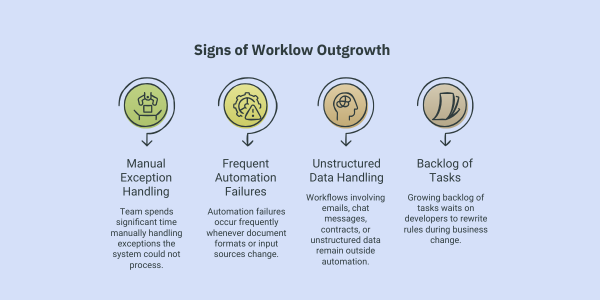
- Your team spends significant time manually handling exceptions the system could not process.
- Automation failures occur frequently whenever document formats or input sources change.
- Workflows involving emails, chat messages, contracts, or unstructured data remain outside what your automation can handle.
- A growing backlog of tasks waits on developers to rewrite rules before automation can resume during periods of business change.
How Some Enterprises Use Traditional Workflow Automation and AI Workflow Automation Together?
Many mature enterprises run both systems in parallel. Rule-based automation handles the stable, high-volume, fully structured workflows where it performs without issues. AI workflow automation takes over at the edges: the unstructured inputs, the exceptions, the multi-step processes that require interpretation. An insurance company might use traditional automation to route standardized forms and AI workflow automation to process claim narratives, extract details from medical records, and flag fraud patterns. The two approaches complement each other when applied to the right tasks.
How to Decide which One to Choose for your Enterprise?
Ask two questions about the workflow you want to automate:
- First, does every input arrive in a predictable, structured format with no meaningful variation?
- Second, does the process follow a fixed sequence with no exceptions that require judgment?
If both answers are yes, traditional automation is likely sufficient. If either answer is no, AI workflow automation will deliver better outcomes and lower long-term maintenance costs.
Aekyam is an enterprise AI Orchestration platform that brings AI workflow automation to your existing operations without requiring you to rebuild from scratch. It connects your applications, data, and AI into a single workflow layer, replacing rigid rule-based logic with intelligent automation that reads unstructured data, handles exceptions, and scales as your processes evolve. Whether you are taking your first step toward AI-driven automation or looking to orchestrate it across your entire enterprise, Aekyam gives you the infrastructure to do it. Connect with our team of experts and request for a demo to know more.
Frequently Asked Questions
1. What should I do if my business requires frequent maintenance of automation workflows?
Frequent maintenance points to a rule-based system that cannot handle change on its own. AI-driven automation for workflows that shift often, because machine learning models adapt to new data patterns without requiring developers to rewrite logic each time. Start by identifying the workflows that generate the most maintenance tickets and replace their rigid rules with a model that learns.
2. What should I do if my system is not able to interpret chats, emails, or contracts?
Traditional automation cannot read or interpret free-form text. The solution is to add an Natural Language Processing-powered AI layer to your stack, which reads emails, chat messages, and contracts, extracts the key information, and routes each input to the right workflow automatically. Most modern platforms come with pre-built NLP models, so this does not require building anything from scratch.
3. What should I do to ensure end-to-end automation of my business processes?
End-to-end automation requires a hybrid approach. Use rule-based automation for structured, stable segments of your process and AI-driven workflow automation wherever inputs are variable or exceptions require judgment. Map your process from start to finish, identify every point where humans currently intervene, and connect both automation layers through a unified orchestration platform to close those gaps.
4. How can I reduce the processing time for insurance claims drastically?
The two biggest bottlenecks in claims processing are manual data extraction and exception handling. AI-driven workflow automation can read claim documents and medical records in any format, extract the relevant fields automatically, and cross-reference them against policy rules in real time. Predictive models trained on historical claims can flag high-risk or fraudulent cases for priority review, so adjusters spend time only where human judgment is genuinely required. Together, these capabilities compress multi-day claim cycles into hours.
5. How can I process unstructured data quickly?
AI workflow automation handles unstructured data by converting it into structured inputs before it reaches your core systems. NLP models read and extract information from text-heavy inputs like emails and contracts, while computer vision combined with OCR digitizes scanned invoices and handwritten forms. Once the data is structured, AI workflow automation, automates workflows process, route, and act on it automatically, without any manual intervention.
6. How does Aekyam help businesses switch from traditional to AI workflow automation?
Aekyam starts with an assessment of your existing workflows to identify where traditional automation is creating bottlenecks or failing to handle unstructured inputs. It then deploys AI models tailored to your document types and process logic, integrates them with your current systems, and builds the orchestration layer that connects everything into a single unified workflow. Existing infrastructure does not need to be dismantled. Aekyam extends what you already have and lets you evolve toward fully intelligent automation at your own pace.
Share
Read Similar Blogs